

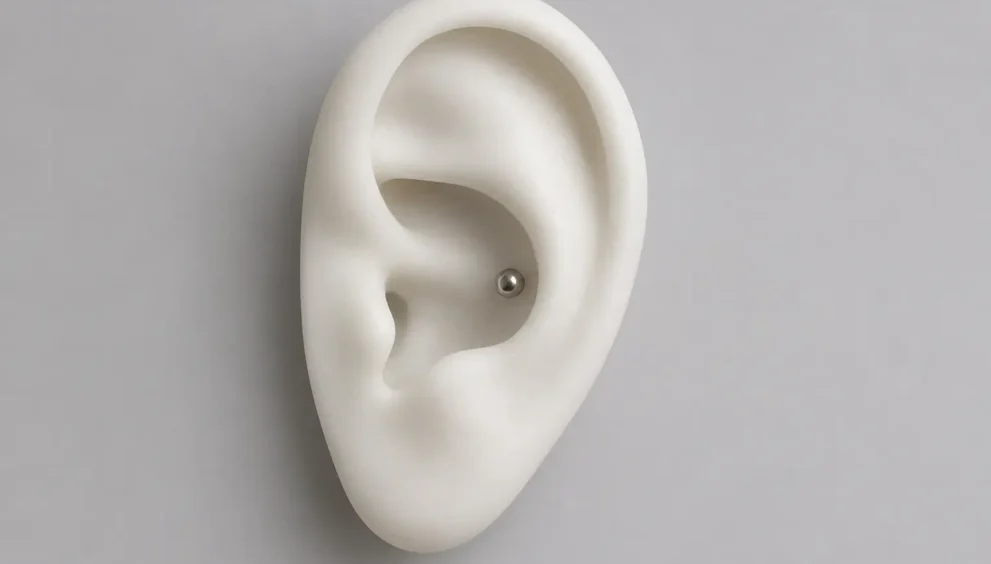
How Fast Does a Conch Piercing Close Up Without Jewelry?
A conch piercing can close surprisingly fast without jewelry, especially during the healing phase. While some people may remove their jewelry for several hours without any issues, others notice tightening or partial closure within a single day.
The exact timeline depends on several factors, including how long the piercing has been healed, individual healing ability, jewelry size, and overall ear health.
Unlike earlobe piercings, a conch piercing passes through thick ear cartilage. Because cartilage heals differently from soft tissue, many people assume a healed conch will stay open indefinitely.
However, that is not always the case. Even fully healed cartilage piercings can shrink or become difficult to reinsert if jewelry remains out for too long. Understanding when it may be safe to switch your jewelry can help reduce irritation and avoid complications during the healing process.
Understanding how conch piercings close, what affects the process, and what to do if the hole starts shrinking can help prevent the need for re-piercing.
Why Cartilage Piercings Behave Differently
The conch is located in the central cartilage portion of the ear. Unlike the earlobe, cartilage receives less blood flow, which often results in a longer healing period.
Because of this slower healing process:
- Conch piercings typically take 6 to 12 months to fully heal.
- Some people need up to 18 months for complete stabilization.
- Removing jewelry too early increases the risk of closure.
- Healing timelines vary significantly from person to person.
Additionally, many people mistake a comfortable piercing for a fully healed piercing. In reality, the internal tissue channel may still be developing even when pain and swelling have disappeared.
How Quickly Can a New Conch Piercing Close?
A fresh conch piercing can begin shrinking within minutes after jewelry removal.
During the first few months, the body still treats the piercing as a healing wound. Once the jewelry is removed, the tissue naturally attempts to seal itself.
Typical closure patterns for newer conch piercings include:
- Within a few hours, noticeable tightening may occur.
- Within 24 hours, reinsertion can become difficult.
- Within several days, partial closure is common.
- Within a few weeks, complete closure may occur.
For this reason, professional piercers generally recommend leaving jewelry in place continuously throughout the healing period.
What Happens After a Conch Piercing Has Healed?
Even after healing, a conch piercing does not become permanently immune to closure.
Many people confuse “healed” with “permanent.” A healed piercing simply means a stable tissue channel has formed around the jewelry.
However, that channel can still shrink when jewelry is removed. Understanding what the recovery process typically looks like can help set realistic expectations and reduce the risk of complications during the months following a new piercing.
Some healed conch piercings remain open for weeks, while others begin narrowing within days.
Several factors influence this process:
- Age of the piercing
- Jewelry gauge size
- Cartilage thickness
- Individual healing speed
- Previous irritation or trauma
- Overall skin elasticity
As a result, two people with identical conch piercings may experience completely different closure timelines.
Shrinking vs. Closing: Understanding the Difference
One of the most misunderstood aspects of piercings is the difference between shrinking and closing.
A piercing does not usually disappear instantly. Instead, it gradually becomes smaller.
When a conch piercing shrinks:
- The channel still exists.
- Jewelry reinsertion becomes difficult.
- Smaller jewelry may fit temporarily.
- Professional taper tools can often reopen it.
When a conch piercing closes completely:
- New tissue seals the channel.
- Jewelry can no longer pass through.
- Professional re-piercing may be necessary.
Therefore, difficulty inserting jewelry does not automatically mean the piercing has closed permanently.
Factors That Affect How Fast a Conch Piercing Closes
Several variables determine closure speed.
Piercing Age
Older piercings generally stay open longer than newer ones. A conch piercing worn continuously for several years typically resists closure better than one that healed recently.
Jewelry Gauge
Larger gauges create a wider tissue channel. Consequently, larger conch piercings often shrink more slowly.
Individual Healing Ability
Some people naturally heal faster than others. Faster healing can lead to quicker shrinking and closure.
Cartilage Structure
Ear anatomy differs from person to person. Thicker cartilage sometimes influences how the piercing channel behaves after jewelry removal.
Previous Irritation
A piercing that has experienced infection, irritation, bumps, or repeated trauma may be more prone to shrinking.
Signs Your Conch Piercing Is Starting to Close
Watch for these warning signs after removing jewelry:
- Increased resistance during reinsertion
- Tightness around the piercing channel
- Mild tenderness
- Reduced visible opening
- Difficulty inserting standard jewelry
While these changes are often related to shrinking, it is also important to recognize symptoms that may require closer attention, especially if discomfort, swelling, or unusual discharge develops.
Acting quickly can often prevent permanent closure.
What Should You Do If Your Jewelry Falls Out?
If your conch jewelry accidentally falls out:
- Wash your hands thoroughly.
- Attempt reinsertion only if it slides in easily.
- Never force jewelry through resistance.
- Contact a professional piercer immediately.
- Seek assistance within 24 to 48 hours whenever possible.
Professional piercers often use insertion tools that can safely reopen partially shrunken channels.
Final Thoughts
A conch piercing can begin shrinking much faster than many people expect. While newer piercings may tighten within hours, even fully healed cartilage piercings can gradually narrow when jewelry is removed.
Because healing varies significantly between individuals, there is no universal timeline that applies to everyone.
The safest approach is to keep jewelry in place whenever possible and to seek professional help immediately if the piercing begins to shrink.
Understanding the difference between healing, shrinking, and complete closure helps protect your piercing and reduces the chances of needing another procedure in the future.