
LSI Keyword Generator
An LSI keyword generator helps you uncover the semantically related terms search engines expect around any topic, so your content reads naturally while still building the topical depth modern SEO rewards. This tool generates NLP terms — the modern, practical version of what's traditionally called LSI keywords.
What Is Latent Semantic Indexing and Why It Still Shapes SEO
Latent semantic indexing is the original concept behind what most SEOs now call LSI keywords — words and phrases that are contextually tied to your main topic. Rather than functioning as a simple keyword research tool that only returns exact-match phrases, a true related keywords finder looks at meaning and context, which is closer to how modern semantic search optimization actually works.
This is where NLP keyword analysis comes in. Natural language processing lets a tool examine a body of text and identify which terms consistently appear together, revealing patterns of semantic relevance and co-occurrence terms that a human writer might miss. The result is a form of contextual keyword suggestions that goes beyond guesswork.
Take the word "dressing." On its own, it's ambiguous — a search engine has no way to know if you mean a salad topping, a Thanksgiving side dish, or getting ready in the morning. The related words sitting around your main keyword are what resolve that ambiguity, both for the reader and for the algorithm.
How Search Engines Actually Use NLP to Rank Content
Google's ranking systems now rely heavily on a Google NLP algorithm layer to interpret meaning rather than just matching strings of text. This includes natural language understanding, knowledge graph optimization, and entity based SEO, where specific people, places, and things are recognized as connected concepts rather than isolated keywords.
Underneath this sits ontology based SEO and word embedding SEO — techniques that map how concepts relate to one another mathematically, enabling concept based search where a query can return relevant results even without an exact keyword match. Search engines also apply passage indexing optimization, meaning a single well-optimized section of your page can rank on its own, judged by document relevance scoring and content relevance scoring rather than the page as a whole.
How the Free LSI Keyword Generator Works
Three simple steps — no account required.
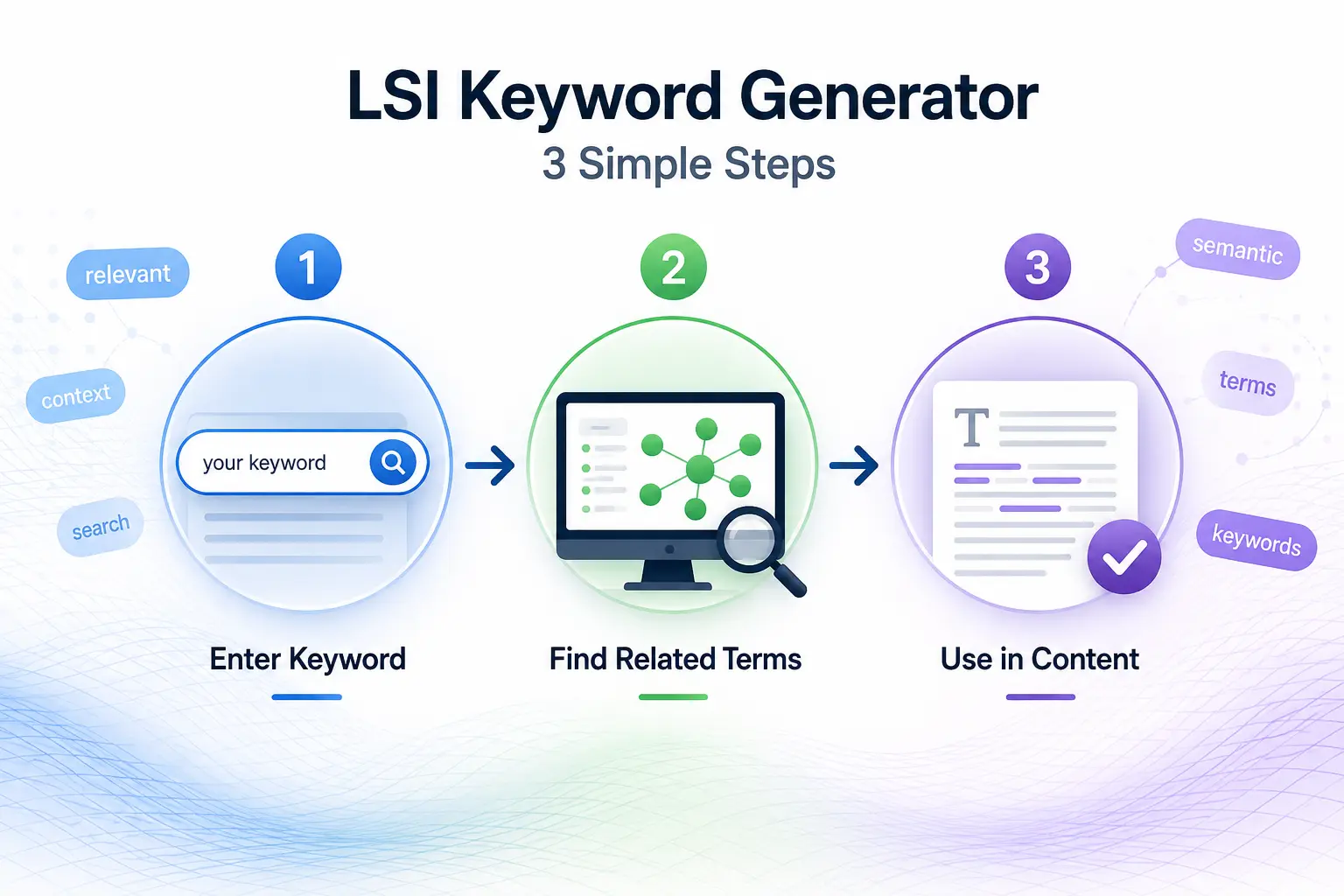
- Enter your seed keyword — type your main topic into the tool above. This anchors the entire keyword universe mapping process around your subject.
- Review your related terms — the generator applies TF-IDF analysis and keyword co-occurrence patterns to surface terms grouped by thematic keyword grouping and keyword semantic clusters.
- Apply them to your content — use the results for search query expansion, filling out headings and body copy with natural search term variations.
Why Related Keywords Matter for Rankings
A page built only around one repeated phrase struggles with keyword density optimization and reads as thin. Layering in related terms instead improves content comprehensiveness score signals and supports topical authority building across your site. It's also one of the most reliable ways to run a content gap analysis against competing pages and spot what your article is missing.
Done well, this also protects against keyword cannibalization prevention — where two of your own pages compete for the same query — since each page ends up targeting a distinct cluster of keyword relationship analysis rather than overlapping terms. Combined, these practices feed directly into the search engine ranking factors modern algorithms weigh most heavily.
- Search visibility improvement — match a wider range of related search terms, not just one exact phrase.
- Semantic search ranking — signal genuine topic coverage through consistent semantic keyword mapping.
- Natural, readable copy — avoid repetition while improving lexical diversity SEO across your article.
Who This SEO Content Optimization Tool Is For
Bloggers building topic clusters — use topic clustering and search intent mapping to structure a pillar page and its supporting posts.
Writers targeting long tail keywords — pull long tail keywords and keyword variations generator results for deeper, more specific coverage.
SEOs doing keyword context analysis — run keyword context analysis and keyword proximity analysis to see how terms should sit near each other on the page.
Site owners refining intent — apply keyword intent classification so each page matches what searchers actually want.
Putting It Into Practice On the Page
Beyond body copy, related terms belong in your semantic HTML markup — heading tags, image alt text, and structured data all reinforce the same context. Treat this generator as a search engine optimization tool you return to for every article, not a one-time lookup, and pair it with a broader semantic content strategy and ongoing semantic text analysis of your published pages to keep them current. If you're building out a full content workflow, browse our other free SEO tools to cover keyword research, metadata, and on-page optimization in one place.
Related SEO & Semantic Search Concepts
latent semantic indexing keyword research tool semantic search optimization related keywords finder NLP keyword analysis search intent mapping topic clustering long tail keywords contextual keyword suggestions semantic relevance co-occurrence terms keyword density optimization natural language processing SEO topical authority building entity based SEO keyword variations generator search engine optimization tool semantic keyword mapping content optimization tool TF-IDF analysis keyword co-occurrence search query expansion thematic keyword grouping semantic content strategy keyword relationship analysis Google NLP algorithm passage indexing optimization keyword context analysis semantic HTML markup content relevance scoring search visibility improvement keyword semantic clusters ontology based SEO word embedding SEO knowledge graph optimization keyword intent classification semantic search ranking content gap analysis related search terms keyword proximity analysis search term variations semantic text analysis keyword universe mapping natural language understanding document relevance scoring concept based search lexical diversity SEO keyword cannibalization prevention search engine ranking factors content comprehensiveness score
More Terms That Strengthen Your Semantic SEO
Beyond the core list, a few additional concepts round out a genuinely comprehensive LSI keyword generator strategy: SERP semantic analysis, AI content optimization, search engine relevance algorithm, contextual SEO writing, on-page semantic signals, and query-topic alignment. Weaving these into your broader content plan reinforces the same depth the core term list builds, without repeating yourself.
The History of Latent Semantic Indexing
Latent semantic indexing dates back to a 1988 patent, long before modern search engines existed. Originally, it was a mathematical technique built to solve a specific problem: two documents could be about the same subject without ever using the same exact words. Researchers needed a way to detect that hidden — or "latent" — connection between related terms.
The method worked by building a term-document matrix and applying a linear algebra technique called singular value decomposition to reduce noise and surface the underlying relationships between words. The original patent expired in 2008, and Google's own engineers have since confirmed that current ranking systems don't run this exact 1980s process. Even so, the core idea survived: understanding meaning through context, not just keyword matching, is now central to how search engines interpret content. That's why the term "LSI keywords" is still used today, even though it describes a broader, more modern practice of semantic keyword research rather than the original algorithm itself.
LSI Keywords vs Long-Tail Keywords: What's the Difference?
These two terms get confused often, but they serve different purposes. A long-tail keyword is a longer, more specific version of your main keyword — it usually contains your target phrase plus extra words, like "best LSI keyword generator for bloggers." You'd target it directly as its own ranking opportunity.
An LSI keyword, on the other hand, doesn't need to contain your main keyword at all. It's a supporting term that adds context around your topic. For a page about "digital cameras," a long-tail keyword might be "best digital cameras for beginners," while an LSI keyword would simply be "megapixels" or "aperture" — words that belong in the article without being search phrases you're chasing on their own.
In practice, a strong page uses both: long-tail keywords to capture specific search intent, and LSI keywords woven throughout to prove the page genuinely covers the subject in depth.
Frequently Asked Questions
What are LSI keywords, really?
They're words and phrases that tend to appear alongside your main topic in well-written content. The name comes from an old indexing technique, but today the term is used more loosely to mean "contextually related terms."
Do search engines still use LSI directly?
Modern search engines rely on newer NLP models rather than the original 1980s technique. What hasn't changed is the underlying benefit: covering related vocabulary makes content read as complete, and that still helps rankings.
How many related keywords should I use?
There's no fixed number. Add a term only where it fits a sentence naturally — stuffing unrelated terms in for the sake of it hurts readability more than it helps rankings.
Where should I place these terms in my content?
Subheadings, your opening and closing paragraphs, image alt text, and naturally within the body copy tend to carry the most weight.
Is this tool free to use?
Yes — no signup, no credit card, and no daily search limit.