
Free Printable Addition and Subtraction Worksheets PDF
Learning math becomes so much easier when practice feels like play instead of pressure. These free printable addition and subtraction worksheets PDF pages give children a simple, stress-free way to build strong number skills at home or in the classroom. Whether your child is just starting with single-digit sums or already tackling multi-digit subtraction, this page offers ready-to-use practice sheets for every grade level, from Grade 1 all the way through Grade 6.
Parents and teachers usually search for worksheets that are easy to print, easy to understand, and easy to check. That’s exactly what you’ll find here. Each section briefly explains the concept, then gives real practice questions, followed by a clear answer key so you can check the work in seconds. Because every worksheet builds on the last one, your child moves forward naturally, step by step, without feeling rushed or overwhelmed.
What Are Addition and Subtraction Worksheets?
Addition and subtraction worksheets are printable pages filled with number problems that help children practice basic math operations. Addition means combining two or more numbers to find a total, while subtraction means taking one number away from another to find the difference. Together, these two operations form the foundation of nearly every other math skill your child will learn later, including multiplication, division, fractions, and even algebra.
Since young learners understand best through repetition, worksheets give them steady, structured practice instead of random guesswork. As a result, children build confidence one problem at a time, and parents get a clear, simple way to track progress week after week. Moreover, because these worksheets follow a grade-by-grade structure, no child ever feels stuck doing work that’s too hard or too easy for their level.
Why Printable Worksheets Help Children Learn Better
Screens are everywhere today, yet paper still works wonders for math practice. Here’s why printable worksheets remain so effective:
- Writing numbers by hand strengthens memory and number sense.
- Printable sheets remove distractions like notifications and pop-ups.
- Children can work at their own pace, without any pressure.
- Parents can review completed work instantly using the answer key.
- Worksheets can be reused, saved in a folder, or turned into a personal workbook.
In short, printable worksheets combine simplicity with real learning value. That’s exactly why teachers still rely on them every single day, even in the age of tablets and apps.
Understanding Addition in Simple Words
Addition simply means putting numbers together to make a bigger number. Think of it like collecting toys: if you have 3 toy cars and your friend gives you 2 more, you now have 5 toy cars in total. That’s addition in action! The little plus sign (+) always tells us to combine numbers, and the equal sign (=) tells us the final answer.
Once children understand this idea using real objects, moving to numbers on paper becomes much smoother. Therefore, every worksheet below starts with the easiest numbers first, then slowly increases in difficulty.
Grade 1 Addition Worksheet: Adding Numbers up to 10
At this stage, children learn to add small numbers using counting and simple pictures in their minds. Keep it light, keep it fun, and let them use fingers if needed — that’s perfectly normal at this age!
Practice Questions
- 2 + 3 =
- 4 + 1 =
- 5 + 5 =
- 6 + 2 =
- 3 + 3 =
- 7 + 1 =
- 1 + 8 =
- 4 + 4 =
- 2 + 6 =
- 5 + 3 =
Answer Key: 5, 5, 10, 8, 6, 8, 9, 8, 8, 8
Understanding Subtraction in Simple Words
Subtraction means taking a number away from another number. Imagine you have 6 candies, and you eat 2 of them. How many candies are left? That’s subtraction! The minus sign (−) tells us to take away, while the equal sign shows the final result.
Children often find subtraction slightly trickier than addition at first. However, once they picture it as “taking away” rather than a new, scary topic, everything starts to click into place.
Grade 1 Subtraction Worksheet: Taking Away up to 10
Encourage your child to draw small circles and cross a few out while solving these questions. This little trick makes subtraction visual, simple, and even a bit fun.
Practice Questions
- 9 − 3 =
- 7 − 2 =
- 10 − 4 =
- 6 − 1 =
- 8 − 5 =
- 5 − 3 =
- 10 − 6 =
- 9 − 7 =
- 4 − 2 =
- 8 − 8 =
Answer Key: 6, 5, 6, 5, 3, 2, 4, 2, 2, 0
Grade 2 Addition Worksheet: Two-Digit Numbers
By Grade 2, children start adding two-digit numbers, and this is the perfect moment to introduce place value, meaning tens and ones. For example, in the number 34, the 3 stands for 30, while the 4 stands for 4 ones. Understanding this idea makes bigger addition problems feel far less confusing.
Practice Questions
- 23 + 15 =
- 42 + 31 =
- 18 + 24 =
- 35 + 22 =
- 27 + 19 =
- 44 + 13 =
- 16 + 38 =
- 29 + 21 =
- 33 + 17 =
- 45 + 25 =
Answer Key: 38, 73, 42, 57, 46, 57, 54, 50, 50, 70
Grade 2 Subtraction Worksheet: Two-Digit Numbers
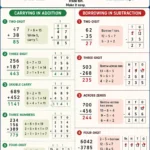
Subtracting two-digit numbers introduces the idea of borrowing, sometimes called regrouping. Don’t worry if this feels tricky at first, because it simply takes a little extra practice before it clicks. Once children see the pattern, they solve these problems almost automatically.
Practice Questions
- 45 − 18 =
- 62 − 27 =
- 50 − 24 =
- 38 − 19 =
- 71 − 35 =
- 84 − 46 =
- 93 − 58 =
- 66 − 29 =
- 55 − 37 =
- 80 − 42 =
Answer Key: 27, 35, 26, 19, 36, 38, 35, 37, 18, 38
Grade 3 Addition Worksheet: Three-Digit Numbers
Grade 3 students move on to three-digit addition, often carrying numbers from one column to the next. This step feels big at first, but once your child masters the pattern, it becomes second nature rather quickly.
Practice Questions
- 234 + 158 =
- 467 + 325 =
- 189 + 246 =
- 512 + 378 =
- 345 + 267 =
- 623 + 189 =
- 456 + 234 =
- 578 + 316 =
- 289 + 411 =
- 634 + 257 =
Answer Key: 392, 792, 435, 890, 612, 812, 690, 894, 700, 891
Grade 3 Subtraction Worksheet: Three-Digit Numbers
These problems build on the borrowing skills learned in Grade 2, now applied across three full digits. Take it column by column, always starting from the right, and the answer comes together smoothly.
Practice Questions
- 543 − 217 =
- 621 − 345 =
- 789 − 456 =
- 654 − 298 =
- 432 − 167 =
- 800 − 356 =
- 715 − 489 =
- 592 − 214 =
- 468 − 279 =
- 900 − 523 =
Answer Key: 326, 276, 333, 356, 265, 444, 226, 378, 189, 377
Grade 4 Mixed Worksheet: Addition and Subtraction Together
At this stage, mixing both operations in one worksheet helps children stay sharp and switch between skills smoothly. Read each question carefully before solving, since one small symbol completely changes the answer.
Practice Questions
- 1,245 + 678 =
- 2,345 − 987 =
- 3,456 + 1,234 =
- 4,567 − 2,345 =
- 5,678 + 2,222 =
- 6,789 − 3,456 =
- 1,111 + 2,222 =
- 8,765 − 4,321 =
- 3,333 + 4,444 =
- 9,876 − 5,432 =
Answer Key: 1,923; 1,358; 4,690; 2,222; 7,900; 3,333; 3,333; 4,444; 7,777; 4,444
Grade 5 Word Problems: Real-Life Addition and Subtraction
Word problems help children see how math applies to everyday life, not just to a page of numbers. Read each sentence slowly, underline the important numbers, and decide whether the story needs addition or subtraction before solving.
Practice Questions
- A farmer had 245 apples. He picked 178 more. How many apples does he have now?
- A school had 560 students. 85 students left for a trip. How many students remain?
- Sara saved 320 rupees. She saved 150 more. What is her total savings?
- A shop had 900 pencils. It sold 465 pencils. How many pencils are left?
- A library had 1,200 books. It received 350 new books. How many books does it have now?
Answer Key: 423 apples; 475 students; 470 rupees; 435 pencils; 1,550 books
Grade 6 Advanced Worksheet: Large Numbers and Multi-Step Problems
By Grade 6, children handle larger numbers and problems that require more than one step. This builds the reasoning skills they will need for future math topics like fractions, ratios, and basic algebra.
Practice Questions
- 12,345 + 6,789 − 2,345 =
- 45,678 − 12,345 + 3,456 =
- 23,456 + 9,876 − 5,432 =
- 78,901 − 34,567 + 1,234 =
- 56,789 + 11,111 − 22,222 =
Answer Key: 16,789; 36,789; 27,900; 45,568; 45,678
Common Mistakes Children Make (And How to Fix Them)
Every child makes small mistakes while learning, and that’s perfectly okay. However, spotting these patterns early helps a lot:
- Forgetting to carry numbers in addition, which leads to answers that are too small.
- Borrowing incorrectly in subtraction, especially when a column has a zero.
- Misreading the symbol, mixing up plus and minus signs in mixed worksheets.
- Rushing through word problems without underlining the important numbers first.
Gently pointing out these patterns, rather than simply marking answers wrong, helps children learn faster and feel far more confident.
Tips to Make Worksheet Practice More Effective
A few small habits can turn simple worksheets into powerful learning tools:
- Set a fixed time each day for practice, even if it’s just 10 minutes.
- Praise effort, not just correct answers, since encouragement builds real confidence.
- Let children check their own work using the answer key before you review it.
- Mix easy and challenging questions so practice never feels boring.
- Take short breaks between worksheets to keep focus fresh and sharp.
How to Use These Worksheets at Home or in Class
First, choose the worksheet that matches your child’s current grade level. Next, print the page, or work directly from a tablet if printing isn’t possible right now. Then, give your child enough time to solve each question without rushing them along. Finally, use the answer key to review the work together, and celebrate progress no matter how small it seems.
Teachers can also use these worksheets as warm-up activities, homework sheets, or quick assessments to check understanding before moving on to a new topic.
Frequently Asked Questions
How often should my child practice addition and subtraction?
Short, regular practice works better than long, occasional sessions. Ten to fifteen minutes a day is usually enough to build steady progress.
What if my child keeps making the same mistake?
Slow down and revisit the concept using simple objects like counters or coins before returning to the worksheet.
Are these worksheets suitable for classroom use?
Yes, teachers can print these pages for warm-up drills, homework, or short in-class assessments.
Final Thoughts
Addition and subtraction form the building blocks of all future math learning, so steady, regular practice truly matters. These free printable addition and subtraction worksheets PDF pages, covering Grade 1 through Grade 6, give children a clear path to practice at their own level and pace. With simple explanations, real practice questions, and complete answer keys, both parents and teachers can support learning confidently, one worksheet at a time.