
Regrouping Worksheets: Carrying and Borrowing Guide
Big numbers can feel scary for young students. One minute a child adds small numbers easily, and the next minute a column adds up to more than nine — and everything stops. This is where a good addition and subtraction worksheet helps. It teaches regrouping, the skill of carrying in addition and borrowing in subtraction, one small step at a time. This guide gives simple steps, easy examples, and grade-wise practice for grades 1 through 5, so every child can learn regrouping without confusion.
What Is Regrouping in an Addition and Subtraction Worksheet?
Regrouping means moving value from one column to the next. Ten ones become one ten. 10 tens become one hundred. In addition, this is called carrying. In subtraction, it is called borrowing. Once a child sees it as “trading ten,” the idea becomes easy, not scary.
This skill matters because it is the base for almost every math topic that comes later, from multiplication to money problems. A child who understands regrouping well in grade 2 or grade 3 rarely struggles with harder column math in later grades. That is why a steady, grade-by-grade addition and subtraction worksheet routine, rather than one long session, works best for building this skill.
Carrying in Addition: Step-by-Step Column Work
Carrying happens when a column adds up to ten or more, and the extra value must move to the next column to the left.
Example 1: Two-digit carrying
  47
+ 38
-----
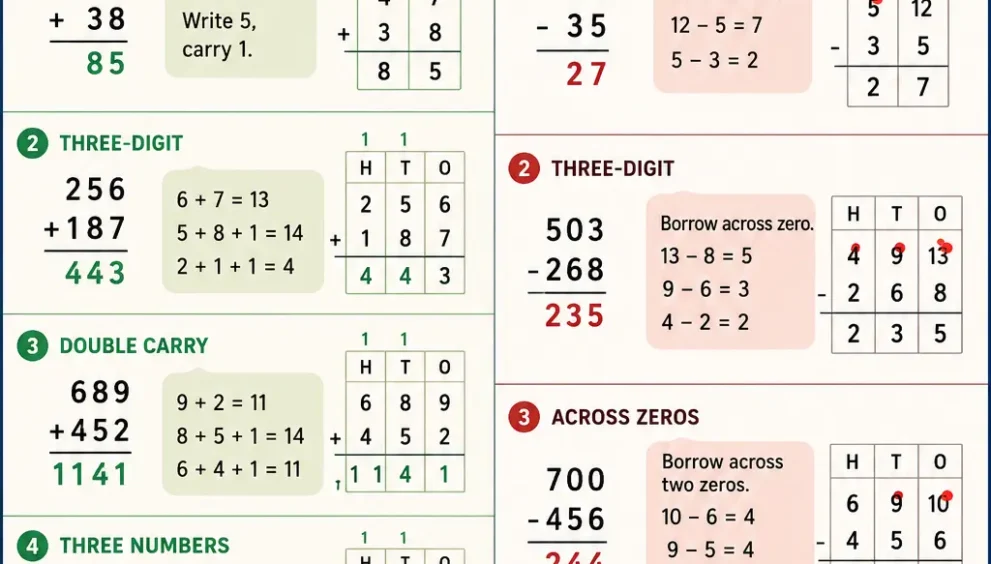
Start with the ones column. Seven plus eight equals fifteen, which is too large for one column, so we write down the five and carry the one over to the tens column. Now add the tens column. Four plus three plus the carried one equals eight. The final answer is eighty-five.
Example 2: Three-digit carrying
  256
+ 187
-----
Begin with the ones column. Six plus seven equals thirteen, so we write the three and carry the one. Moving to the tens column, five plus eight plus the carried one equals fourteen, so we write the four and carry another one. Finally, in the hundreds column, two plus one plus the carried one equals four. The final answer is four hundred forty-three.
Example 3: Double carrying
  689
+ 452
-----
Start with the ones column, where nine plus two makes eleven. Write the one and carry the remaining one to the tens column. Then add eight, five, and the carried one to get fourteen, writing the four and carrying one more time. Finish by adding six, four, and the carried one to make eleven. As there is no column left, write the complete number. The final answer is one thousand one hundred forty-one.
Example 4: Three numbers added together
   234
   156
+  389
------
Adding three numbers follows the same column-by-column method. Four plus six plus nine equals nineteen, so write the nine and carry the one. Then add three, five, eight, and the carried one to make seventeen, writing the seven and carrying one more time. Finish by adding two, one, three, and the carried one to get seven. So the final answer is 779.
Example 5: Four-digit carrying
  3684
+ 2957
------
Begin with the ones column, where four plus seven equals eleven. Write the one and carry the one to the tens column. Next, add eight plus five and the carried one to get fourteen, then write the four and carry the one again. Continue with the hundreds column, where six plus nine and the carried one equal sixteen. Write the six and carry the one to the thousands column. Finally, add three plus two and the carried one to make six. The final answer is six thousand six hundred forty-one.
Practicing carrying with small, careful steps like these, on one addition and subtraction worksheet, helps a child spot a column that adds up to ten or more quickly and confidently.
Borrowing in Subtraction: Step-by-Step Column Work
Borrowing happens when the top digit in a column is smaller than the bottom digit, so a child must borrow ten from the column on the left before subtracting.
Example 1: Two-digit borrowing
  62
- 35
-----
In the ones column, two minus five cannot be done directly, so we borrow one ten from the six in the tens column. The six becomes five, and the two becomes twelve. Twelve minus five equals seven. In the tens column, five minus three equals two. The final answer is twenty-seven.
Example 2: Three-digit borrowing
  503
- 268
-----
In the ones column, three minus eight needs a borrow, but the tens column is zero, so we must borrow from the hundreds column first. The five becomes four, the zero becomes ten, and then that ten lends one to the ones column, becoming nine, while the ones column becomes thirteen. Thirteen minus eight equals five. In the tens column, nine minus six equals three. In the hundreds column, four minus two equals two. The final answer is two hundred thirty-five.
Example 3: Borrowing across zeros
  700
- 456
-----
In the ones column, zero minus six needs a borrow, but both the tens and hundreds columns start with difficult digits, so the borrow travels across two zeros. The seven becomes six, the first zero becomes ten and then nine after lending, and the ones column becomes ten.
Ten minus six equals four. In the tens column, nine minus five equals four. In the hundreds column, six minus four equals two. The final answer is two hundred forty-four.
Example 4: Four-digit borrowing
  6042
- 3785
------
In the ones column, two minus five needs a borrow, so the tens column drops from four to three, and the ones column becomes twelve. Twelve minus five equals seven. In the tens column, three minus eight needs another borrow, so the hundreds column lends, becoming nine, and the tens column becomes thirteen.
Thirteen minus eight equals five. In the hundreds column, nine minus seven equals two. In the thousands column, five minus three equals two. The final answer is two thousand two hundred fifty-seven.
Example 5:
  50213
- 28749
-------
In the ones column, three minus nine needs a borrow, but the tens column is zero, so the borrow must travel further left. The hundreds column lends first, becoming one; the tens column becomes ten and then nine after lending; and the ones column becomes thirteen.
Five-digit borrowing
Thirteen minus nine equals four. In the tens column, nine minus four equals five. In the hundreds column, one minus seven needs another borrow, so the thousands column lends, becoming one, and the hundreds column becomes eleven.
Eleven minus seven equals four. In the thousands column, one minus eight needs a borrow from the ten-thousands column, which becomes four, and the thousands column becomes eleven. Eleven minus eight equals three. In the ten-thousands column, four minus two equals two. The final answer is twenty-one thousand four hundred sixty-four.
Borrowing across zeros is the hardest step for young learners, so a strong addition and subtraction worksheet should always include a few problems built around zeros, just like the examples above.
Grade-Wise Practice: Solve These Regrouping Problems
Each grade level below focuses on a different level of column difficulty, so a child always practices problems that match what they are ready for.
Grade 1 (numbers within twenty, using simple carrying and borrowing)
- 8 + 6 = ?
- 15 − 7 = ?
- 9 + 5 = ?
- 17 − 9 = ?
- 7 + 8 = ?
- 13 − 6 = ?
Answers: 14, 8, 14, 8, 15, 7
Grade 2 (two-digit numbers with a single regrouping step)
- 45 + 27 = ?
- 63 − 28 = ?
- 58 + 36 = ?
- 81 − 47 = ?
- 39 + 46 = ?
- 72 − 38 = ?
Answers: 72, 35, 94, 34, 85, 34
Grade 3 (three-digit numbers with double regrouping steps)
- 342 + 289 = ?
- 501 − 236 = ?
- 476 + 358 = ?
- 620 − 275 = ?
- 519 + 267 = ?
- 804 − 459 = ?
Answers: 631, 265, 834, 345, 786, 345
Grade 4 (larger numbers, including tricky zeros)
- 4,006 − 2,758 = ?
- 3,215 + 1,897 = ?
- 6,004 − 3,867 = ?
- 2,749 + 3,586 = ?
- 5,300 − 2,764 = ?
- 4,178 + 2,946 = ?
Answers: 1,248, 5,112, 2,137, 6,335, 2,536, 7,124
Grade 5 (multi-step regrouping with bigger, word-style numbers)
- 8,247 + 3,956 = ?
- 7,003 − 4,589 = ?
- 9,164 + 5,278 = ?
- 10,002 − 6,745 = ?
- 6,428 + 5,873 = ?
- 12,006 − 8,459 = ?
Answers: 12,203, 2,414, 14,442, 3,257, 12,301, 3,547
Word Problems Using Regrouping
Real addition and subtraction worksheet packs also test regrouping inside short word problems, since tests rarely give a plain column problem alone without any context.
Problem 1: Ali has forty-eight marbles. His friend gives him thirty-seven more. How many marbles does Ali have now?
  48
+ 37
-----
In the ones column, eight plus seven equals fifteen, so we write the five and carry the one. In the tens column, four plus three plus the carried one equals eight. Ali now has eighty-five marbles.
Problem 2: A shop had one hundred thirty-two books. It sold sixty-eight books. How many books are left?
  132
-  68
-----
In the ones column, two minus eight needs a borrow, so the tens column drops from three to two, and the ones column becomes twelve. Twelve minus eight equals four. In the tens column, two minus six needs another borrow, so the hundreds column drops from one to zero, and the tens column becomes twelve. Twelve minus six equals six. The shop has sixty-four books left.
Problem 3: Sara saved two hundred fifty-six rupees in January and one hundred eighty-nine rupees in February. How much did she save in total?
  256
+ 189
-----
Six plus nine equals fifteen in the ones column, so write the five and carry the one. Then add five, eight, and the carried one to make fourteen, writing the four and carrying one again. Finish by adding two, one, and the carried one to get four. Sara saved four hundred forty-five rupees in total.
Problem 4:
A school had four thousand five hundred students. This year, one thousand seven hundred forty-eight students left. How many students remain?
  4005
- 1748
------
In the ones column, five minus eight needs a borrow, but the tens column is zero, so the borrow travels through the hundreds column first. The hundreds column becomes nine, the tens column becomes ten and then nine after lending, and the ones column becomes fifteen. Fifteen minus eight equals seven.
Move to the tens column, where nine minus four equals five. Then solve the hundreds column by subtracting seven from nine to get two. Finish with the thousands column, where three minus one equals two. The school has two thousand two hundred fifty-seven students remaining.
Word problems like these help a child practice one more skill beyond the column steps themselves: deciding whether to carry or borrow before touching a pencil, simply by reading the situation carefully.
Common Mistakes Students Make During Regrouping
Most regrouping mistakes come from rushing rather than from not understanding the concept itself. A child who slows down for the first few problems on any addition and subtraction worksheet, and checks each carried or borrowed digit before moving on, almost always avoids the errors listed below.
- Forgetting to carry the one, and writing the full two-digit number instead of just the ones digit.
- Subtracting the smaller digit from the larger digit regardless of which one is actually on top.
- Skipping a zero while borrowing across two or more columns, which throws off the whole answer.
- Writing digits in the wrong column, so that tens and ones end up mixed together.
- Losing track of a small carried digit partway through a longer addition problem with several numbers.
A good addition and subtraction worksheet should include a few problems built around these exact mistakes, along with an answer key that explains the correct regrouping step in words, not just the final number.
Practice Set: Mixed Carrying and Borrowing Problems
- 58 + 37 = ?
- 91 − 46 = ?
- 274 + 168 = ?
- 603 − 258 = ?
- 489 + 356 = ?
- 900 − 645 = ?
- 3,258 + 1,967 = ?
- 5,004 − 2,789 = ?
- 76 + 85 = ?
- 400 − 173 = ?
- 68 + 47 = ?
- 512 − 267 = ?
- 246 + 379 = ?
- 700 − 358 = ?
6,342 + 2,879 = ?
- 8,001 − 4,536 = ?
- 94 + 58 = ?
- 350 − 186 = ?
- 1,647 + 2,895 = ?
- 6,000 − 3,748 = ?
Answers: 95, 45, 442, 345, 845, 255, 5225, 2215, 161, 227, 115, 245, 625, 342, 9221, 3465, 152, 164, 4542, 2252
Working through a mixed set like this one, switching between carrying and borrowing without warning, closely mirrors how these skills actually appear on classroom tests and standardized assessments.
Tips for Teaching Regrouping at Home or in Class
Use base-ten blocks so a child can physically see and touch “ten ones becoming one ten,” rather than just imagining it. Keep numbers lined up neatly in columns, since one misplaced digit can break the entire answer even when every calculation is correct. Mix carrying and borrowing problems on the same worksheet page, since real tests almost always mix both skills together.
Let a child master accuracy first, and only add a timer once the steps feel automatic. Praise the correct steps along the way, not just the final answer, so a child learns to trust the process even on problems they get wrong.
Frequently Asked Questions
What age should a child learn carrying and borrowing?
Most children begin learning single-digit carrying and borrowing around age six or seven, in grade 1 or grade 2, and continue building the skill steadily through grade 4.
Is regrouping the same thing as borrowing?
Borrowing is one specific type of regrouping, used only in subtraction problems. Carrying is the addition version of the same idea. Regrouping is simply the general name that covers both processes.
How many regrouping problems should a child practice each day?
Somewhere between ten and fifteen mixed problems a day is usually enough for steady, lasting progress without tiring out a young learner.
Why does my child get the right steps but still land on the wrong final answer?
This usually means a carried or borrowed digit got lost somewhere in the middle of the problem. Slowing down and writing the small carried number clearly above the column almost always fixes this issue.
Should carrying and borrowing be practiced on paper or with an app?
Paper worksheets work better at first, since a child needs to write each carried or borrowed digit by hand. Apps and timed games work well later, once the paper steps feel solid.
Final Thoughts on Mastering Regrouping
Carrying and borrowing are not extra rules layered on top of math — they are simply how addition and subtraction work once numbers grow larger than a single digit. A clear addition and subtraction worksheet, built grade by grade with real practice problems and full explanations, turns a confusing idea into an easy daily habit. With steady, patient practice on the examples above, most children move from hesitant guessing to fast, confident regrouping in just a few short weeks.