
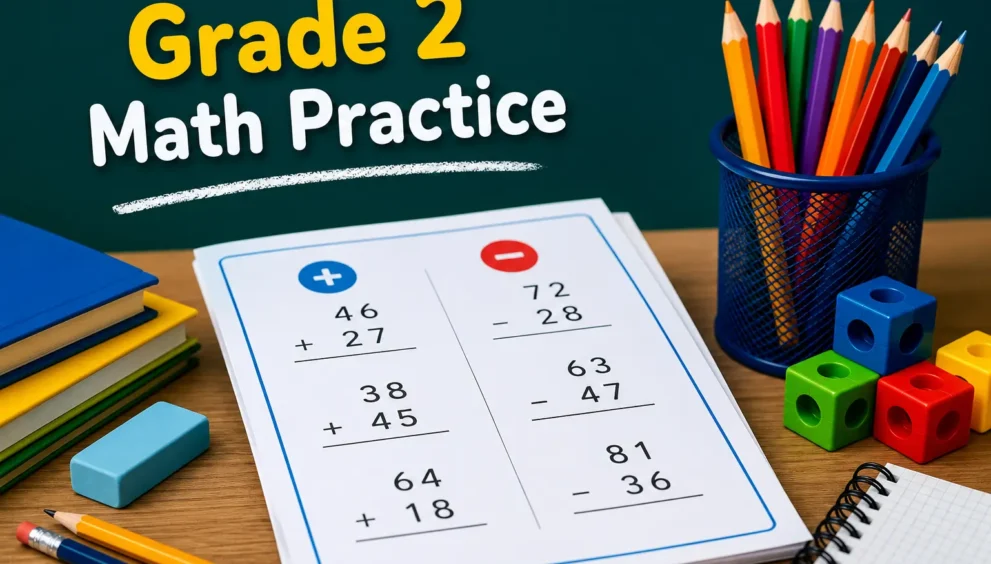
Grade 2 Addition and Subtraction Worksheets
Second grade is where math starts to feel like actual math. Gone are the days of counting on fingers for every single problem — now kids are working with double-digit numbers, learning to regroup, and building the kind of number fluency that carries them into third grade and beyond. So if you’re a parent or teacher looking for the right worksheets to support that jump, you’re in exactly the right place.
Addition and subtraction worksheets for Grade 2 sit at a pivotal point in a child’s math journey. This is the year regrouping (carrying and borrowing) gets introduced properly, and it’s also the year many kids either build lasting confidence or start to fall behind. The good news? With the right worksheets and a bit of consistency, most kids move through this stage smoothly.
Let’s walk through exactly what Grade 2 worksheets should include, why each type matters, and how to use them effectively at home or in the classroom.
What Makes Grade 2 Different
By the time kids reach second grade, they’ve usually mastered single-digit addition and subtraction facts from Grade 1. So what changes now? Mainly, the numbers get bigger, and the strategies get more sophisticated.
Grade 2 worksheets typically introduce double-digit addition and subtraction, meaning numbers in the tens and even approaching one hundred. This shift requires kids to understand place value in a much deeper way than before, since they now need to track both the ones column and the tens column separately while solving a single problem.
Additionally, this is the year regrouping seriously enters the picture. Up until now, most problems avoided regrouping entirely. In Grade 2, that changes — and it changes fast. A student who breezed through Grade 1 worksheets might suddenly hit a wall when 47 + 28 shows up on the page. That’s completely normal, and it’s exactly why dedicated Grade 2 worksheets matter so much.
Double-Digit Addition Without Regrouping
Before diving into full regrouping, it helps to start with double-digit addition that doesn’t require it. This builds confidence with the format itself — lining up numbers by place value, adding column by column — without adding the extra complexity of carrying.
A typical worksheet at this stage might include problems like:
- 23 + 14
- 35 + 42
- 51 + 27
These problems keep the ones and tens columns simple, so kids can focus entirely on the mechanics of double-digit addition. Once that foundation feels solid, moving into regrouping becomes a much smaller leap.
Double-Digit Addition With Regrouping
Regrouping is, without question, the skill that defines Grade 2 math. When the ones column adds up to more than nine, kids need to carry a ten over into the next column — a process that can feel confusing at first but becomes automatic with enough practice.
Here’s an example:
- 48 + 37
Adding 8 and 7 gives 15, so the student writes down the 5 and carries the 1 over to the tens column. Then 4 + 3 + 1 = 8, giving a final answer of 85. Worksheets that walk through this process step by step, often with visual boxes for the carried number, help this concept click much faster than abstract explanation alone.
Good Grade 2 worksheets usually include ten to fifteen regrouping problems per page, since repetition really is what makes this skill stick. Mixing in a few without-regrouping problems keeps kids on their toes too, since they learn to recognize which situation calls for carrying and which doesn’t.
Double-Digit Subtraction With Borrowing
Subtraction with borrowing works in the opposite direction but follows a similar logic. When the ones column doesn’t have enough to subtract from, kids borrow a ten from the tens column.
Take this example:
- 72 – 48
Since 2 is smaller than 8, the student borrows a ten from the 7, turning it into 6, and the 2 becomes 12. Now 12 – 8 = 4, and 6 – 4 = 2, giving a final answer of 24. This borrowing process tends to trip up more kids than carrying does, so it’s worth giving it extra dedicated practice on its own worksheets before mixing it with addition.
Mixed Addition and Subtraction Practice
Once a child feels comfortable with both regrouping directions separately, mixed worksheets bring addition and subtraction together on the same page. This matters because real tests and real-life math rarely announce which operation to use ahead of time.
A sample mixed worksheet might look like this:
- 56 + 27
- 83 – 39
- 44 + 38
- 91 – 45
This format forces kids to actually read each problem before jumping in, rather than assuming every question follows the same pattern. It’s a small habit, but it pays off enormously once tests and word problems enter the picture.
Word Problems for Grade 2
Grade 2 word problems typically involve a single addition or subtraction step, but they require kids to translate everyday language into a math equation — which is often the hardest part.
Consider this example:
A farmer had 56 apples. He picked 27 more from the trees. How many apples does he have now?
The word “more” signals addition here, and recognizing that connection is exactly the skill Grade 2 word problem worksheets are designed to build. Compare that to a subtraction-flavored problem:
There were 83 students at the school assembly. 39 students left early. How many students remained?
The word “left” or “remained” signals subtraction. Worksheets that mix both signal types together teach kids to slow down and actually read for meaning, rather than guessing based on the numbers alone.
It also helps to introduce two-step word problems gradually as the year progresses. For example: “A classroom had 34 pencils. The teacher gave out 12 pencils, then bought 20 more. How many pencils are there now?” This kind of layered problem asks kids to work through the situation in order, rather than solving everything in one calculation, which builds planning skills that pay off well beyond Grade 2.
Missing Number Problems
Missing number worksheets flip the format, asking students to solve for a hidden value instead of a final total. For example:
- 34 + __ = 61
- __ – 28 = 15
This style strengthens the connection between addition and subtraction, since solving for a missing addend often means using subtraction to work backward. It also introduces early algebraic thinking in a way that feels approachable rather than intimidating.
Fact Families for Grade 2
Fact family worksheets reinforce how three numbers connect through both operations. Take 24, 37, and 61:
- 24 + 37 = 61
- 37 + 24 = 61
- 61 – 24 = 37
- 61 – 37 = 24
By Grade 2, fact families extend beyond simple single-digit examples into double-digit numbers, which naturally reinforces regrouping skills at the same time. This dual benefit makes fact family practice one of the more efficient worksheet types for this age group.
Mental Math for Grade 2
Not every Grade 2 problem needs to be solved on paper. Mental math worksheets encourage kids to use number strategies instead of writing out every step. For instance, adding 29 + 15 becomes much easier when a child learns to think of it as 30 + 14, rounding 29 up to a friendlier number and adjusting accordingly.
These worksheets typically use fewer problems per page, since the goal is building quick strategic thinking rather than volume. Pairing mental math practice with regrouping worksheets gives kids two different tools for the same underlying skills, which strengthens overall number sense.
Fun and Themed Formats
Second graders still respond well to worksheets that don’t feel like traditional homework. Color-by-number pages, where solving a problem reveals a color to fill in, turn a dozen practice problems into something that feels more like an art project than math drills.
Seasonal worksheets work nicely here too — think autumn leaf subtraction in October or snowflake addition in December. These themed pages don’t replace core skill practice, but they do add variety, which keeps motivation higher across a full week of worksheets.
Printable PDF Worksheets
For most parents and teachers, printable PDF format remains the most practical option. A well-organized Grade 2 worksheet set should include clear labeling by skill (addition without regrouping, subtraction with borrowing, mixed practice, word problems) along with an answer key for quick checking.
Downloading a full set rather than a single page also saves time, since it lets you rotate through different skill types across a week without searching for a new worksheet every single day.
Tips for Using Grade 2 Worksheets Effectively
A few practical adjustments make a real difference at this level.
First, don’t rush into regrouping before basic double-digit addition feels comfortable. If a child is still counting on fingers for simple two-digit sums, adding the complexity of carrying on top of that shaky foundation usually backfires.
Next, keep sessions short. Ten to fifteen minutes of focused Grade 2 practice most days works far better than one long, exhausting session once a week. Kids retain regrouping strategies better through frequent, spaced repetition than through cramming.
Also, always include an answer key. Grade 2 is exactly the age where kids can start checking their own work, and that small independence builds real ownership over their learning.
Finally, mix formats throughout the week. Rotate between straightforward number problems, word problems, missing numbers, and the occasional themed worksheet. This variety prevents the kind of disengagement that comes from doing the same style of page day after day.
It’s also worth pairing worksheet practice with a quick verbal check-in every so often. Asking a child to explain out loud how they solved a regrouping problem — “why did you carry the one there?” — reveals whether they truly understand the process or are simply following steps without grasping the reasoning behind them. That distinction matters, because kids who memorize steps without understanding often struggle once numbers get larger in Grade 3.
Common Mistakes to Watch For
A few patterns show up often at this stage, and catching them early saves a lot of frustration later.
One common mistake is misaligning columns when writing out double-digit problems by hand — lining up a ones digit under a tens digit throws off the entire calculation. Worksheets with pre-printed grid boxes help prevent this specific error.
Another frequent issue is forgetting to carry or borrow altogether, especially when a child is still building the habit. Worksheets that isolate regrouping problems, rather than mixing them randomly with non-regrouping problems, help kids build that habit more deliberately before combining everything together.
Final Thoughts
Grade 2 addition and subtraction worksheets cover a lot of ground — double-digit numbers, regrouping in both directions, word problems, mental math, and more. That might sound like a lot, but broken into small, consistent practice sessions, it’s entirely manageable for most kids.
The key is patience paired with repetition. Regrouping especially takes time to click, and that’s completely normal. With a steady rotation of worksheets covering each of these skills, most second graders build genuine confidence with double-digit addition and subtraction well before the school year ends.