
Addition and Subtraction Word Problems Worksheets
An addition and subtraction worksheet, when built around word problems, teaches a child to translate a real-life story into the correct equation before solving it, rather than just practicing bare arithmetic. Therefore, each section below first explains the concept briefly, then walks through fully worked math, and scales the difficulty from Grades 1–2 up through Grades 5–6 so that every level encounters problems matched to its skill.
What makes a strong addition and subtraction worksheet
A strong worksheet, first and foremost, mixes addition and subtraction on the same page so that the correct operation never becomes predictable from position alone, and this, in turn, forces the student to read and decide each time. To illustrate, compare these four equations below, which represent the pure computation half of the skill before any story attaches to them:
68 + 24 = 92 93 − 37 = 56 145 + 268 = 413 520 − 175 = 345
Word problem types, worked in full
Word problems fall into four recognizable categories, and a complete worksheet cycles through all of them rather than repeating one pattern.
Single-step problems
One operation solves the entire story, which makes this the right starting point for younger learners.
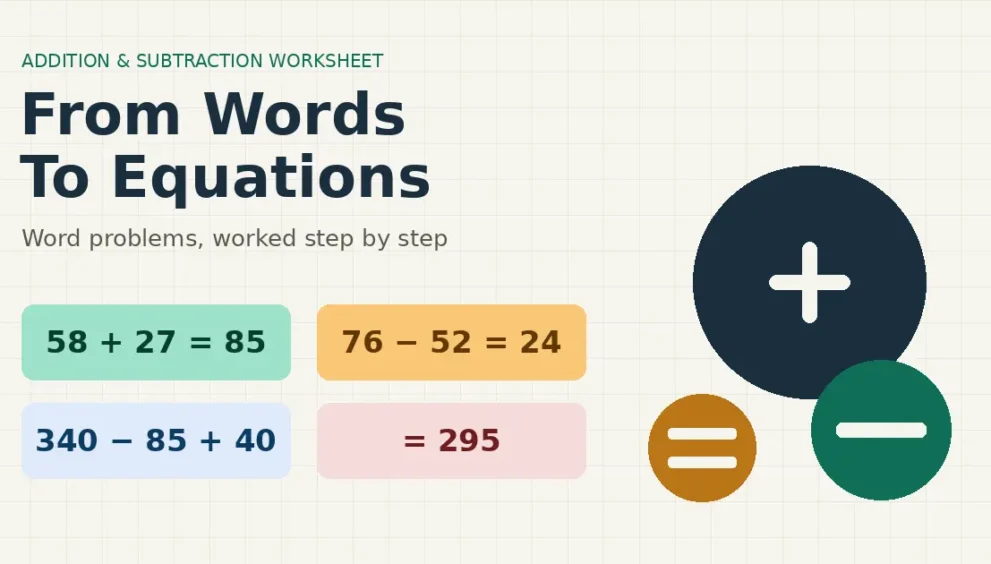
A library has 58 books on one shelf and 27 books on another shelf. How many books are there in total? 58 + 27 = 85
A farmer has 234 chickens and buys 156 more chickens. How many chickens does he have now? 234 + 156 = 390
A train had 480 passengers on board. 195 passengers got off at one station. How many passengers remain? 480 − 195 = 285
A bakery baked 267 loaves of bread in the morning and 189 more in the afternoon. How many loaves did it bake in total? 267 + 189 = 456
Two-step problems
Two operations apply in sequence, so the child must hold the first result in mind before finishing the story.
A shop had 120 apples. It sold 45 apples in the morning, then received 30 more apples in the afternoon. How many apples does it have now? 120 − 45 = 75 75 + 30 = 105
A warehouse had 1,020 boxes. It shipped 375 boxes out and later received 210 boxes in. How many boxes does it have now? 1,020 − 375 = 645 645 + 210 = 855
A school had 340 students enrolled. 85 students left for a school trip and 40 new students joined the same day. How many students remain? 340 − 85 = 255 255 + 40 = 295
A farm had 500 chickens. It sold 180 chickens at the market, then bought 95 new chicks. How many chickens are on the farm now? 500 − 180 = 320 320 + 95 = 415
Comparison problems
The story asks for a difference rather than a total, and the correct operation often isn’t hinted at by any obvious keyword.
Ali has 76 marbles, and Zara has 52 marbles. How many more marbles does Ali have than Zara? 76 − 52 = 24
A bookstore sold 88 books on Monday and 143 books on Tuesday. How many more books were sold on Tuesday than on Monday? 143 − 88 = 55
A company shipped 2,450 units in January and 1,875 units in February. How many more units shipped in January than February? 2,450 − 1,875 = 575
A cinema sold 615 tickets on Friday and 480 tickets on Saturday. How many more tickets were sold on Friday than on Saturday? 615 − 480 = 135
Missing-number problems
The total is already known, and a starting part is missing, so the child has to work the story backward.
A basket had some oranges already inside it. After adding 18 more oranges, it now holds 65 oranges in total. How many oranges were in the basket originally? 65 − 18 = 47
Hina has 342 pages left to read out of a 500-page book. How many pages has she already finished reading? 500 − 342 = 158
A parking lot had some cars already parked. After 46 more cars arrived, the lot had 130 cars total. How many cars were parked originally? 130 − 46 = 84
Grade-wise practice, with full stories and answers
Difficulty scales through both the size of the numbers and the number of steps required, while the underlying reasoning stays identical at every level.
Grades 1–2 (numbers under 100, single-step)
A pond had 14 ducks, and 6 more ducks arrived. How many ducks are there now? 14 + 6 = 20
A basket had 32 apples, and 15 more were added. How many apples in total? 32 + 15 = 47
A shelf had 58 toys, and 23 were given away. How many toys remain? 58 − 23 = 35
Extra Grades 1–2 practice with answers
- A box had 25 crayons, and 12 more were added. How many crayons now?
- A tree had 40 birds, and 16 flew away. How many birds remain?
Answers: 25 + 12 = 37; 40 − 16 = 24
Grades 3–4 (hundreds, up to two steps)
A zoo had 612 visitors on Saturday and 178 more on Sunday. How many visitors across both days? 612 + 178 = 790
A store had 845 shirts and sold 267 of them. How many shirts remain in stock? 845 − 267 = 578
A class had 250 pencils, gave out 175, then received 90 new pencils. How many pencils are there now? 250 − 175 = 75 75 + 90 = 165
Extra Grades 3–4 practice with answers
- A garden had 320 flowers, and 145 more were planted. How many flowers are there now?
- A shop had 480 shirts and sold 235 of them. How many shirts remain?
- A bus had 210 passengers, 85 got off, and 60 new passengers got on. How many passengers are on the bus now?
Answers: 320 + 145 = 465; 480 − 235 = 245; 210 − 85 = 125, then 125 + 60 = 185
Grades 5–6 (thousands, multi-step and combined comparison)
A company shipped 2,450 units in January and 1,875 units in February, and aims to ship 5,000 units across both months combined. How many more units are needed to hit that target? 2,450 + 1,875 = 4,325 5,000 − 4,325 = 675
A charity raised 3,215 rupees in week one and 1,890 rupees in week two, toward a 7,000-rupee goal. How much more is needed? 3,215 + 1,890 = 5,105 7,000 − 5,105 = 1,895
A warehouse held 6,050 units, shipped out 1,890 units, then received a new delivery of 425 units. How many units does it hold now? 6,050 − 1,890 = 4,160 4,160 + 425 = 4,585
More real-life problems for Grades 5–6
These stories combine larger numbers with two or three operations, matching the level students reach by Grades 5–6.
A factory produced 4,280 units in March and 3,650 units in April, against a quarterly target of 12,000 units. How many units are still needed in May to hit the target? 4,280 + 3,650 = 7,930 12,000 − 7,930 = 4,070
A school library had 5,600 books. It donated 1,340 books to another school and purchased 875 new books. How many books does the library have now? 5,600 − 1,340 = 4,260 4,260 + 875 = 5,135
A stadium sold 8,450 tickets for a Saturday match and 6,720 tickets for a Sunday match. How many more tickets were sold on Saturday than Sunday? 8,450 − 6,720 = 1,730
Answer key: 4,070; 5,135; 1,730
Six-step strategy for any grade
- Read the full problem once before solving anything.
- Underline every known number in the story.
- Identify exactly what the question is asking for.
- Decide whether the story describes a total, a remainder, or a combination of both.
- Write the equation using the identified numbers.
- Solve it, then check the answer against the original story.
An answer larger than the starting amount in a “giving away” story — writing 47 + 18 = 65 instead of the correct 65 − 18 = 47 — signals a step-four error in the reasoning, not a mistake in the arithmetic itself.
Extra practice set for Grades 5–6, with answer key
- 5,340 + 2,870 = ?
- 8,120 − 3,455 = ?
- A warehouse had 4,600 units in stock, shipped out 1,275 units, then received 980 more units. How many units are in stock now?
- A school raised 3,215 rupees in week one and 2,780 rupees in week two, aiming for a 7,000-rupee target. How much more money is needed?
- 6,050 − 1,890 + 425 = ?
- A farm produced 9,240 kilograms of wheat and sold 5,675 kilograms at the market. How many kilograms remain unsold?
- An airline carried 12,450 passengers in one week and 9,830 passengers the next week. How many more passengers flew in the first week?
- A shopping mall had 7,600 visitors on Friday, 2,150 more than usual arrived on Saturday, and 1,340 fewer arrived on Sunday than on Saturday. How many visitors came on Sunday?
- 10,500 − 4,275 + 1,600 = ?
- A charity collected 6,780 rupees in one campaign and needs a total of 15,000 rupees across two campaigns. How much must the second campaign raise?
Answer key:
- 8,210
- 4,665
- 4,600 − 1,275 = 3,325; 3,325 + 980 = 4,305
- 3,215 + 2,780 = 5,995; 7,000 − 5,995 = 1,005
- 6,050 − 1,890 = 4,160; 4,160 + 425 = 4,585
- 9,240 − 5,675 = 3,565
- 12,450 − 9,830 = 2,620
- 7,600 + 2,150 = 9,750; 9,750 − 1,340 = 8,410
- 10,500 − 4,275 = 6,225; 6,225 + 1,600 = 7,825
- 15,000 − 6,780 = 8,220
Common mistakes
First, keyword guessing fails as soon as phrasing changes, because a child who scans only for the word “total” will miss a comparison problem entirely, even though comparison problems still require subtraction. Similarly, number-order confusion shows up when a child writes 27 + 58 where a story actually needs 58 − 27, usually because the child assumes the first number mentioned always comes first in the equation.
In addition, skipping the working step hides whether an error came from misreading the story or from a simple calculation slip, since a bare final answer like 855 doesn’t reveal whether the child correctly computed 1,020 − 375 + 210 or simply guessed a plausible-looking number.
Fix Common Mistakes
Ultimately, the fix for every one of these mistakes is the same: first, require the full equation on paper rather than just the final number, and additionally, mix addition and subtraction throughout the page so that no single shortcut keeps working for an entire worksheet. Moreover, this applies equally at every grade level, because a Grade 6 student guessing on a four-digit problem is, in fact, making the exact same reasoning error as a Grade 2 student guessing on a two-digit one.
Tips for parents and teachers
Reading each problem aloud first separates the reading difficulty from the equation-building difficulty, so both skills aren’t tested at once. Asking a child to explain the chosen operation before solving catches a wrong equation while it’s still cheap to fix.
Reviewing a wrong answer by walking back through the six-step method, rather than simply marking it incorrect, turns every mistake into a lesson the child can apply to the next problem. Adjusting only the number size and step count as a child moves up in grade, while keeping the same six-step process, gives a consistent method that scales all the way from Grade 1 through Grade 6.
Frequently asked questions
What age group are these worksheets suitable for?
Roughly ages six through eleven. Numbers stay under 100 for the youngest learners and move into the thousands with multi-step reasoning by Grades 5–6, while the underlying six-step method stays identical across every level, which is what makes a single worksheet framework usable across an entire primary school curriculum.
How many problems should a child practice per session?
Ten to fifteen mixed problems, covering all four types above, work better than a long block built from one repeated pattern, since fatigue tends to break reasoning before it breaks arithmetic. A shorter set solved carefully, with the full equation written out each time, teaches more than a long set rushed through for a final answer alone.
Why is subtraction harder than addition in word problems?
Phrases like “how many more” or “how many are left” point straight to subtraction rather than addition, but never contain the actual word “subtract,” so a child cannot rely on one trigger word the way addition problems often allow. This is exactly why comparison and missing-number problems, both built on subtraction, tend to need more repeated practice than simple total problems.
Should addition and subtraction stay mixed on one page?
Yes. Grouping all addition problems first and all subtraction problems afterward lets a child answer correctly without ever choosing the operation, which defeats the purpose of a word problem worksheet in the first place. Mixing the two operations throughout every grade band, from the simplest single-step problems up through the multi-step Grade 5–6 examples above, keeps the actual skill being tested consistent even as the numbers grow larger.
Conclusion
Addition and subtraction word problems worksheets close the gap between calculating 340 − 85 + 40 correctly and knowing that this exact sequence is what a story actually calls for — a gap that widens with age unless students practice it deliberately at every grade level. Whether a Grade 1 learner works with single digits or a Grade 6 student works with five-digit totals, the same read-underline-decide-solve-check process turns a confusing paragraph into a solvable equation every time.