

Riser Desk for Home Office: Is It a Good Fit?
A home office rarely stays the same for long. What starts as a laptop on a kitchen table often turns into a full workstation within a few months, and that’s usually when the discomfort begins. Shoulders tighten, the lower back complains after long calls, and by evening, sitting feels like the last thing anyone wants to do. This is the point where many remote workers, freelancers, and hybrid employees start searching for a better setup — and a riser desk is almost always one of the first suggestions they come across.
However, before adding one more piece of furniture to a home office, it’s worth asking a more specific question: what is a riser desk actually fit for your space, your work style, and your daily routine? Not every home office benefits equally, and understanding why is far more useful than following a trend.
A Quick Refresher: What a Riser Desk Actually Does
A riser desk sits on top of an existing desk or table and lifts the monitor, keyboard, and workspace to a standing height whenever needed. Because of this, it allows a person to shift between sitting and standing without replacing their entire desk setup. Unlike a full standing desk, which is a standalone unit, a riser desk works as an add-on layer — a distinction that matters a lot once budget and space become part of the decision.
Why Home Office Workers Are Considering Riser Desks
Remote and hybrid work changed how people spend their day. Meetings that once meant walking to a conference room now happen from the same chair, hour after hour. As a result, many home-based professionals report stiffness, fatigue, or a general feeling of being “stuck” by mid-afternoon.
A riser desk appeals to this group for a few clear reasons:
- It introduces movement into an otherwise static day.
- It requires no major furniture replacement or renovation.
- It’s relatively easy to install and adjust.
- It can be used part-time, meaning there’s no pressure to stand all day.
Because of this flexibility, a riser desk tends to attract people who want a change without committing to a complete office overhaul.
How a Riser Desk Fits Different Home Office Environments
Not every home office looks the same, and the environment plays a bigger role in suitability than most people expect.
| Home Office Type | How a Riser Desk Typically Fits |
|---|---|
| Small bedroom or corner setup | Works well if desk depth allows the base to sit stably |
| Shared family space | Useful since it can be removed or lowered when not in use |
| Dedicated home office room | Excellent fit; can pair with an ergonomic chair and monitor arm |
| Compact apartment desk | Depends on desk strength; lightweight models are safer |
| Multi-monitor workstation | Needs a wider or dual-tier riser to support the extra weight |
In particular, apartment dwellers and those working from smaller desks should check weight capacity and surface depth before buying, since an undersized desk can make the riser feel unstable.
Types of Riser Desks and Which Ones Suit Home Use
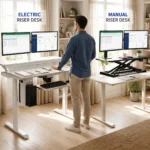
Riser desks generally fall into a few categories: manual crank models, pneumatic (spring-assisted) models, and electric versions with push-button height adjustment. Each comes with a different balance of cost, convenience, and durability, and the right one depends on how often a person expects to switch positions during the day.
For home offices specifically, this decision matters more than it might seem, since daily usage patterns differ a lot from office environments where breaks are more structured. Readers who want a deeper side-by-side breakdown — including price ranges, adjustment speed, and long-term durability — can review this detailed comparison of electric and manual riser desks to see which mechanism better suits a home routine.
Riser Desk vs Traditional Desk: What Changes
Switching from a traditional desk to a riser setup changes more than posture. It also changes workflow, since standing periods naturally shorten meeting fatigue and create small, built-in breaks throughout the day. On the other hand, a traditional desk offers unmatched stability and a lower upfront cost, which still makes it the right choice for some users.
It’s also worth understanding how a riser desk compares to a full standing desk, since the two are often confused despite being fundamentally different products. For a complete breakdown of cost, footprint, and long-term flexibility, this comparison of riser desks and standing desks explains exactly where each option makes more sense.
Benefits and Limitations of Using a Riser Desk
| Benefits | Limitations |
|---|---|
| Encourages movement throughout the day | Takes up existing desk space |
| Lower cost than a full standing desk | May reduce desk surface area for other items |
| Easy to install without tools (in most cases) | Not all desks can support the added weight |
| Can be used part-time or full-time | Cheaper models may wobble under heavy use |
| Portable if the setup changes later | Cable management can become more complex |
Overall, the benefits tend to outweigh the limitations for users who genuinely alternate between sitting and standing. However, someone who intends to stand all day, every day, may eventually outgrow a riser desk and prefer a dedicated standing desk instead.
Who Actually Benefits Most From a Riser Desk
Not every home worker needs the same solution, and recognizing this early can save both money and frustration.
- Remote employees with back-to-back video calls often find that standing periods reduce the mental fatigue that comes from sitting motionless for hours.
- Freelancers who control their own schedule can experiment freely with sit-stand ratios without needing anyone’s approval.
- Students working from a shared desk benefit from a setup they can adjust and put away as needed.
- Home-based professionals juggling deep-focus work and meetings often appreciate switching posture between tasks.
- Hybrid employees moving between office and home benefit from consistency, especially if their office desk is also height-adjustable.
- Long-hour computer users, including developers, writers, and designers, tend to notice the biggest difference, since they spend the most consecutive hours at a desk.
In contrast, someone who works only an hour or two per day at their desk may not notice enough benefit to justify the investment.
Factors to Consider Before Choosing One
Before purchasing a riser desk for a home office, a few practical questions are worth answering:
- Desk compatibility — Can the existing desk support the added weight and depth?
- Available space — Is there enough surface area left for a keyboard, mouse, and other essentials?
- Monitor setup — Single or dual monitor, and does the riser support that configuration?
- Usage pattern — Will the desk be raised occasionally, or several times a day?
- Budget — Manual models cost less, while electric versions offer smoother, faster adjustments.
- Mobility needs — Some users prefer a riser that can move between rooms or desks easily.
Answering these honestly, rather than assuming a generic model will fit, tends to prevent most of the common regrets buyers report later.
Common Mistakes People Make With Riser Desks
Even with a good product, poor setup habits can undo most of the benefit. Some of the most frequent mistakes include:
- Setting the height incorrectly, which can lead to neck or wrist strain over time.
- Standing for excessively long periods without breaks, defeating the purpose of alternating posture.
- Ignoring cable management, which creates clutter and tripping hazards.
- Choosing a riser that’s too small for the desk or monitor setup.
- Skipping an anti-fatigue mat, which can make standing periods less comfortable.
Because of these patterns, it’s worth spending a few extra minutes on setup rather than rushing straight into daily use.
Building an Ergonomic Workstation Around a Riser Desk
A riser desk works best as part of a broader ergonomic setup rather than a standalone fix. Pairing it with an adjustable chair, a monitor positioned at eye level, and a keyboard placed at elbow height can meaningfully improve comfort. Additionally, alternating between sitting and standing every 30 to 60 minutes is generally considered a reasonable starting rhythm, though individual comfort levels vary.
This kind of posture-friendly workspace is associated with reduced strain during long work sessions, though results depend heavily on consistency and correct setup rather than the desk alone.
Is a Riser Desk a Good Fit for Your Home Office? A Decision Framework
| If your situation is… | A riser desk is likely… |
|---|---|
| You sit for 6+ hours daily with few breaks | A strong fit |
| You have a small or shared desk space | A fit, with a compact model |
| You already own a standing desk | Unnecessary |
| You want to test standing before a bigger investment | An excellent starting point |
| You need to move your setup frequently | Worth considering a lightweight model |
| You rarely spend long hours at your desk | Possibly unnecessary |
Ultimately, the right decision comes down to daily habits rather than trends. A riser desk isn’t a universal upgrade — it’s a targeted solution for people whose workday genuinely calls for more movement.
Final Thoughts
A riser desk can be a practical, low-commitment way to bring more movement into a home office, particularly for people who spend long, uninterrupted hours at their desk. At the same time, it isn’t the right fit for every space or every routine, and understanding your own habits matters more than following what’s popular. By weighing desk compatibility, usage patterns, and long-term comfort goals, it becomes much easier to decide whether a riser desk truly belongs in your home office — or whether another solution might serve you better.