

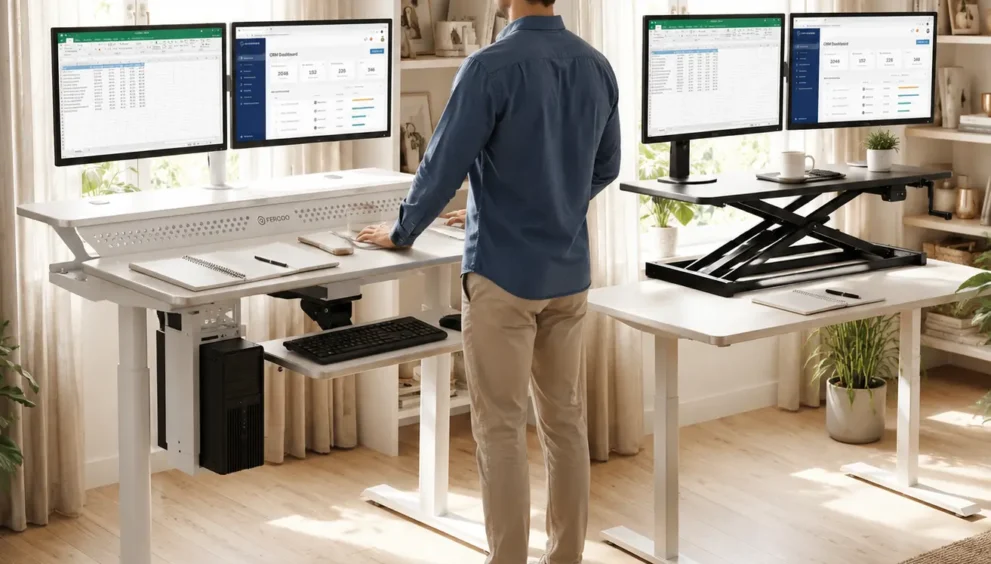
Electric vs Manual Riser Desk: Which One Should You Choose
Once you’ve decided that a riser desk fits your workspace better than a full standing desk, a second question follows quickly: should you choose an electric model or a manual one? If you’re still working out the basics on What Is a Riser Desk guide covers the fundamentals. This article, however, focuses specifically on the electric-versus-manual decision, since the lifting mechanism changes almost everything about how the desk feels to use day to day.
Table of Contents
- What Is an Electric Riser Desk?
- What Is a Manual Riser Desk?
- Electric vs Manual Riser Desk: Comparison Table
- Key Differences Explained
- Similarities Between Both Types
- Pros and Cons
- Which One Is Better for Different Users?
- Ergonomics and Comfort
- Cost Comparison
- Buying Guide
- Common Buying Mistakes
- Future Trends
- FAQ
- Final Verdict
What Is an Electric Riser Desk?
An electric riser desk uses a small motor to raise and lower the platform, so instead of pulling a lever or turning a crank, you simply press a button. Consequently, the transition between sitting and standing height takes only a few seconds and requires almost no physical effort.
Most electric riser desks include a control panel, and some offer programmable height presets that let you save your preferred sitting and standing positions. This is particularly useful if more than one person shares the same desk, since each user can switch to their own setting instantly rather than adjusting the height manually every time.
Because the motor handles the lifting, electric riser desks also tend to support somewhat heavier loads than their manual counterparts, though the difference varies by model. On the other hand, they require access to a power outlet, which can limit placement options in some rooms.
What Is a Manual Riser Desk?
A manual riser desk relies on a hand-operated mechanism instead of a motor. Two designs are most common: spring-assisted platforms, which use internal tension to make lifting easier, and crank-based systems, where you turn a handle to raise or lower the surface.
Since there’s no motor or wiring involved, manual riser desks are generally lighter, simpler, and less expensive. They also don’t depend on a nearby outlet, so you can place them anywhere on your desk without worrying about cable routing. The trade-off is effort — adjusting a manual riser desk takes a bit more physical work, and it typically offers a narrower height range than an electric model.
Electric vs Manual Riser Desk: Comparison Table
| Feature | Electric Riser Desk | Manual Riser Desk |
|---|---|---|
| Height adjustment | Motorized, push-button | Hand crank or spring-assisted |
| Ease of use | Very easy | Requires some physical effort |
| Speed | Fast, a few seconds | Slower, especially crank models |
| Noise level | Slight motor hum during adjustment | Silent |
| Stability | Generally higher | Moderate, depends on build quality |
| Weight capacity | Typically higher | Typically lower |
| Power requirement | Needs an outlet | None required |
| Maintenance | Occasional motor upkeep | Minimal |
| Portability | Heavier, less portable | Lighter, easier to move |
| Price | Higher upfront cost | Lower upfront cost |
| Best for | Frequent height changes, shared desks | Budget-conscious or occasional use |
Key Differences Explained
The most noticeable difference is effort. Because an electric riser desk adjusts at the push of a button, users are more likely to actually switch positions throughout the day. A manual model, by contrast, requires you to stop what you’re doing and physically crank or lift the platform, which can discourage frequent adjustments even when you intend to make them.
Noise is another factor worth considering. Electric motors typically produce a light hum while moving, which is rarely disruptive but may stand out in a very quiet room. Manual riser desks, since they have no motor, move silently.
Weight capacity also tends to favor electric models. Motorized lifting mechanisms are generally engineered to handle more weight, which matters if you’re running dual monitors or a heavier equipment setup. Manual riser desks can still support a monitor and keyboard comfortably, but they’re more likely to feel less stable once you add extra accessories.
Finally, there’s the matter of dependency. An electric riser desk needs a power source, so its placement is tied to where an outlet is available. A manual riser desk has no such requirement, which gives it an edge for anyone who wants complete flexibility in where the desk sits.
Similarities Between Both Types
Despite these differences, electric and manual riser desks share a fair amount in common:
- Both sit on top of an existing desk rather than replacing it
- Both allow you to switch between sitting and standing without buying new furniture
- Both are available in a range of sizes and platform depths
- Both can support a monitor, keyboard, and mouse for typical desk work
- Both require correct height and monitor positioning to deliver real ergonomic benefit
Pros and Cons
Electric Riser Desk
Pros
- Effortless, one-touch height adjustment
- Often includes memory presets for saved positions
- Generally higher weight capacity
- Encourages more frequent position changes
Cons
- Higher purchase price
- Requires a nearby power outlet
- Slightly heavier and less portable
- Motor may need occasional maintenance
Manual Riser Desk
Pros
- Lower cost
- No power source needed
- Lighter and easier to move
- Minimal maintenance over time
Cons
- Requires physical effort to adjust
- Slower transition between heights
- Typically lower weight capacity
- Narrower height range on many models
Which One Is Better for Different Users?
- Remote workers who switch positions often usually benefit more from an electric riser desk, since the ease of adjustment supports consistent use.
- Students and occasional users may find a manual riser desk perfectly adequate, particularly if the desk is adjusted only once or twice a day.
- Shared desks or multi-person households tend to favor electric models with memory presets, since each user can switch to their own height instantly.
- Budget-conscious buyers often start with a manual riser desk and upgrade later if they find themselves using it daily.
- Anyone working with dual monitors or heavier equipment should lean toward an electric model, given its typically higher weight capacity.
- Users in shared or quiet spaces, such as a bedroom or open living area, may prefer a manual riser desk for silent operation.
Ergonomics and Comfort
Regardless of which mechanism you choose, the ergonomic fundamentals stay the same. Your elbows should rest at roughly a 90-degree angle whether you’re sitting or standing, and the top third of your monitor should sit at eye level. Because an electric riser desk makes adjustment so easy, it can actually support better ergonomics in practice — you’re more likely to fine-tune the height throughout the day rather than settling for “close enough.”
That said, a manual riser desk can deliver the same posture benefits if you commit to adjusting it consistently. The mechanism matters less than the habit of alternating between sitting and standing and keeping your setup correctly aligned. Pairing either desk with an anti-fatigue mat also helps reduce strain on the knees and lower back during longer standing periods.
Cost Comparison
Manual riser desks are typically the more affordable option, since they don’t require a motor, control panel, or wiring. Electric riser desks cost more upfront, largely due to the added components, but many users find the convenience worthwhile if they plan to adjust the desk multiple times a day. Long-term costs are relatively similar for both types, since manual models rarely need repairs and electric models are generally reliable when built with quality components — though an electric desk does carry a small chance of eventual motor servicing.
Buying Guide
Before choosing between an electric and manual riser desk, consider the following:
- Adjustment frequency – how often do you realistically expect to switch heights each day?
- Budget – are you prioritizing lower upfront cost or long-term convenience?
- Power access – is there an outlet near where the desk will sit?
- Weight needs – how many monitors and accessories will the platform need to support?
- Noise sensitivity – will you be working in a quiet or shared space?
- Portability – do you need to move the desk between rooms or locations often?
- Warranty and build quality – particularly relevant for electric models, where the motor is the component most likely to need attention over time.
Common Buying Mistakes
- Choosing based on price alone without checking weight capacity
- Overlooking whether an outlet is available near the desk
- Assuming a manual model will be used as often as an electric one, then finding it inconvenient
- Ignoring monitor height and elbow angle after installing the platform
- Buying a larger, heavier electric model without measuring available desk space first
Future Trends
Riser desk technology continues to move toward smarter, more adaptive designs. Some newer electric models now include posture reminders or app-based tracking that nudges you to switch positions after extended periods in one posture. Manufacturers are also experimenting with more sustainable materials, including recycled aluminum platforms and lower-emission production methods, for buyers who weigh environmental impact alongside function. On the manual side, improved spring-assist systems are narrowing the effort gap, making manual riser desks noticeably easier to adjust than earlier crank-only designs.
FAQ
Are electric riser desks worth the extra money?
For people who adjust their desk multiple times a day, most find the convenience worth the added cost. For occasional use, a manual riser desk often covers the same needs for less.
Do manual riser desks last longer?
With fewer moving electronic parts, manual riser desks generally require less maintenance over time. Well-built electric models can last just as long, but they carry a slightly higher chance of eventually needing motor service.
Which desk is easier to maintain?
Manual riser desks are simpler overall, since there’s no motor or wiring to service. Electric models are usually low-maintenance too, but may occasionally need attention if the motor slows or the control panel malfunctions.
Can both support dual monitors?
Some can, but it depends on the specific model’s weight capacity. Electric riser desks tend to handle dual-monitor setups more comfortably than manual ones.
Which is quieter?
Manual riser desks are silent, since there’s no motor. Electric models typically produce a light hum during adjustment, which is rarely disruptive but noticeable in very quiet rooms.
Which option is best for home offices?
It depends on how often you plan to switch positions. Frequent, full-day use tends to favor an electric riser desk, while lighter or occasional use is often well served by a manual model.
Final Verdict
Neither option is universally better — the right choice depends on how often you’ll actually use it. An electric riser desk suits people who want effortless, frequent height changes and are willing to pay more for that convenience. A manual riser desk suits budget-conscious users, occasional standers, and anyone who wants a lighter, more portable setup without needing a power outlet. Match the mechanism to your daily habits, and either type can support a healthier, more comfortable workday.