

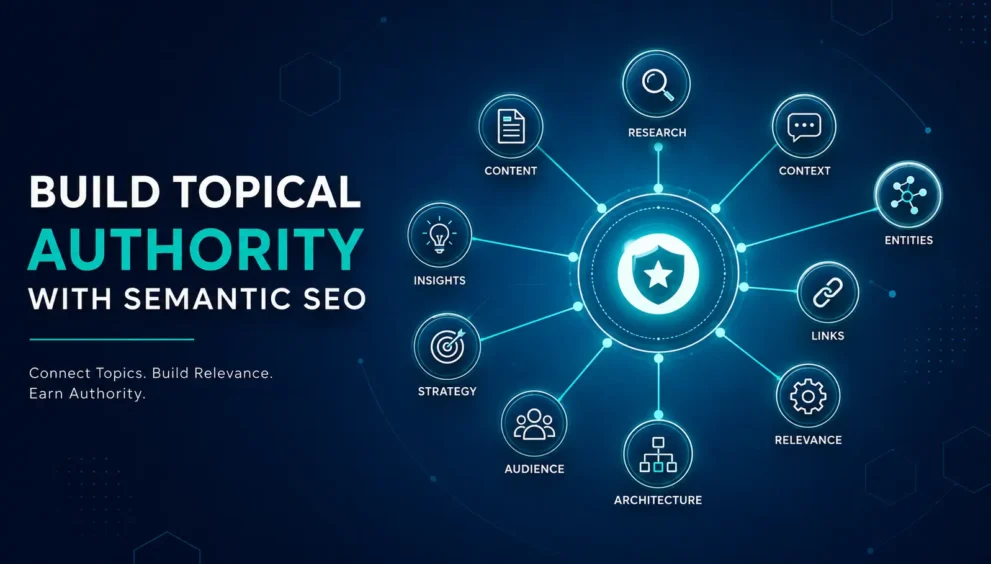
How to Build Topical Authority With Semantic SEO
Most sites publish one article per keyword and wonder why rankings stall. That approach ignores how Google actually reads content today. Modern search engines rank sites based on meaning, context, and coverage — not isolated phrases. This is where semantic keywords come in. They are the related terms, concepts, and entities that prove your content genuinely understands a topic, not just names it. If you want lasting visibility, you need to stop optimizing pages one at a time and start building topical authority through connected, semantically rich content.
This guide breaks down exactly how to do that, step by step — including how these related terms differ from longer, more specific search phrases you may already be targeting.
Table of Contents
- What Is Topical Authority, Really?
- Semantic SEO and Semantic Keywords Explained
- Why Google Rewards Topic Coverage Over Keyword Count
- Building a Topical Map Before You Write Anything
- Finding Semantic Keywords and Related Entities
- Structuring Pillar and Cluster Content
- Internal Linking That Signals Real Relationships
- A Step-by-Step Framework for Building Topical Authority
- Common Mistakes That Block Topical Authority
- How to Measure Topical Authority
- Semantic SEO in the Age of AI and Generative Search
- Conclusion: Build Topics, Not Just Pages
What Is Topical Authority, Really?
Topical authority is how completely your site covers one subject. It is not about how many pages you have published.
A site with 15 deeply connected articles on email marketing can outrank a site with 200 scattered posts. Depth wins over volume, consistently.
Google evaluates topical authority by looking at:
- How many angles of a subject you cover
- Whether your pages connect to each other logically
- If you address the follow-up questions a real expert would answer
- Whether your content stays accurate and current over time
Think of it like hiring a specialist versus a generalist. A specialist who has handled hundreds of similar cases earns trust faster. Google treats websites the same way.
Semantic SEO and Semantic Keywords Explained
Semantic SEO means optimizing for meaning and context, not exact phrases. It shifts your focus from matching search queries to understanding what searchers actually want.
Semantic keywords are the words, phrases, and entities that naturally surround your main topic. They are not synonyms. They are supporting concepts that prove depth.
For example, a page about “email marketing” should naturally include terms like:
- Open rates
- Segmentation
- Automation workflows
- Subscriber lists
- Deliverability
These terms are not filler. They signal that your content understands the full landscape of the topic, not just the headline phrase.
Semantic keywords connect to several layers of meaning:
| Layer | What It Represents |
|---|---|
| Main topic | The core subject your page targets |
| Related concepts | Supporting ideas that add context |
| Entities | Specific people, tools, or named things |
| Attributes | Qualities or features tied to the topic |
| Search intent | The underlying goal behind a query |
When you use semantic keywords naturally, you are not stuffing your content. You are answering the questions a knowledgeable reader would expect covered.
If you want a deeper breakdown of how these related terms work and why they matter, this complete guide to powerful SEO growth covers the concept in more detail.
Why Google Rewards Topic Coverage Over Keyword Count
Google’s algorithms moved past simple keyword matching years ago. Updates like Hummingbird, BERT, and MUM taught Google to interpret full queries, not fragments.
As a result, ranking today depends on demonstrated expertise. Google checks whether your page — and your site — covers a subject the way an expert would.
| Traditional Keyword SEO | Semantic SEO |
|---|---|
| Targets individual keywords | Targets full topics and intent |
| Repeats exact phrases | Uses related concepts naturally |
| One page per keyword | One cluster per subject |
| Measures keyword density | Measures topical completeness |
| Ranks in isolation | Ranks through cluster reinforcement |
This shift matters because it changes your entire content strategy. Instead of asking “what keyword should this page target,” ask “what topic does this page belong to.”
Building a Topical Map Before You Write Anything
A topical map is your blueprint. It lists every subtopic, question, and related concept inside your subject area before you write a single word.
Skipping this step is the most common reason topical authority efforts fail. Without a map, content gets published randomly, and gaps pile up unnoticed.
Here’s how to build one:
- Choose a broad core topic your site should own
- List every subtopic a genuine expert would know
- Group subtopics by user intent — informational, commercial, or transactional
- Identify which subtopics deserve a dedicated page
- Identify which subtopics fit better as a section inside a larger page
Not every related term needs its own page. Some belong as headings inside a broader article. Forcing separate pages for near-duplicate topics creates cannibalization instead of authority.
Finding Semantic Keywords and Related Entities
Once your topical map exists, the next step is filling it with the right terms. This is where semantic keyword research becomes essential.
Start with these methods:
- Analyze top-ranking pages for your target topic and note recurring terms
- Check “People Also Ask” boxes for real user questions
- Use entity recognition tools to identify people, brands, and concepts tied to your subject
- Review autocomplete suggestions for natural query variations
- Study competitor content gaps to find what they missed
Look for patterns across multiple top-ranking pages, not just one. If ten competing articles about “content marketing strategy” all mention “editorial calendar” and “audience persona,” your page needs those terms too.
Missing common entities signals incompleteness. Google’s natural language processing checks for these gaps automatically, even when your writing quality is strong.
Structuring Pillar and Cluster Content
Topic clusters give your semantic keywords somewhere structured to live. Without this architecture, even great content stays isolated and weak.
A cluster has three parts:
- Pillar page — a broad, comprehensive overview of the main topic
- Cluster pages — focused articles that go deep on individual subtopics
- Internal links — connections that tie the pillar and clusters together
| Component | Purpose | Typical Length |
|---|---|---|
| Pillar page | Broad topic overview | 2,000–3,000 words |
| Cluster page | Deep dive on one subtopic | 1,200–2,000 words |
| Supporting page | FAQs and long-tail coverage | 600–1,200 words |
Each cluster page should link back to the pillar. The pillar should link out to every cluster page it supports. This bidirectional structure is what search engines use to understand your topical scope.
Avoid publishing cluster pages before the pillar exists. Without a pillar, cluster pages have no anchor to reinforce, and the cluster signal weakens.
Internal Linking That Signals Real Relationships
Internal linking is not decoration. It is how you explicitly tell search engines which pages relate to each other.
Weak internal linking uses generic anchor text like “click here” or “read more.” Strong internal linking uses descriptive phrases that match the destination page’s topic.
Compare these two approaches:
| Weak Internal Linking | Strong Internal Linking |
|---|---|
| “Click here for more info” | “Learn how to build a topical map” |
| Random, afterthought placement | Planned before publishing |
| Only pillar-to-cluster direction | Cluster pages link to each other too |
| Inconsistent anchor phrasing | Anchor text matches destination topic |
A practical rule: every cluster page should link back to its pillar within the first 200 words. This reinforces the relationship early, both for readers and crawlers.
Also link related cluster pages to each other where topics naturally intersect. This creates a dense web that strengthens the entire subject area, not just one page.
A Step-by-Step Framework for Building Topical Authority
Use this sequence when starting a new topic cluster or auditing an existing one.
- Choose a broad core topic your business genuinely has expertise in
- Define your audience and their intent at each stage of their search journey
- Build a topical map covering every relevant subtopic
- Identify semantic keywords through competitor and SERP research
- Identify related entities your content should mention
- Group related queries by intent and funnel stage
- Create the pillar page first, covering the topic broadly
- Develop supporting cluster content for each major subtopic
- Connect pages through contextual internal links
- Cover subtopics completely rather than superficially
- Identify content gaps competitors have missed
- Update outdated pages regularly to maintain accuracy
- Measure performance across the full cluster, not single pages
- Expand the cluster as new questions and subtopics emerge
This is not a one-time project. Topical authority compounds over months as each new piece strengthens the pages around it.
Common Mistakes That Block Topical Authority
Most failures come from structural decisions, not bad writing. Watch for these patterns.
- Publishing without a cluster plan. Standalone articles never reinforce each other, so authority never compounds.
- Confusing word count with depth. A focused 1,200-word article can outperform a repetitive 4,000-word one.
- Treating semantic keywords as synonyms. Stuffing synonyms is not the same as covering related concepts.
- Ignoring internal linking until the end. Links added as an afterthought rarely connect the right pages meaningfully.
- Targeting the same query with multiple pages. This causes cannibalization instead of authority.
- Never updating old content. Topical authority decays if a cluster isn’t reviewed and refreshed.
Here’s the difference in outcome between weak and strong execution:
| Weak Topical Authority | Strong Topical Authority |
|---|---|
| Scattered, unrelated articles | Interconnected topic clusters |
| Keyword-focused pages | Intent and entity-focused pages |
| No internal linking plan | Deliberate, bidirectional linking |
| Rarely updated | Reviewed and refreshed quarterly |
| Ranks for one phrase | Ranks for dozens of related queries |
How to Measure Topical Authority
You cannot improve what you don’t track. Topical authority isn’t a single number, but several signals combined show whether it’s working.
Track these metrics at the cluster level, not just per page:
- Keyword rankings across the cluster — not just your primary target term
- Organic traffic growth for the whole topic, month over month
- Average position across all related queries
- Internal click-through from cluster pages to the pillar
- Engagement signals like time on page and scroll depth
- New queries you rank for that you never directly targeted
Use Google Search Console to check which cluster keywords sit between positions 11 and 20. These are your fastest wins — small updates can push them into the top 10.
If a keyword that was ranking well starts slipping, that’s your signal to refresh the page. Add current data, strengthen internal links, and address any new questions users are asking.
Beyond rankings and traffic, it also helps to check how well a page’s content scores against top competitors. This guide to content scoring methods explains how to evaluate whether a page is genuinely comprehensive or just long.
Semantic SEO in the Age of AI and Generative Search
AI-powered search changes how content gets discovered, but it does not remove the need for topical depth. If anything, it increases it.
Large language models and AI Overviews pull from content that demonstrates clear entity relationships and complete topic coverage. They favor sources that read as genuinely comprehensive.
A few practical realities to plan around:
- Users increasingly ask full questions instead of short keyword fragments
- AI-generated answers can resolve simple, surface-level questions instantly
- Websites need to offer deeper, more specific value beyond the basic answer
- Strong semantic structure helps content remain understandable to both users and machines
- Clusters with consistent internal linking are easier for AI systems to parse and cite
This does not mean stuffing content with keywords to “trick” an algorithm. It means genuinely building the kind of resource an AI system — or a human expert — would trust as a reference.
There is no guaranteed method to appear inside every AI answer. But content with real topical completeness consistently performs better across both traditional search and generative search experiences, because both systems are evaluating the same underlying signal: does this source actually understand the subject?
Conclusion: Build Topics, Not Just Pages
Building topical authority is a shift in mindset before it’s a shift in tactics. Stop asking which keyword to target next. Start asking which topic your site should own completely.
The path forward is straightforward, even if the execution takes patience:
- Think in topics, not isolated keywords
- Understand the intent behind every query you target
- Build connected pillar and cluster content
- Use semantic keywords naturally, never forced
- Connect entities and concepts across your content
- Strengthen internal linking deliberately
- Answer the real questions your audience is asking
- Keep expanding and updating your topical ecosystem over time
Sites that follow this approach don’t just rank for one phrase. They become the trusted source for an entire subject — and that kind of authority holds up through algorithm updates, AI search shifts, and everything search engines throw at content next.
Start with one topic. Map it completely. Build outward from there.
A Quick Real-World Example
Imagine a site targeting “project management software” with one standalone article. It ranks decently for that single phrase, then plateaus.
Now compare that to a competitor building a full cluster around the same core topic:
- A pillar page covering project management software broadly
- A cluster page comparing agile versus waterfall methodologies
- A cluster page on team collaboration features
- A cluster page on integrations with time-tracking tools
- A cluster page on pricing models for small teams
Each cluster page links back to the pillar. The pillar links out to every cluster page, using descriptive anchor text that matches each destination topic.
Within a few months, this second site typically ranks not just for “project management software,” but for dozens of related searches it never directly targeted. That is the compounding effect of topical authority in action — each new piece reinforces the ones around it, and the whole cluster becomes harder for competitors to displace.
This is also why isolated, high-quality articles often underperform expectations. A single excellent page has to earn its authority entirely on its own. A page inside a well-built cluster inherits context, trust, and relevance from every connected page around it.