

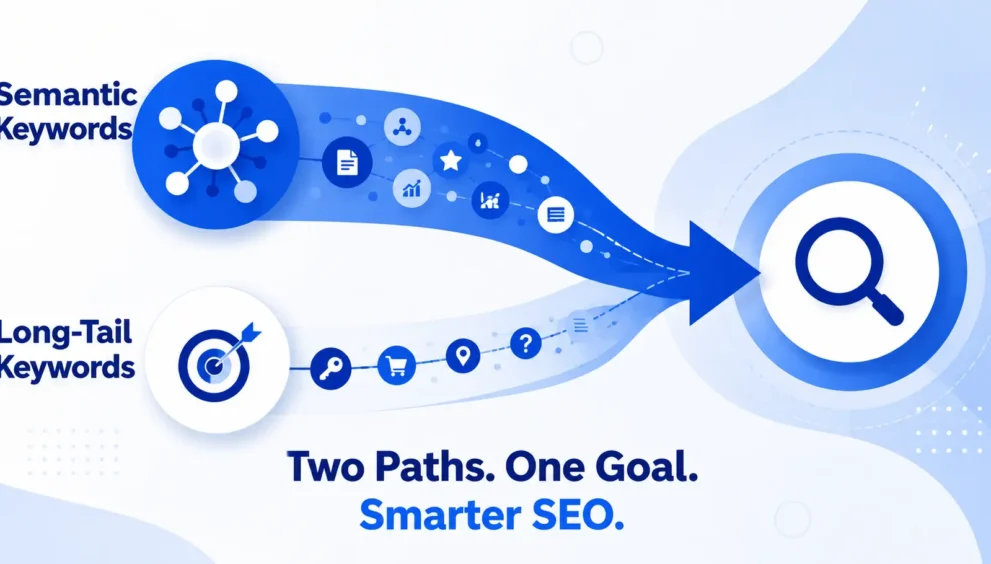
Semantic vs Long-Tail Keywords: The Essential Differences
Confuse these two terms, and you’ll chase the wrong metric for months. Semantic keywords and long-tail keywords solve completely different problems in an SEO strategy, and mixing them up produces content that’s either too broad to rank or too narrow to matter. Understanding semantic keywords as a distinct concept is the first step toward using both correctly.
Table of Contents
- What Are Semantic Keywords?
- What Are Long-Tail Keywords?
- How to Find Each Type
- The Core Differences
- Where the Two Actually Overlap
- Practical Examples Side by Side
- When to Use Each
- How to Use Them Together
- Common Mistakes to Avoid
- Google’s Algorithm Timeline
- Quick FAQ
- Conclusion
What Are Semantic Keywords?
Semantic keywords are words and phrases that relate conceptually to a topic, without needing to contain the target phrase at all. They’re often confused with the outdated idea of LSI keywords, but the two concepts aren’t the same thing.
- Not synonyms — they’re words that naturally cluster around a topic.
- Don’t need to include the seed keyword anywhere in the phrase.
- Signal topical depth rather than targeting a specific search query.
- Example set for “content marketing”: “editorial calendar,” “audience engagement,” “content distribution.”
- Prove a page understands the ecosystem around a subject, not just the phrase itself.
- Help search engines judge whether content is comprehensive or repetitive.
- Emerge naturally when a writer genuinely understands the topic being covered.
- Don’t require keyword research tools to identify — expert vocabulary usually does the job.
- Work best spread throughout a page rather than clustered in one paragraph.
What Are Long-Tail Keywords?
Long-tail keywords are longer, specific search phrases that reflect a clear, narrow searcher intent.
- Typically three or more words in length.
- Reflect an exact, real search query someone actually types.
- Example: “best content marketing tools for startups” instead of “content marketing.”
- Carry lower search volume than broad keywords.
- Face far less competition than shorter, broader terms.
- Convert at a higher rate, since intent is already specific.
- Function as a destination — a precise answer to a precise question.
- Work well for niche pages, blog posts, and product-specific landing pages.
- Get easier to rank for as a site’s overall authority grows.
How to Find Each Type
- For long-tail keywords: use keyword research tools that report volume and competition data.
- Check Google’s autocomplete suggestions while typing a broad seed keyword.
- Scroll to “Related searches” at the bottom of any results page.
- For semantic keywords: read the top-ranking competitor pages for recurring vocabulary.
- Note which terms Google bolds in search snippets and meta descriptions.
- Ask what a genuine expert would naturally mention when explaining the topic.
The Core Differences
| Factor | Semantic Keywords | Long-Tail Keywords |
|---|---|---|
| Purpose | Adds contextual depth around a topic | Targets one specific search query |
| Length | Single word or short phrase | Usually three or more words |
| Contains main keyword | Not required | Usually yes |
| Search volume | Not searched directly | Measurable, though typically low |
| Where used | Woven through body copy | Titles, headings, URLs |
| What it signals | Genuine topical understanding | Precise user intent |
Additional distinctions worth noting:
- Semantic keywords aren’t things people search for directly.
- Long-tail keywords are, by definition, real search queries.
- Semantic depth measures breadth of coverage across a topic.
- Long-tail targeting measures precision toward one specific need.
- You optimize for a long-tail keyword, but around semantic keywords.
- Long-tail research relies on volume and competition data from keyword tools.
- Semantic research relies on autocomplete, related searches, and competitor analysis instead.
Where the Two Actually Overlap
These categories aren’t mutually exclusive, and treating them as rivals misses the point.
- A long-tail keyword can carry genuine semantic weight at the same time.
- “Best content marketing tools for startups” is long-tail and semantically tied to content marketing.
- A page built around a long-tail keyword still needs semantic support to rank.
- Targeting a long-tail phrase alone, without context, produces thin, easily outranked content.
- Long-tail keywords tell you what to write about.
- Semantic keywords tell you how completely you covered it.
- A single sentence can even do both jobs at once, naturally.
- The overlap grows stronger as a topic gets more specific and technical.
Practical Examples Side by Side
- Running shoes — Long-tail: “best running shoes for flat feet women.” Semantic: “arch support,” “pronation,” “cushioning,” “trail vs road.”
- Remote work — Long-tail: “how to stay productive working from home with kids.” Semantic: “time blocking,” “async communication,” “deep work.”
- Healthy breakfast — Long-tail: “quick high-protein breakfast for busy mornings.” Semantic: “meal prep,” “blood sugar balance,” “protein intake.”
- SEO tools — Long-tail: “free SEO tools for small business owners.” Semantic: “keyword difficulty,” “backlink profile,” “site audit,” “SERP tracking.”
- Coffee brewing — Long-tail: “best coffee maker for small apartments.” Semantic: “grind size,” “extraction time,” “water temperature,” “bloom stage.”
- Home gym — Long-tail: “cheap home gym setup for beginners.” Semantic: “resistance bands,” “progressive overload,” “compound movements,” “workout split.”
Strip the long-tail phrase from any example above, and the semantic terms alone still clearly signal the topic.
When to Use Each
- Use a long-tail keyword to decide what a page should target directly.
- Place it in the title, H1, and opening paragraph as the anchor.
- Use semantic keywords once you’re actually writing the body content.
- Weave them into subheadings, body paragraphs, alt text, and FAQ sections.
- Long-tail keywords decide the destination; semantic keywords make the trip feel thorough.
- Lean on long-tail targeting when launching a new page with no existing authority.
- Lean on semantic depth when strengthening an older page that already ranks decently.
How to Use Them Together
- Start with a long-tail keyword that reflects real, specific search demand.
- Build the page’s structure and headings around answering that exact question.
- Fill the body with semantic keywords that reflect genuine topic depth.
- Avoid stuffing either type in artificially — cut a term if it doesn’t fit.
- A page can then rank for its exact target and dozens of related queries.
- Revisit and refresh both keyword layers periodically as the topic evolves over time.
Worked example: a page targeting “best running shoes for flat feet women” as its anchor:
- Title, H1, and opening paragraph point directly at the long-tail phrase.
- The body naturally works through arch support, pronation, and cushioning types.
- None of those semantic terms were the reason the page got built.
- They’re what convinces a search engine the page beats a thinner competitor.
Common Mistakes to Avoid
- Treating semantic keywords as a checklist to exhaust, not a vocabulary bank.
- Targeting a long-tail keyword so narrowly the page lacks broader credibility.
- Assuming semantic richness alone ranks a page without a specific search intent.
- Copying a competitor’s related-terms list instead of writing from real understanding.
- Believing the two concepts compete, when they solve different halves of one problem.
- Forcing an unnatural term into a sentence just because a tool suggested it.
For a broader look at how semantic vocabulary supports topical authority across a full content cluster, this semantic keyword strategy guide covers how to find and place that vocabulary at scale.
Google’s Algorithm Timeline: When the Shift Happened
- 2013 — Hummingbird: Google moved from matching individual keywords to interpreting the meaning of a full query. This is the update that started phasing out reliance on exact-match phrasing.
- 2015 — RankBrain: Machine learning entered ranking directly, helping Google interpret queries it had never seen before by relating them to familiar ones.
- 2018 — Neural Matching: Google began connecting concepts in a query to concepts on a page, even without shared keywords.
- 2019 — BERT, and the LSI denial: Google’s transformer model deepened sentence-level context understanding. That same year, John Mueller publicly confirmed Google has never used LSI at all.
- 2021 — MUM: Extended semantic understanding across languages and content formats, reinforcing that context now outweighs literal phrasing.
- Present day: Semantic signals, entities, and intent are what Google recognizes. LSI was never adopted at any point in this timeline.
Quick FAQ
- Can a keyword be both semantic and long-tail? Yes. A phrase can be specific enough to count as long-tail while still sitting inside a broader semantic field. The two labels describe different qualities of the same keyword, not separate categories.
- Do semantic keywords need to appear word-for-word? No. What matters is the underlying concept, not exact phrasing. Google’s semantic systems recognize related terms and ideas even when the wording differs from a seed keyword.
- Should every page target a long-tail keyword? Not strictly, but most ranking pages benefit from one clear anchor. Without a specific target, a page risks feeling unfocused and harder for search engines to match to any single query.
- How many semantic keywords does a page need? There’s no fixed number to hit. Add a term only where it fits the sentence naturally, and let genuine topic knowledge determine the final count rather than a checklist.
Conclusion
Semantic keywords and long-tail keywords aren’t competing strategies — they answer two different questions. Long-tail keywords tell a search engine exactly which query a page targets. Semantic keywords tell it whether the content understands the topic surrounding that query. The strongest approach uses both: a long-tail keyword to anchor the page’s purpose, and genuine semantic keywords to prove the content delivers on it completely.