

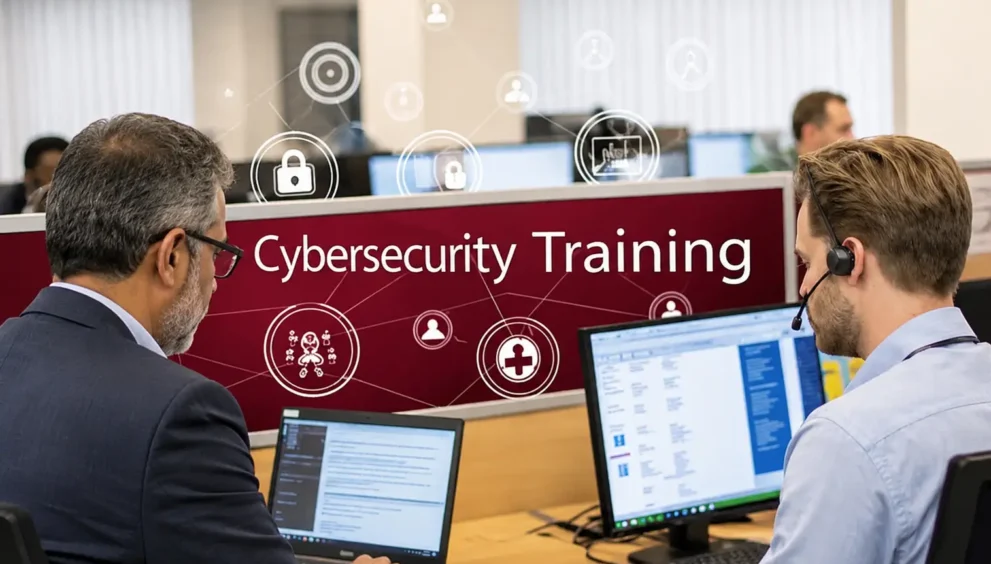
IT Business Solutions Makes Cybersecurity Training Simple
Cybersecurity training has a reputation problem. Most employees picture a dull, hour-long video, a quiz nobody remembers, and a certificate that gathers digital dust until next year’s mandatory refresh. However, that outdated approach is exactly why so many small and medium-sized businesses still get caught off guard by a single phishing email. The good news is that this is changing fast. With the right IT business solutions in place, cybersecurity training stops being a once-a-year chore and becomes a simple, ongoing habit that actually protects your business.
In this guide, we’ll walk through why training matters more than ever, what actually makes it effective, and how modern IT business solutions are quietly transforming a boring compliance task into something your team might genuinely find useful.
Why Cybersecurity Training Can No Longer Be an Afterthought
Cyber risk isn’t a future problem — it’s already here, and it’s growing faster for smaller organizations than for large enterprises. Recent UK government research found that nearly half of all businesses identified a security breach or attack within the past year. Meanwhile, separate industry studies suggest the vast majority of small and medium-sized businesses have already experienced at least one cyberattack.
Here’s the part that surprises most business owners: smaller companies often face proportionally more social engineering attempts than large enterprises do. That’s because attackers know smaller teams typically have fewer technical defenses and less formal training in place, which makes them an easier target rather than a safer one.
On top of that, human error consistently shows up as a leading cause of data breaches across multiple independent studies. In other words, firewalls and antivirus software can only do so much. Eventually, someone on your team clicks a link, and what happens next depends entirely on whether they were trained to recognize the warning signs.
Busting the Myths That Keep Businesses Unprepared
Before diving into solutions, it helps to clear up a few misconceptions that quietly keep businesses vulnerable.
“We’re too small to be a target.” In reality, attackers don’t discriminate based on company size. Smaller businesses often hold valuable customer data, financial records, and access to larger supply-chain partners, which makes them attractive stepping stones for bigger attacks.
“This is an IT problem, not a company-wide one.” Technical tools matter, but cybersecurity is fundamentally a people issue. Treating it as solely IT’s responsibility often creates a false sense of security, since staff assumes someone else has it covered.
“One training session a year is enough.” Unfortunately, people forget the majority of what they learn within days. Annual, one-off sessions check a compliance box, but they rarely change day-to-day behavior.
What Actually Makes Cybersecurity Training Work
Effective training isn’t about cramming more information into employees’ heads. Instead, it’s about building habits that stick. A few principles consistently separate training that works from training that gets ignored.
Keep Sessions Short and Focused
Long, technical modules overwhelm people and rarely improve retention. Short, five-to-ten-minute lessons that focus on one specific risk tend to land far better than a sprawling hour-long course.
Make It Continuous, Not Annual
Since people forget quickly, ongoing reinforcement matters more than a single big event. Monthly or even weekly micro-lessons, paired with occasional refreshers, keep security top of mind without becoming exhausting.
Use Real-World Phishing Simulations
Reading about phishing and actually almost falling for a realistic simulated attempt are two very different learning experiences. Simulated phishing emails let employees practice spotting red flags in a safe environment, which builds far stronger instincts than a slideshow ever could.
Personalize Training by Role
A finance employee handling wire transfers faces different risks than someone in customer support. Tailoring content by role makes training feel relevant instead of generic, which significantly improves engagement.
Measure Results and Adjust
Tracking completion rates, simulation results, and reporting behavior over time reveals exactly where your team still struggles. Without measurement, training becomes guesswork.
How IT Business Solutions Simplifies Cybersecurity Training
This is where things get genuinely useful. Rather than treating cybersecurity training as a separate, bolted-on task, modern IT business solutions weave it directly into the tools your team already uses every day.
Built-In Security Awareness Platforms
Instead of juggling a separate training portal, integrated IT business solutions often embed short lessons directly inside everyday communication tools like Microsoft Teams or Slack. Employees complete training where they already work, which removes friction and dramatically improves completion rates.
AI-Powered Threat Simulation
AI has changed the phishing landscape, and not for the better. Deepfake audio and video scams have exploded in recent years, making convincing fraud attempts easier to produce than ever. On the defensive side, though, AI-powered platforms can now generate highly realistic, personalized phishing simulations automatically, adapting difficulty based on how each employee performs.
Centralized Reporting and Compliance Tracking
Rather than manually tracking spreadsheets of who completed what training, centralized IT business solutions consolidate everything into one dashboard. This makes it far easier to demonstrate compliance to regulators, partners, or cyber insurance providers when they ask for proof.
Just-in-Time Support
Employees don’t always remember what they learned six months ago. A well-integrated IT business solution can answer quick, practical questions on demand — such as password requirements or approved software — pulling directly from your existing training content and policies.
Traditional Training vs. IT Business Solutions-Led Training
| Factor | Traditional Training | IT Business Solutions-Led Training |
|---|---|---|
| Format | Annual, long-form sessions | Short, continuous micro-lessons |
| Delivery | Separate learning portal | Embedded in daily tools (Teams, Slack) |
| Phishing Practice | Occasional, generic simulations | AI-personalized, adaptive simulations |
| Tracking | Manual spreadsheets | Centralized real-time dashboards |
| Support | Limited to training period | Just-in-time answers year-round |
| Relevance | One-size-fits-all | Tailored by employee role |
Where Cybersecurity Training Is Headed Next
Training methods are evolving quickly, and businesses that stay ahead of these shifts will have a real advantage.
- AI-generated threats will keep escalating. As deepfake technology becomes more accessible, training will need to cover voice and video impersonation, not just text-based phishing.
- Zero-trust culture will extend beyond IT policy. Employees will increasingly need to understand why verification matters at every step, not just click permissions.
- Microlearning will become the default, replacing lengthy annual courses with bite-sized, continuously updated lessons.
- Gamification will drive engagement further, using leaderboards and progress tracking to make security awareness feel less like a chore.
- Integrated IT platforms will absorb training entirely, so that security awareness becomes a built-in feature of daily business tools rather than a separate system employees have to remember to use.
Common Mistakes Businesses Make With Cybersecurity Training
Even well-intentioned training programs often stumble on a few avoidable mistakes:
- Treating training as a once-a-year checkbox instead of an ongoing habit.
- Using fear-based messaging that discourages employees from reporting mistakes.
- Delivering generic content that ignores role-specific risks.
- Skipping simulations, so employees never practice real-world scenarios.
- Failing to measure results, which makes it impossible to know what’s actually working.
A Simple Checklist to Get Started
- [ ] Assess your team’s current cybersecurity awareness level.
- [ ] Choose a training format that fits into daily workflows.
- [ ] Schedule short, recurring lessons instead of one annual session.
- [ ] Add realistic phishing simulations to test real behavior.
- [ ] Track completion rates and simulation results over time.
- [ ] Get visible buy-in from leadership to reinforce the culture.
Frequently Asked Questions
How long should cybersecurity training take?
Short sessions of five to ten minutes, delivered regularly, tend to work better than long annual courses, since they’re easier to complete and easier to remember.
What’s the difference between compliance training and awareness training?
Compliance training satisfies a regulatory requirement, while awareness training actively changes day-to-day employee behavior. The best programs accomplish both at once.
Who should deliver cybersecurity training?
While IT often manages the technical setup, training itself works best when it involves leadership support and role-specific content rather than being treated as purely an IT initiative.
How do I know if my training program is outdated?
If your content hasn’t been updated to address AI-driven scams, deepfake impersonation, or remote work risks within the past year, it’s likely falling behind current threats.
Final Thoughts
Cybersecurity training doesn’t have to feel like a burden, and it definitely doesn’t have to be boring. When businesses shift from a once-a-year checkbox exercise to an ongoing, integrated habit, the results speak for themselves — fewer successful phishing attempts, faster incident reporting, and a workforce that actually feels confident handling suspicious messages.
That’s precisely where modern IT business solutions make the biggest difference: by embedding training directly into daily tools, personalizing it by role, and using AI to keep pace with constantly evolving threats. In the end, the businesses that treat cybersecurity training as a continuous habit, rather than an annual formality, are the ones best positioned to stay protected.