

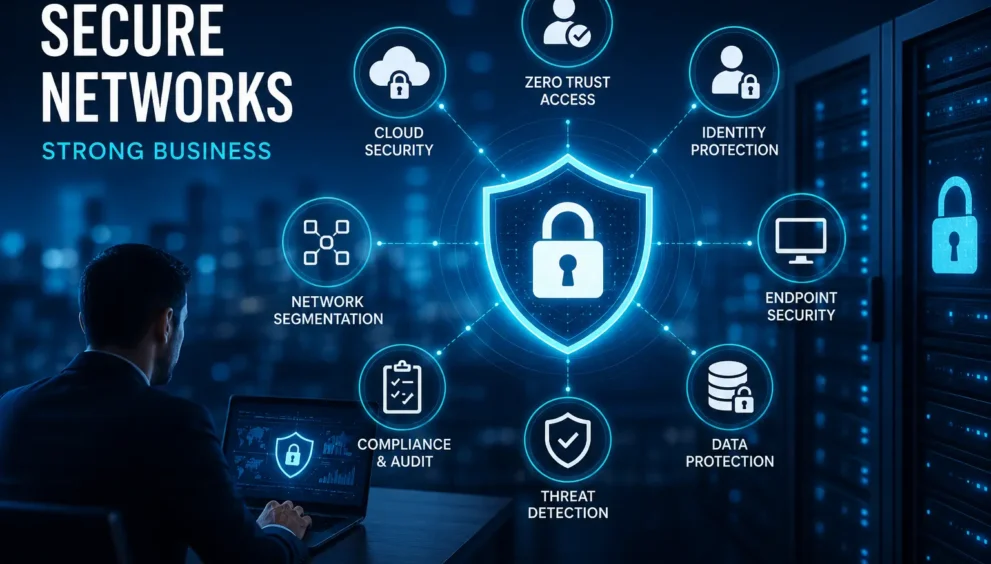
Why IT Business Solutions for Network Security Have Become a Boardroom Priority
Network security used to be an IT department’s problem. In 2026, it’s a business survival issue. Every invoice, customer record, and internal conversation now travels across a network, which means every network gap is a business gap. Cloud platforms, remote teams, and connected devices have multiplied the number of doors into a company’s systems, and attackers only need one left unlocked.
This is why strong IT business solutions for network security have moved from the server room to the boardroom — the organizations treating them as a strategic investment, not a line-item expense, are the ones staying ahead of a threat landscape that keeps getting faster and more automated.
Want me to swap this into the article file and update the download, or keep it here for you to place manually?
The Real Challenges Businesses Are Fighting Right Now
Before choosing a solution, it helps to understand what’s actually working against you.
- Escalating cyber threats — Ransomware groups now steal data before encrypting it, keeping leverage even when backups exist.
- Hybrid and remote work — Employees connecting from home networks and personal devices erase the old idea of a single, defendable perimeter.
- Cloud misconfigurations — One overlooked permission on a cloud storage bucket can expose years of sensitive files to the public internet.
- Insider risk — Not every threat is malicious; a distracted employee clicking the wrong link causes as much damage as a determined hacker.
- AI-assisted attacks — Criminals now use generative AI to write convincing phishing emails and probe for weaknesses faster than ever.
- Third-party exposure — Vendors and contractors with lingering system access are a frequent, often forgotten, entry point.
- Compliance pressure — Regulations like GDPR mean a breach isn’t just costly — it can trigger legal penalties too.
These challenges rarely show up one at a time. A single phishing email can lead to stolen credentials, lateral movement across a poorly segmented network, and a ransomware payload — all within hours.
IT Business Solutions That Actually Solve These Problems
Mature, proven technologies exist to counter each of the risks above.
- Zero Trust Security verifies every user and device on every request, instead of assuming anyone inside the network is automatically safe.
- Identity and Access Management (IAM) ensures people only have access to what their role requires — nothing more.
- Multi-Factor Authentication (MFA) stops the vast majority of credential-based break-ins, even when a password is compromised.
- Endpoint Detection and Response (EDR) watches devices for suspicious behavior and can isolate one before an infection spreads.
- Security Information and Event Management (SIEM) pulls together logs from firewalls, endpoints, and cloud systems so teams spot patterns a single tool would miss.
- Managed Security Service Providers (MSSPs) give businesses without a full internal security team round-the-clock monitoring and expert response.
- AI-powered threat detection flags unusual behavior — like a login from an impossible location — far faster than manual review.
- Cloud security platforms close the configuration gaps that come with fast-moving cloud adoption.
- Network segmentation limits how far an attacker can move once inside, containing damage instead of letting it spread.
- Secure, tested backups following the 3-2-1 rule (three copies, two media types, one offsite) turn ransomware from catastrophe into inconvenience.
- Disaster recovery planning defines exactly how the business gets back online, and how fast, after an incident.
- Security awareness training addresses the one vulnerability no software can patch: human error.
None of these tools work in isolation. Businesses with the strongest security postures layer them together, so a failure in one control gets caught by another.
2026 Trends Reshaping How Businesses Defend Their Networks
AI-driven cybersecurity and automated response are moving from experimental to standard, detecting and containing threats in seconds without waiting for a human analyst.
Zero Trust is becoming the default architecture, not an advanced option for large enterprises. With remote work permanent, “trust but verify” no longer holds up — every request needs proof.
Secure Access Service Edge (SASE) consolidates networking and security into a single cloud-delivered service, simplifying protection for distributed teams.
Extended Detection and Response (XDR) goes beyond endpoints, correlating signals across email, cloud, identity, and network layers for a fuller picture of an attack.
Identity-first security treats a user’s identity, not their network location, as the true perimeter — critical now that “the office” is wherever someone opens a laptop.
Compliance automation reduces the manual burden of audits, using continuous monitoring tools that generate real-time compliance evidence instead of a stressful annual scramble.
Predictive threat intelligence helps teams anticipate attack patterns from global data, shifting security from reactive to preventive.
Together, these trends point to one theme: security that runs continuously in the background instead of being bolted on after something breaks.
Choosing the Right Solution for Your Business
There’s no universal answer. Weigh these factors carefully:
- Business size and complexity — A five-person team and a five-hundred-person enterprise need very different scales of protection.
- Budget realities — Prioritize the controls that reduce your highest-impact risks first.
- Existing infrastructure — New tools should integrate with what you already run, not force a costly rebuild.
- Scalability — Choose solutions that can grow with you as hiring or cloud adoption increases.
- Compliance obligations — Regulated industries like finance and healthcare need solutions built with audits in mind.
- Vendor reputation and support — A tool is only as good as the support behind it when something breaks at 2 a.m.
- Integration capability — Disconnected tools create blind spots; look for platforms that share data with each other.
- Return on investment — Weigh the solution’s cost against the average cost of a breach in your industry — it’s rarely a close call.
Best Practices for Long-Term Protection
Technology alone isn’t enough. Long-term resilience depends on consistent habits:
- Run continuous monitoring instead of periodic checks
- Patch and update systems on a predictable schedule
- Conduct secure cloud migration risk assessments and penetration tests
- Refresh employee security training at least quarterly
- Test backups regularly, not just create them
Review third-party and vendor access regularly
- Document and rehearse an incident response plan before you need it
Conclusion: Security Is Now a Growth Strategy, Not Just a Safeguard
Network security in 2026 isn’t about building a wall and hoping it holds. It’s about designing systems that expect a breach attempt and are built to contain it quickly, recover quickly, and keep the business running regardless. Companies that invest in layered, well-integrated IT security solutions aren’t just avoiding losses — they’re building the trust and stability that let them compete confidently in a connected economy. The businesses that lead their industries over the next decade will be the ones treating security not as a cost center, but as the foundation their entire digital strategy stands on.