
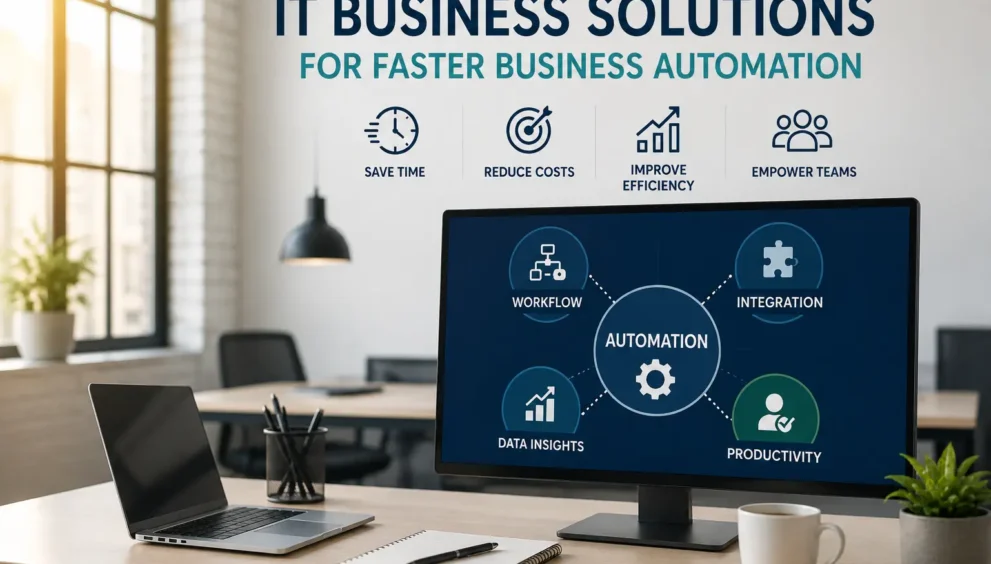
IT Business Solutions for Faster Business Automation
Modern businesses operate in an environment where speed, accuracy, and adaptability determine long-term success. Manual workflows, disconnected systems, and repetitive administrative tasks often slow down operations, reduce productivity, and limit business growth. As customer expectations continue to rise, organizations can no longer depend on traditional processes to remain competitive.
This is where IT business solutions become essential. Rather than simply replacing manual work with software, modern IT solutions create intelligent, connected business environments where processes flow smoothly across departments.
They help organizations automate routine activities, improve collaboration, reduce operational costs, and make faster business decisions without compromising quality. Businesses that also prioritize secure remote work solutions can extend these automation benefits to distributed teams while maintaining productivity and data protection.
Business automation is no longer reserved for large enterprises with extensive IT resources. Today, companies of every size can adopt scalable technologies that streamline operations while preparing for future digital transformation. Instead of adding complexity, the right automation strategy simplifies daily work and allows employees to focus on higher-value responsibilities that contribute directly to business growth.
Why Business Automation Has Become a Business Priority
Every growing organization eventually reaches a point where manual processes become difficult to manage. Employees spend valuable hours entering the same information into multiple systems, approving repetitive requests, searching for documents, or following up through emails. Although these tasks appear small individually, they consume significant time across an entire organization.
As businesses expand, these inefficiencies become even more noticeable. Delayed approvals, inconsistent reporting, communication gaps, and human errors begin affecting productivity as well as customer satisfaction.
Business automation addresses these challenges by creating standardized workflows that operate consistently every day. Instead of relying on manual coordination, automated systems move information between departments, notify responsible teams, generate reports, and complete repetitive actions without unnecessary delays.
Some of the most common operational challenges include:
- Repetitive manual data entry
- Slow approval processes
- Disconnected business applications
- Inconsistent customer experiences
- Limited visibility into ongoing operations
- Higher operational costs
- Increased risk of human error
- Difficulty scaling business processes
Rather than solving these issues individually, automation creates a connected ecosystem where information flows naturally across the business.
How IT Business Solutions Drive Faster Business Automation
Successful automation is never about replacing people. It is about removing repetitive work that prevents employees from contributing their expertise where it matters most.
Modern IT business solutions combine cloud technology, workflow automation, artificial intelligence, data integration, and secure collaboration tools into one connected infrastructure. As a result, departments communicate more efficiently while routine operations continue without constant manual intervention.
For example, when a customer submits an inquiry, automation can instantly assign the request to the appropriate department, notify responsible employees, update the CRM system, generate documentation, and monitor response times simultaneously. What previously required several manual steps now happens within seconds.
Instead of creating isolated improvements, integrated automation improves the entire operational cycle.
Key areas where automation delivers immediate value include:
- Customer relationship management
- Finance and accounting workflows
- Human resource management
- Procurement processes
- Inventory management
- Project collaboration
- IT service management
- Document processing
- Internal approvals
- Business reporting
The result is greater operational consistency while allowing employees to focus on innovation, customer relationships, and strategic decision-making.
Core Technologies Behind Modern Business Automation
Today’s automation platforms are significantly more advanced than traditional workflow software. Instead of following simple predefined rules, they intelligently connect systems, analyze information, and support business decisions in real time.
Several technologies work together to make this possible.
Cloud Computing
Cloud platforms allow employees to access business applications securely from anywhere while keeping data synchronized across departments, making seamless cloud migration easier for organizations. Teams no longer depend on local servers or isolated software environments.
Artificial Intelligence
AI enhances automation by recognizing patterns, processing documents, generating insights, and supporting decision-making. Rather than automating only repetitive tasks, intelligent systems continuously improve operational efficiency through data analysis.
Workflow Automation
Workflow engines eliminate manual approvals by automatically routing requests, assigning responsibilities, and tracking progress from beginning to completion.
System Integration
Modern organizations use multiple software platforms for finance, sales, HR, inventory, and customer support. Integration ensures these systems exchange information automatically instead of requiring employees to duplicate work.
Data Analytics
Automation platforms collect operational data continuously, giving managers greater visibility into business performance, process efficiency, and improvement opportunities.
Together, these technologies create an automation strategy that supports both daily operations and future business growth.
Building Automation Around Business Processes Instead of Software
One of the biggest mistakes organizations make is purchasing new technology before understanding how their existing processes actually work.
Successful automation begins with identifying operational bottlenecks instead of chasing the latest software trends. Businesses should first evaluate where delays occur, which activities consume excessive employee time, and which repetitive tasks create unnecessary operational costs.
Once these processes are clearly mapped, automation can be introduced where it produces measurable improvements rather than unnecessary complexity.
A practical automation roadmap usually includes:
- Identifying repetitive workflows
- Mapping current business processes
- Prioritizing high-impact automation opportunities
- Integrating existing business systems
- Testing workflows before deployment
- Measuring operational performance continuously
- Improving processes based on business data
This structured approach delivers faster results while minimizing disruption during implementation.
Many organizations discover that small automation improvements often generate immediate productivity gains. As confidence grows, they gradually expand automation across additional departments, creating a scalable digital foundation for long-term business success.
IT Business Solutions Are Shaping the Future of Business Automation
The future of business automation is no longer about completing repetitive tasks faster. Instead, it focuses on building intelligent business operations that can adapt, scale, and continuously improve as market demands change.
Modern organizations increasingly rely on connected digital ecosystems where applications communicate automatically, employees receive real-time insights, and decision-makers gain complete visibility into business performance. Rather than reacting to problems after they occur, businesses can identify bottlenecks early and resolve them before they affect customers or operations.
This shift allows organizations to become more agile while maintaining consistency across every department.
Businesses investing in modern IT infrastructure are preparing for technologies that will continue evolving over the coming years, including:
- AI-assisted decision support
- Intelligent workflow optimization
- Predictive business analytics
- Automated document processing
- Smart customer engagement
- Cloud-native business platforms
- Advanced cybersecurity integration
- Real-time operational monitoring
These innovations help organizations remain competitive without constantly rebuilding their operational systems.
Business Benefits That Go Beyond Automation
Many companies initially invest in automation to reduce manual work. While this remains an important advantage, the long-term value extends much further.
As automated processes become part of daily operations, businesses begin making faster decisions because accurate information is always available. Employees spend less time performing administrative tasks and more time solving customer problems, improving products, and supporting strategic objectives.
At the same time, leaders gain greater confidence because they can monitor workflows, identify delays, and measure performance using real-time business data.
Organizations that implement automation effectively often experience improvements such as:
- Faster operational efficiency
- Better customer experiences
- Increased employee productivity
- Reduced processing errors
- Improved collaboration across departments
- Higher business scalability
- Stronger data accuracy
- Better resource utilization
- Faster response to market changes
- More consistent business performance
These improvements create measurable business value while establishing a stronger foundation for future growth.
Best Practices for Implementing Business Automation Successfully
Technology alone does not guarantee successful automation. The greatest results come from aligning automation with business goals rather than simply digitizing existing problems.
Organizations should begin by understanding how employees perform their daily work, where delays regularly occur, and which repetitive activities create unnecessary costs. This practical understanding allows businesses to automate processes that deliver immediate operational improvements.
Business leaders should also involve employees throughout the implementation process. Teams that understand how automation supports their work are more likely to adopt new systems successfully and identify additional opportunities for continuous improvement.
For sustainable automation, organizations should focus on these best practices:
- Define clear business objectives before selecting technology.
- Automate repetitive, high-volume tasks first.
- Integrate existing systems instead of replacing everything at once.
- Choose scalable cloud-based platforms.
- Monitor workflow performance using business analytics.
- Maintain strong cybersecurity throughout every automated process.
- Review and optimize workflows regularly as business needs evolve.
- Train employees to work alongside automation technologies rather than around them.
Taking a gradual, well-planned approach reduces implementation risks while delivering measurable improvements much sooner.
Preparing for Long-Term Digital Growth
Business automation should never be viewed as a one-time project. Instead, it should become part of an organization’s long-term digital strategy.
As businesses expand, customer expectations evolve, and technologies continue advancing, automation systems must remain flexible enough to support future innovation. Companies that continuously evaluate their workflows, improve system integration, and adopt emerging technologies will remain more resilient than those relying on outdated manual processes.
The combination of automation, artificial intelligence, cloud computing, and real-time analytics is transforming how businesses operate. Organizations that embrace these capabilities today are building a competitive advantage that extends well beyond operational efficiency.
Final Thoughts
Faster business automation is no longer simply about reducing workload. It is about creating a connected, intelligent organization where technology supports people, streamlines operations, and enables better decision-making every day.
Modern IT business solutions provide the foundation for this transformation by connecting systems, simplifying workflows, improving collaboration, and delivering valuable insights across the entire business. Rather than replacing human expertise, they empower employees to focus on innovation, customer relationships, and strategic growth while routine operations run efficiently in the background.
Businesses that approach automation with a clear strategy, scalable technology, and a continuous improvement mindset will be better prepared for future challenges and opportunities. As digital transformation continues to reshape every industry, investing in intelligent automation today positions organizations for greater efficiency, stronger competitiveness, and sustainable long-term success.