

Semantic Keywords: Complete Guide to Powerful SEO Growth
Here’s the thing about SEO in 2026: repeating a keyword doesn’t cut it anymore. Search engines want proof you actually understand the topic, not just that you know how to type a phrase fifteen times across an article. That proof comes from semantic keywords — and once you get the hang of using them, rankings tend to follow on their own, without the forced repetition that used to define “SEO writing.”
What’s changed in recent years:
- Articles stuffed with one repeated phrase used to rank fine — they don’t anymore
- Google’s systems got better at detecting genuine topic understanding vs. surface-level matching
- Readers got more discerning, and thin content gets abandoned fast
- The game moved from “match the phrase” to “prove you understand the subject”
What Are Semantic Keywords?
Ever notice how an expert writes differently than someone who just skimmed a topic? The expert reaches for specific vocabulary without even thinking about it. That vocabulary — the words that naturally cluster around a subject — is what we call semantic keywords.
What they are, and aren’t:
- Not synonyms
- Not clever substitutes
- Simply the language a real understanding of the topic produces
- A pattern search engines pick up on, signaling your page goes deeper than one repeated phrase
If you’d rather skip the manual digging, drop your primary keyword into a free semantic keyword generator and let it surface that surrounding vocabulary for you in seconds.
Think of it like being asked to talk about your job for five minutes:
- You wouldn’t repeat your job title fifty times
- You’d naturally bring in the tools you use
- The problems you solve
- The people you work with
- The outcomes you’re responsible for
That surrounding vocabulary is what makes the conversation feel real instead of scripted. Search engines are trying to detect the same thing.
Table of Contents
- Why Semantic Keywords Matter for SEO
- Semantic Keywords vs. Long-Tail Keywords
- Semantic Keywords vs. LSI Keywords
- Real-World Examples of Semantic Keywords
- How to Find Semantic Keywords
- Where to Place Semantic Keywords
- A Step-by-Step Semantic Keyword Workflow
- Semantic Keywords and AI-Driven Search
- Common Mistakes to Avoid
- Frequently Asked Questions
A Quick Example First
Quick example — “content marketing” as a topic pulls in words like:
- “editorial calendar”
- “audience engagement”
- “content distribution”
None of these contain the phrase itself. That’s the whole point. Most people just run the seed keyword through a free semantic keyword generator and let it spit out a clustered list in seconds.
The bigger shift underneath all this:
- Search used to be about matching strings — exact phrase present, decent shot at ranking
- Now, natural language processing reads for meaning, context, and relationships between ideas
- A search engine today can tell a page written by someone who genuinely knows the subject from one that’s simply stuffed with the phrase
Get the mix right, and an article signals real depth to the algorithm — not padding. Depth is what moves the needle now, not repetition.
Why Semantic Keywords Matter for SEO
Not a trend. Not a fad that’ll fade by next quarter. This is just how ranking systems work now — entity recognition, context, meaning, not exact-match strings.
What solid semantic coverage actually gets you:
- Expands search visibility across dozens of related queries, not just one exact phrase
- Builds topical authority, so future related content has an easier time ranking
- Prevents keyword cannibalization, keeping your own pages from competing with each other
- Improves readability, since natural vocabulary sidesteps repetitive, robotic phrasing
- Supports AI-driven search, where tools like ChatGPT and AI Overviews favor comprehensive answers
Why one-phrase pages fall short:
- They might rank for that single term — but nothing beyond it
- A slightly different search variation, and the page doesn’t show up at all
- A page with real semantic range competes across a whole cluster of related searches at once
- That advantage compounds across dozens or hundreds of articles
Why the gap keeps widening:
- Search engines keep getting better at spotting genuine explanation vs. name-dropping
- Natural language models can parse whether a paragraph demonstrates real understanding
- Writers leaning into semantic depth build content that ages better and ranks wider
The compounding effect worth knowing:
- A handful of ranking articles starts associating your whole site with a topic
- That’s the mechanism behind “topical authority” — not magic, just accumulated signal
- Many pages, each demonstrating depth through vocabulary, add up into a pattern the algorithm trusts
Semantic Keywords vs. Long-Tail Keywords
Easy to mix these up — they both sound like “extra keywords” on paper. They’re not the same job, and confusing them leads to inefficient content planning.
| Feature | Semantic Keywords | Long-Tail Keywords |
|---|---|---|
| Definition | Contextually related terms | Longer, specific keyword phrases |
| Contains main keyword | Not required | Usually yes |
| Main purpose | Adds depth and context | Targets a specific search intent |
| Example | “editorial calendar” | “best content marketing tools for startups” |
| How it’s used | Woven throughout the body | Targeted directly, often in headings |
Long-tail keywords, in short:
- A target — someone typed a specific phrase into Google
- You write directly toward it
- Example: “best content marketing tools for startups” tells you exactly what the searcher wants — a comparison, a shortlist, decision-making help
Semantic keywords, in short:
- Not targeted at anything specific
- Just belong, the way background details belong in a well-told story
- Nobody searches “editorial calendar” on its own — but it signals you understand the ecosystem around the topic
Why you need both:
- Long-tail phrases capture the exact intent that brought someone to the page
- Semantic keywords prove — once they’re reading — that the page delivers past that one search
- Nailing intent but reading shallow bounces readers fast
- Being semantically rich without targeting intent means nobody finds the page at all
Still fuzzy on where one ends and the other begins? Our breakdown of the essential differences between semantic and long-tail keywords walks through it in more depth.
Semantic Keywords vs. LSI Keywords
“LSI keywords” and “semantic keywords” get used all the time interchangeably. Related, sure. Identical? Not quite.
What LSI actually is:
- Stands for Latent Semantic Indexing
- Comes from a 1988 patent, decades before Google existed
- Built to detect that two documents were about the same subject even using almost none of the same words
- Relied on singular value decomposition applied to a term-document matrix
- Surfaced hidden relationships between terms based on co-occurrence across large bodies of text
What’s changed since:
- Google’s own engineers have confirmed current ranking systems don’t run this specific technique anymore
- The original patent expired in 2008
- Search technology has moved well past the 1980s-era math it was built on
What “semantic keywords” means today:
- Natural language processing
- Knowledge graphs
- Entity relationships
- All working together to pull real meaning straight out of your writing
- Fundamentally more sophisticated than the original LSI approach
Does this change what you do day-to-day? Not really. Worth knowing anyway, so you’re chasing the right target — natural, topic-aware writing — instead of an algorithm that stopped running years ago. For the full history of how LSI worked and why they’re obsolete now, see our deep dive.

Real-World Examples of Semantic Keywords
Examples beat definitions here, every time.
“Healthy breakfast recipes” — semantic keywords include:
- “protein intake”
- “meal prep”
- “blood sugar balance”
None repeat the seed phrase. All of them fit naturally into a genuinely useful article on the subject.
“Remote work productivity” — semantic keywords include:
- “time blocking”
- “async communication”
- “deep work”
Language that only shows up when the person writing actually lives this way day to day.
“Content marketing”, one more time:
- “editorial calendar”
- “audience engagement”
- “content distribution”
Teams digging into this exact space often end up at resources like Blogging Hub for practical, tool-based content strategies.
The test to apply to your own writing:
- Strip out the main keyword entirely
- Does the surrounding vocabulary still clearly signal what the piece is about?
- If yes — solid semantic coverage
- If the piece falls apart without the repeated phrase — you’re leaning too hard on repetition
How to Find Semantic Keywords
No paid tools needed for this part. A handful of free methods cover most of what you’ll actually use.
Don’t lean on just one method — stack two or three together, since each catches terms the others miss:
- Google Autocomplete — type your seed keyword and note every suggestion that appears
- Related Searches — scroll to the bottom of any results page for genuine semantic neighbors
- People Also Ask — surfaces real sub-questions tied directly to your main topic
- Competitor content review — check which related terms repeat across top-ranking pages
- Bolded SERP terms — Google highlights words it considers contextually relevant
What each method actually reveals:
- Autocomplete reflects what real users type — actual search behavior
- Related searches show what Google itself considers adjacent topics
- People Also Ask reveals genuine sub-questions readers have, which make great subheadings
- Competitor review shows what’s already working for pages that rank well
- Bolded SERP terms are Google telling you, in plain sight, which words it considers relevant
Want the full walkthrough on each of these? Our guide on 5 proven free methods for finding semantic keywords covers each one step by step.
Want speed instead? Use a dedicated tool. Resources like Bloggings Hub run TF-IDF analysis and co-occurrence patterns on your seed keyword and cluster dozens of related terms in seconds flat. For a deeper look at the math and methodology behind this kind of scoring, see our complete breakdown of content scoring.
What TF-IDF means, briefly:
- Stands for “term frequency-inverse document frequency”
- A statistical method identifying which words matter most in a document relative to how common they are across a wider body of text
- A reliable way to surface genuinely relevant terms rather than just common ones
What this saves you:
- An hour of manual digging now takes about as long as typing the keyword in
- Bonus: the clustered terms naturally suggest subtopics you should probably be covering
Where to Place Semantic Keywords
Finding the terms is the easy half. Where they land decides how much weight they actually carry.
- Subheadings carry the strongest signal of topic structure for both readers and crawlers
- Opening paragraph should establish topic breadth immediately, not just repeat one phrase
- Body copy is where most semantic keywords naturally belong, spread throughout
- Image alt text is frequently overlooked but genuinely useful for context
- Closing section reinforces overall topic coverage one final time before the reader leaves
Why subheadings matter so much:
- Both readers and crawlers scan them first
- Generic filler headings (“Introduction,” “Wrapping Up”) waste a huge opportunity
- Specific headings that name related terms signal far more than vague ones
Why the opening paragraph matters:
- Often the first thing both a human skimmer and an algorithm evaluate
- Thin or generic openings undersell the depth of what follows
The rule that matters most:
- If a term doesn’t fit the sentence, cut it
- A page written for the reader first beats one stuffed for a keyword count — every time, no exceptions
- Treating the related-terms list as a checklist to exhaust, rather than a vocabulary bank to draw from, is the most common mistake in semantic SEO
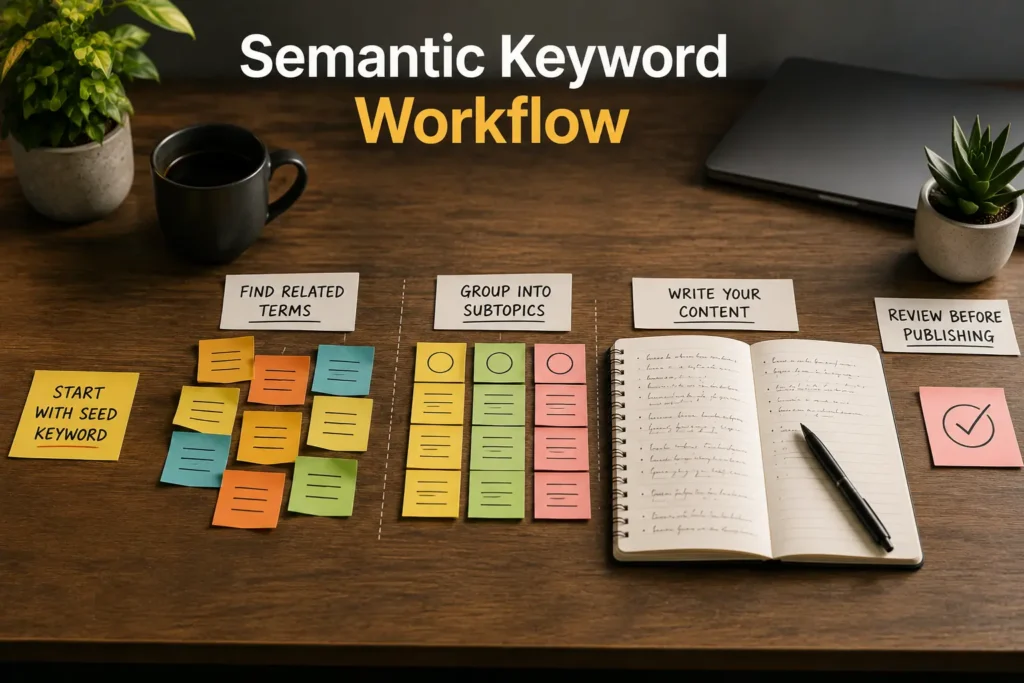
A Step-by-Step Semantic Keyword Workflow
A repeatable process beats reinventing your approach every time you sit down to write.
- Choose your seed keyword and clarify exactly what the searcher wants to know
- Generate related terms using free tools, manual research, or both combined
- Group terms into clusters by subtopic, which naturally becomes your content outline
- Write for the reader first, letting semantic keywords appear only where they truly fit
- Review before publishing, swapping repeated exact phrases for natural related terms
Why each step matters:
- Step 1 keeps you anchored to actual searcher intent, not just a topic you find interesting
- Step 2 is the research phase — skipping it means relying entirely on your own vocabulary
- Step 3 is the one people skip most — jumping straight to drafting scatters terms randomly with no structure
- Step 4 requires discipline — resist forcing in every term from your research list
- Step 5 is your final pass — hunt for spots where you repeated the seed phrase out of habit
Benefits of clustering first (step 3):
- Better flow
- Faster outlining
- Fewer subtopics that quietly slip through the cracks
Semantic Keywords and AI-Driven Search
AI search rewrote the rules here. ChatGPT, Perplexity, and Google’s AI Overviews summarize whole topics now instead of just handing back a list of blue links.
What these systems reward:
- Content that actually explains something in full
- Thin, repetitive pages rarely make it into an AI-generated answer — not enough substance to summarize
- Genuine, comprehensive coverage of a topic over surface-level matching
Why semantic keywords help here specifically:
- Comprehensive coverage reads as reliable
- Both classic search engines and AI models are trained to pick up on that
- Right supporting vocabulary throughout gives AI models more surface area to extract and summarize from
The bigger picture:
- Writers building real topical depth now stay visible across classic search AND the newer AI-driven layer
- Think of it less as “optimizing for AI” and more as writing content genuinely comprehensive enough that both humans and machines recognize it as authoritative
Common Mistakes to Avoid
Even solid writers fall into a handful of the same traps early on. Happens to everyone.
Most of it comes down to one thing: treating semantic keywords like a checklist item instead of part of genuinely explaining a topic to a real person.
- Keyword stuffing — cramming related terms in unnaturally instead of writing normally
- Ignoring search intent — adding related words without answering what the reader actually needs
- Skipping structure — burying important terms deep in paragraphs instead of using headings
- Copying competitors exactly — reusing their term list without adding genuine original insight
- Treating it as one-time work — semantic optimization should evolve as content matures
Why each one hurts:
- Semantic stuffing is a subtler version of exact-match stuffing — still noticeable to readers
- Ignoring intent produces “comprehensive” content that doesn’t answer what the reader came for
- Skipping structure buries terms where readers and crawlers can’t find them quickly
- Copying competitors produces derivative content with nothing making your page worth choosing
- Treating it as one-time work misses that topics evolve and new related terms emerge over time
Frequently Asked Questions
What are semantic keywords in simple terms?
Semantic keywords are related words that add context around a main topic. They help search engines understand what content genuinely covers, beyond one exact phrase.
Are semantic keywords the same as synonyms?
No. Synonyms mean the same thing as your keyword. Semantic keywords are different words entirely that simply relate contextually to the same broader subject.
Do semantic keywords guarantee higher rankings?
No single technique guarantees rankings on its own. That said, comprehensive content built around genuine semantic depth consistently outperforms thin, repetitive pages in modern search results.
How many semantic keywords should one article include?
No magic number here. Add a term only where the sentence genuinely calls for it — placement quality beats hitting a specific count, every time.
Can I find semantic keywords without paying for tools?
Yes. Google’s autocomplete, related searches, and a handful of free clustering tools all work fine at no cost — fine for beginners and small teams alike.
How is this different from regular keyword research?
Regular keyword research goes after specific search phrases directly. Semantic keyword research builds contextual depth around the topic instead, supporting your main keywords rather than replacing them.
Should every page on my site use semantic keywords?
Pretty much, yeah. Any page you want ranked benefits from natural topical depth — it’s what tells search engines the page actually delivers on what it promises.
Final Thoughts
Semantic keywords really aren’t that complicated. They reflect how search engines read content today. Work them into your writing naturally, and you’re helping both real readers and ranking systems recognize genuine expertise when they see it. The principle that carries across every method in this guide:
Write like someone who actually knows the topic. The vocabulary that proves it tends to show up on its own. Tools and workflows help you get there faster — not a substitute for genuine understanding. Start with one seed keyword. Map what naturally surrounds it. Write something that actually explains the topic, start to finish, no shortcuts. Do that consistently, and it beats thin, repetitive content every time.