

You scrub it away on Saturday, and by Friday those black spots are creeping back along the grout lines. Sound familiar? Shower mold is the most stubborn cleaning problem in any home — but only if you’re using the wrong method for the wrong surface. This guide covers exactly how to clean shower mold from every surface in your bathroom, which cleaner actually kills mold instead of just hiding it, and the two-minute daily habit that stops it from ever coming back.
How to Clean Shower Mold: The Quick Answer
To clean shower mold, spray undiluted white vinegar or 3% hydrogen peroxide directly onto the moldy area, let it sit for 30–60 minutes, scrub with a stiff-bristled brush, rinse with warm water, and dry the surface completely. For stained grout, hydrogen peroxide works best. Never mix bleach with vinegar or ammonia — the fumes are toxic.
That’s the short version. But the method that works on your tiles will fail on your caulk, and the pink film near your drain needs a different approach than black spots on grout. Let’s break it all down.
What Causes Mold in the Shower?
Mold grows in showers because they provide the three things mold spores need: constant moisture, warmth, and a food source. Your shower delivers all three every single day, which is why bathrooms develop mold faster than any other room in the house.
Here are the five root causes behind almost every case of shower mold:
1. Trapped humidity. Every hot shower fills the room with steam. When that moisture can’t escape, it settles on tiles, glass, and grout — and stays there until your next shower adds more. Mold thrives when relative humidity stays above 60%.
2. Poor ventilation. An exhaust fan that’s too small for the room, or one that gets switched off the moment you step out, never clears the moist air. No airflow means surfaces stay wet for hours.
3. Soap scum and body oils. That thin film on your shower walls isn’t just ugly — it’s food. Mold feeds on the organic residue left behind by soap, shampoo, and skin oils.
4. Cracked grout and failing caulk. Once grout crumbles or caulk peels, water seeps behind your tiles into porous material you can’t reach with any cleaner. This is where recurring mold usually lives.
5. Hidden leaks. A slow drip inside the wall or under the shower pan keeps material wet 24/7. If mold keeps returning to the same spot no matter what you do, suspect a leak.
Cleaning removes the mold you can see. Fixing these causes is what keeps it gone — we’ll cover prevention in detail later in this guide.
Mold vs. Mildew: Which One Do You Have?
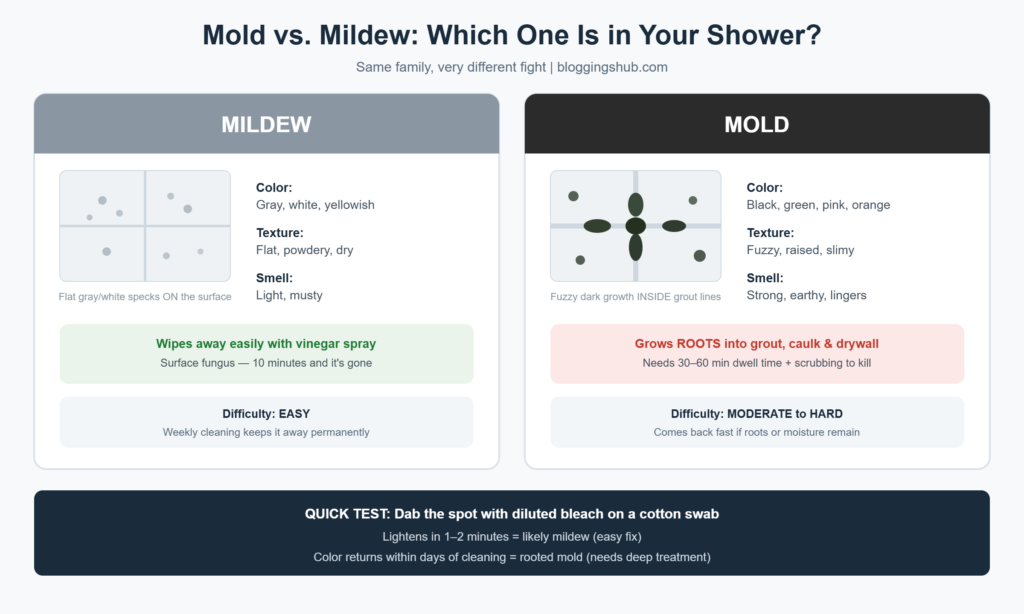
Mildew is a surface fungus that sits on top of surfaces and wipes away easily, while mold grows roots into the material and requires deeper treatment. Knowing which one you’re dealing with tells you how hard the fight will be.
| Mildew | Mold | |
| Color | Gray, white, or yellowish | Black, green, pink, orange, or brown |
| Texture | Flat, powdery | Fuzzy, raised, or slimy |
| Where it grows | On top of surfaces | Into grout, caulk, drywall, and wood |
| Smell | Light, musty | Strong, earthy, persistent |
| Cleaning difficulty | Wipes off easily | Needs dwell time, scrubbing, sometimes replacement |
Quick test: dab the spot with a cotton swab dipped in diluted bleach. If it lightens in 1–2 minutes, it’s likely mildew or surface mold. If the dark color returns within days of cleaning, you’re dealing with rooted mold — and possibly mold growing behind the surface.
Types of Shower Mold by Color (and What Each One Means)
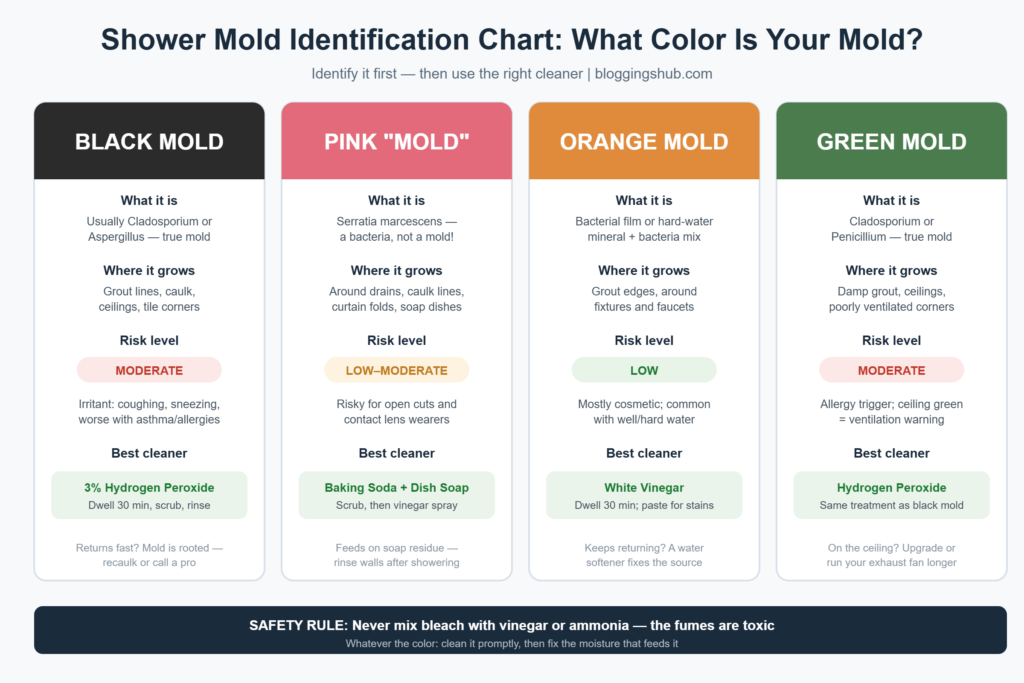
Not all shower mold is the same organism, and the color tells you a lot about what you’re dealing with and how urgent the problem is. Here’s how to identify — and clean — each type.
How to Clean Black Mold in Shower Areas
Black mold in the shower is usually Cladosporium or Aspergillus — common household species — rather than the infamous toxic black mold (Stachybotrys chartarum), which needs constantly soaked drywall or wood to survive and rarely grows on hard shower surfaces.
To clean black mold in your shower:
- Spray 3% hydrogen peroxide generously over the black spots.
- Let it sit for 30 minutes — you may see it fizz, which means it’s working.
- Scrub firmly with a stiff brush, following grout lines where the mold concentrates.
- Rinse with warm water and dry completely with a microfiber cloth.
- Repeat once if dark staining remains.
If black mold returns to the exact same spot within a week, or covers more than 10 square feet, skip to the professional help section — that pattern means the colony lives deeper than any spray can reach.
How to Clean Pink Mold in Shower Corners
Here’s a surprise: that pink or salmon-colored slime around your drain and along caulk lines isn’t actually mold at all. It’s Serratia marcescens, an airborne bacteria that feeds on soap and shampoo residue. It’s one of the most common shower problems — and one of the easiest to fix.
To clean pink mold from your shower:
- Mix a paste of baking soda and dish soap (roughly 4 tablespoons baking soda to 1 tablespoon soap).
- Scrub the pink film away with a soft brush — it lifts off easily.
- Rinse, then spray the area with white vinegar and leave it to air dry. The vinegar kills remaining bacteria.
- Wash any affected shower curtains or liners (machine wash with a cup of vinegar).
Pink mold matters more than it looks: while harmless to touch for most people, Serratia can cause infections if it contacts open wounds or contact lenses, so don’t ignore it.
How to Clean Orange Mold in Shower Tiles
Orange mold in the shower is typically either a bacterial film (like pink mold’s cousin) or iron and mineral deposits from hard water mixing with bacterial growth. It clings to grout edges and around fixtures.
Clean it with undiluted white vinegar: spray, wait 30 minutes, scrub, and rinse. If the orange tint survives vinegar, it’s likely mineral staining from hard water — a paste of vinegar and baking soda applied for 15 minutes usually lifts it. Homes with well water see orange staining more often; a water softener solves the root cause.
Green and Gray-Green Mold
Green mold in showers is usually Cladosporium or Penicillium growing on damp grout and ceilings. Treat it exactly like black mold — hydrogen peroxide, 30 minutes of dwell time, scrub, rinse, dry. Green mold on a bathroom ceiling is a strong sign your exhaust fan isn’t doing its job.
Before You Start: Safety Rules That Are Not Optional
Cleaning mold safely matters as much as cleaning it effectively — a few simple precautions protect your lungs, skin, and eyes from both mold spores and cleaning chemicals.
- Never mix cleaning products. Bleach + vinegar creates chlorine gas. Bleach + ammonia creates chloramine gas. Both are genuinely dangerous in a small, enclosed bathroom. Use one product, rinse thoroughly, and ventilate before trying another.
- Wear gloves and an N95 mask. Scrubbing releases mold spores into the air. An N95 stops you from inhaling them; rubber gloves protect your skin from both mold and cleaners.
- Add eye protection for overhead work. Cleaning a moldy ceiling without goggles means cleaner dripping into your eyes.
- Ventilate the whole time. Run the exhaust fan, open a window, and keep the bathroom door open while you work.
- Skip the DIY entirely if you have asthma, mold allergies, or a weakened immune system — have someone else do it, or hire a professional.
What You’ll Need
Gather everything before you start — nothing’s worse than standing in a wet shower realizing your brush is downstairs. Most of this is already in your kitchen:
- White vinegar (undiluted, the cheap gallon jug works fine)
- 3% hydrogen peroxide (the standard brown bottle)
- Baking soda
- Borax (for stubborn, recurring patches)
- Tea tree oil (optional, for a natural residual protectant)
- Dish soap
- Spray bottles (one per cleaner — label them)
- Stiff-bristled scrub brush + an old toothbrush for grout lines
- Microfiber cloths and a squeegee
- Rubber gloves, N95 mask, safety glasses
- Paper towels and plastic wrap (for the caulk poultice trick in Method 2)
9 Proven Methods to Clean Shower Mold
The golden rule for every method below: dwell time beats scrubbing power. Letting the cleaner sit on the mold for the full recommended time does more work than any amount of elbow grease. Start with the gentlest method that suits your surface and escalate only if the mold resists.
Method 1: White Vinegar — The Everyday Workhorse
White vinegar’s acidity kills the majority of common household mold species, and unlike bleach, it penetrates porous surfaces to attack the roots. This is the method to learn how to clean mold in shower spaces on a routine basis.
- Fill a spray bottle with undiluted white vinegar — don’t water it down.
- Spray the moldy area until visibly wet, soaking grout lines and corners.
- Wait 30–60 minutes. This is the step everyone rushes, and it’s the step that kills the mold.
- Scrub with a stiff brush; use the toothbrush for grout lines and tight edges.
- Rinse with warm water and dry completely with a microfiber cloth.
Best for: tiles, glass, fiberglass, sealed grout, weekly maintenance cleaning. Limitation: vinegar kills mold but can leave gray staining behind in grout — that’s what Method 2 is for.
Method 2: 3% Hydrogen Peroxide — The Stain Lifter
Hydrogen peroxide kills mold and bleaches out the dark staining it leaves behind, making it the best single product for grout and black discoloration.
- Pour 3% hydrogen peroxide into an opaque spray bottle (light degrades it).
- Saturate the moldy area and let it bubble for 10–30 minutes.
- Scrub along grout lines while it’s still wet.
- Rinse and dry. Repeat on heavy staining.
The poultice trick (for caulk and stubborn grout): soak paper towels in peroxide, press them against the moldy line, cover with plastic wrap, and leave for 3–4 hours. The plastic keeps the peroxide wet and working the entire time — this is the closest a home remedy gets to professional treatment.
Best for: black staining, grout lines, caulk (via poultice), any hard surface.
Method 3: Baking Soda Paste — Scrubbing Power Plus Deodorizing
Baking soda is mildly abrasive, so it physically lifts mold off textured surfaces while neutralizing the musty smell at the same time.
- Mix baking soda with just enough water to form a thick paste.
- Spread it over the mold and into grout lines.
- Wait 10–15 minutes, then scrub firmly.
- Rinse and dry.
Best for: textured shower floors, corners, stubborn buildup, odor removal, and pink mold (add a squirt of dish soap).
Method 4: Vinegar + Baking Soda — Sequenced, Not Mixed
Mixed together in a bottle, vinegar and baking soda neutralize each other into salty water — useless. Layered on the surface in sequence, the fizzing reaction physically lifts grime and mold out of pores.
- Apply baking soda paste to the moldy area; wait 10 minutes.
- Spray white vinegar over the paste — it will fizz aggressively.
- Scrub while it’s fizzing, then rinse and dry.
Best for: heavy buildup on grout and floor corners where a single cleaner isn’t enough.

Method 5: Borax — The Long-Game Cleaner
Borax kills mold like the others, but with one unique advantage: you don’t rinse it off. The residue it leaves behind keeps inhibiting mold growth for weeks, making it the best choice for spots that keep coming back.
- Dissolve 1 cup of borax in 1 gallon of warm water.
- Apply generously with a spray bottle or brush.
- Scrub the mold away.
- Wipe up the debris but leave the borax film on the surface — do not rinse.
Best for: recurring mold patches and chronically damp corners. Caution: keep borax-treated surfaces away from pets, and rinse any area they might lick.
Method 6: Tea Tree Oil — The Natural Residual Protectant
Tea tree oil is a natural fungicide that most guides skip — which is a shame, because like borax, it keeps working after you finish. The smell is strong but fades within a day.
- Mix 2 teaspoons of tea tree oil with 2 cups of water in a spray bottle. Shake well.
- Spray on the moldy area and do not rinse — leave it to dry.
- For active patches, spray, wait an hour, scrub lightly, then spray again and leave.
Best for: natural-cleaning households, shower curtains, and preventive weekly spraying. Caution: toxic to cats and dogs if ingested — rinse surfaces pets contact.
Method 7: Dish Soap and Warm Water — For Sensitive Surfaces
Sometimes the gentlest option is the right one. For acrylic tubs, fiberglass surrounds, and freshly sealed surfaces, a squirt of dish soap in warm water with a soft cloth removes light mold film without any risk of surface damage. Follow with a vinegar spray (test a hidden spot first on natural stone) and dry thoroughly.
Best for: acrylic, fiberglass, and any surface where you’re worried about damage.
Method 8: Commercial Mold Removers — When You Want Speed
Store-bought mold removers are legitimate tools, especially gel formulas that cling to vertical surfaces and caulk lines where sprays drip off.
What to look for on the label:
- An EPA registration number — this verifies the product actually kills what it claims.
- A gel or foam formula for caulk and vertical grout lines (it stays put during dwell time).
- “Mold killer” vs. “mold stain remover” — they’re different products. Killers stop the organism; stain removers fix the cosmetics. Heavy infestations need both, in that order.
Follow the label’s dwell time exactly, ventilate well, and never combine commercial products with homemade solutions.
Best for: fast results, vertical surfaces, and people who’d rather not mix anything.
Method 9: Bleach — The Most Misused Cleaner in the Bathroom
Here’s the truth most cleaning guides get wrong: bleach is fine on non-porous surfaces and nearly useless on porous ones. On glazed tile, glass, and fiberglass, a diluted bleach solution (1 cup bleach per gallon of water) kills surface mold and removes staining in about 10 minutes.
But on grout, caulk, and drywall, bleach’s chlorine evaporates at the surface while its water content soaks in — literally feeding the mold roots below. That’s why bleached grout looks perfect for a week and then turns black again.
Use bleach when: the surface is glass, glazed tile, or fiberglass, and you want fast cosmetic results. Skip bleach when: the mold is in grout, caulk, natural stone, or anything porous — use peroxide, vinegar, or borax instead.
And once more, because it matters: never mix bleach with anything except plain water.
Method Comparison Table: Which Cleaner Should You Use?
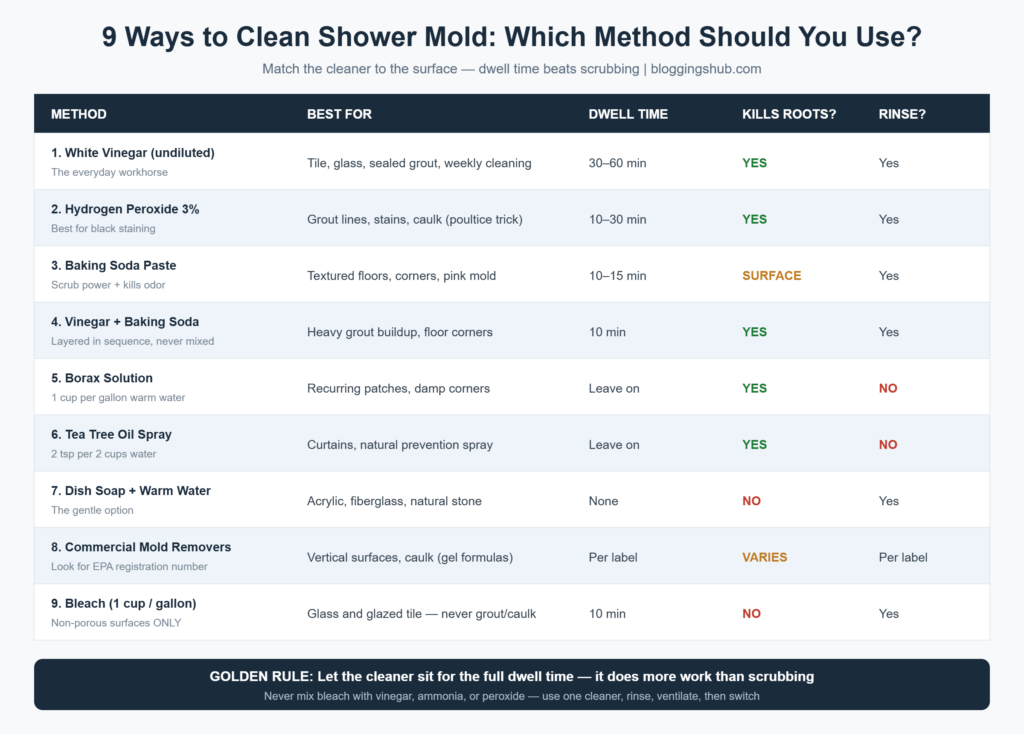
| Method | Best Surface | Dwell Time | Kills Roots? | Rinse After? |
| White vinegar | Tile, glass, sealed grout | 30–60 min | Yes | Yes |
| Hydrogen peroxide | Grout, stains, caulk | 10–30 min | Yes | Yes |
| Baking soda paste | Textured floors, odor | 10–15 min | Surface only | Yes |
| Vinegar + baking soda | Heavy grout buildup | 10 min | Yes | Yes |
| Borax | Recurring patches | Leave on | Yes | No |
| Tea tree oil | Curtains, prevention | Leave on | Yes | No |
| Dish soap + water | Acrylic, fiberglass | None | No | Yes |
| Commercial removers | Vertical surfaces, caulk | Per label | Varies | Per label |
| Bleach (diluted) | Glass, glazed tile only | 10 min | No | Yes |
How to Clean Mold From Every Shower Surface
The single biggest mistake people make is using one method everywhere. Each shower surface has different porosity, and porosity decides which cleaner works. Here’s the surface-by-surface playbook.
How to Clean Shower Grout Mold
Grout is porous cement — mold doesn’t sit on it, it grows into it. That’s why grout is the hardest-hit surface in almost every shower.
- Spray 3% hydrogen peroxide directly onto the grout lines until saturated.
- Let it dwell for 30 minutes.
- Scrub along (not across) the grout lines with a stiff toothbrush.
- Rinse and dry with a cloth.
- For deep black staining, follow with a baking soda paste scrub, then rinse again.
The step nobody does (but should): once the grout is clean and bone dry — wait 24 hours — apply a penetrating grout sealer. Sealed grout sheds water instead of absorbing it, which makes future mold nearly impossible and cleaning ten times easier. Reapply once a year.
If the grout is crumbling or the black returns within days, the mold is living behind the tile. No cleaner fixes that; regrouting or professional assessment does.
How to Clean Mold From Shower Caulk and Silicone
Caulk is the surface where DIY most often fails, because mold grows inside the silicone itself. Here’s the honest escalation path:
Step 1 — The peroxide poultice. Soak paper towel strips in hydrogen peroxide, press them along the caulk line, cover with plastic wrap, and leave for 3–4 hours (overnight is fine). Remove, scrub gently, rinse.
Step 2 — Baking soda follow-up. If staining remains, scrub with baking soda paste and repeat the poultice once.
Step 3 — Accept reality and recaulk. If black staining survives two poultice treatments, the mold has colonized the inside of the silicone. No product revives it — and any guide claiming otherwise is wasting your time. Strip the old caulk with a caulk-removal tool, clean the channel with vinegar, let it dry for 24 hours, and apply fresh mold-resistant silicone (labeled “bathroom/kitchen” with fungicide). A $8 tube and 30 minutes of work beats months of futile scrubbing.
How to Clean Shower Tile Mold
Glazed ceramic and porcelain tiles are non-porous, which makes them the easiest surface in your shower:
- Spray white vinegar across the tiled area.
- Wait 30 minutes, then scrub with a brush or sponge.
- Rinse and squeegee dry.
For natural stone tiles (marble, travertine, slate) — skip the vinegar entirely. Acid etches natural stone. Use dish soap and warm water, or a stone-safe commercial cleaner, and make sure the stone’s sealer is current.
How to Clean Shower Curtain Mold
A moldy curtain or liner is the easiest fix in this entire guide, because you can throw most of them in the washing machine:
Fabric curtains: machine wash on warm with your regular detergent plus 1 cup of white vinegar in the drum. Hang to dry completely before rehanging.
Plastic liners: wash on gentle/cold with 2–3 bath towels (they act as scrubbers), ½ cup baking soda in the wash, and ½ cup vinegar in the rinse. Hang immediately — never machine-dry a plastic liner.
Hand-wash option: lay the curtain flat, scrub with baking soda paste, spray with vinegar, rinse with the showerhead.
If a $10 liner has heavy black mold in the seams and hem, replace it — sometimes the math is just that simple. To keep the new one clean longer, stretch it fully closed after each shower so it dries flat instead of sitting in wet folds.
How to Clean Mold Off Glass Doors and Tracks
The glass itself rarely holds mold — it’s the sliding track that becomes a mold farm, collecting a soup of water, soap scum, hair, and darkness.
- Spray the track generously with undiluted vinegar and let it sit for 30 minutes.
- Drag a vinegar-soaked rag through the channel with a flathead screwdriver to reach the bottom.
- Detail the corners with a toothbrush.
- Rinse by pouring a cup of warm water through the track, then dry.
For the glass panels, vinegar handles mold spots and soap scum in one pass. Finish with a squeegee for a streak-free result.
How to Clean Mold Off the Shower Ceiling
Ceiling mold deserves respect — you’re working overhead with dripping cleaner.
- Put on safety glasses and an N95.
- Spray white vinegar or hydrogen peroxide onto a flat sponge mop (don’t spray the ceiling directly overhead).
- Work the mop across the moldy area, re-wetting as needed.
- After 30–40 minutes, wipe with a clean damp mop, then dry with a towel-wrapped mop head.
Important: mold on the ceiling is almost always a ventilation symptom. If your ceiling grows mold, your exhaust fan is undersized, broken, or not running long enough — fix that or the ceiling mold returns every few months, no matter how well you clean.
Fiberglass and Acrylic Surrounds
These surfaces scratch easily, and scratches give mold a foothold. Use dish soap and warm water or a vinegar spray with a soft cloth or sponge — never abrasive pads, never scouring powder, and go easy with baking soda (light pressure only). Rinse and dry completely.
The Shower Drain
The drain is the most-ignored mold habitat in the bathroom. Once a month: remove the drain cover, pull out hair and buildup (a $3 plastic drain snake works), scrub the cover with vinegar, pour half a cup of baking soda followed by a cup of vinegar down the drain, wait 15 minutes, and flush with hot water. This kills mold and bacteria living just below the drain line — often the source of a musty smell no surface cleaning fixes.
Is Shower Mold Dangerous?
For most healthy people, typical shower mold is an irritant rather than a serious health threat — but it’s not harmless, and some people face genuinely higher risks.
Common shower mold species (Cladosporium, Aspergillus, Penicillium) release spores that can cause sneezing, nasal congestion, coughing, itchy or watery eyes, and throat irritation. According to the EPA and CDC, people with asthma, mold allergies, COPD, or weakened immune systems can experience significantly stronger reactions, including asthma attacks and, in rare cases, respiratory infections.
The famous “toxic black mold” (Stachybotrys chartarum) is rare in showers because it needs constantly saturated cellulose material — drywall, wood — rather than wet tile. You cannot identify a mold species by color alone, and testing is rarely worth the cost for a small patch. The practical rule is simpler: remove any mold promptly, whatever its color, and fix the moisture feeding it.
One special note on pink “mold” (Serratia marcescens bacteria): it’s the one shower growth that poses a direct infection risk through open cuts, catheters, and contact lenses. If anyone in your home wears contacts, keep the shower free of pink film and never store lenses in the bathroom.
When to Call a Professional (and What It Costs)
DIY cleaning handles surface mold, but some situations are beyond any spray bottle. Call a mold remediation professional if:
- The mold covers more than 10 square feet (roughly a 3×3 ft patch)
- Mold returns to the same spot within days of a proper cleaning
- You see mold along walls outside the shower, at baseboards, or on the ceiling of the room below
- There’s a known leak or past flooding near the bathroom
- You smell a persistent musty odor but can’t find visible mold — the classic sign of growth inside the wall
- Anyone in the home is in a high-risk health group
What it costs (US, 2026): a professional mold inspection runs $300–$650. Bathroom-scale remediation typically costs $500–$1,500; if mold has spread into walls or subflooring, $1,500–$3,500+. Expensive — but far cheaper than letting hidden mold eat drywall and framing for another year. Reputable companies follow EPA and IICRC S520 protocols: containment, HEPA filtration, removal of affected material, and post-remediation verification.
How to Stop Shower Mold From Coming Back

Every method above treats the symptom. Prevention treats the cause — and it takes less than three minutes a day. Homes that adopt these seven habits almost never see shower mold again.
1. The 30-second squeegee. After every shower, squeegee the walls and glass. This single habit removes the standing water mold needs and prevents more mold than any deep clean ever will.
2. Run the exhaust fan properly. During the shower and for 20–30 minutes after. Your fan should move at least 1 CFM per square foot of bathroom (a 50 sq ft bathroom needs a 50+ CFM fan). A cheap timer switch automates the whole thing. And just like dryer vent cleaning, the fan itself needs its grille and duct cleaned yearly — a dust-clogged fan moves almost no air.
3. Keep humidity under 50%. A $10 hygrometer tells you where you stand. Consistently above 50% after showers means you need a better fan, longer run time, or a small dehumidifier.
4. Weekly vinegar spray. Every week, mist the shower with white vinegar and walk away — no scrubbing, no rinsing. This 60-second habit kills spores before they establish.
5. Fix leaks within days, not months. Any drip — showerhead, valve, or under the pan — is a 24/7 mold factory. Treat leaks as urgent.
6. Seal your grout yearly. Clean grout, let it dry 24 hours, apply penetrating sealer. Sealed grout is mold’s worst enemy.
7. Let the shower breathe. Leave the door or curtain open (curtain stretched flat) after showering. Wash curtains monthly, liners every other month. Skip cloth bath mats inside the stall and store as few bottles as possible on the floor — every object traps moisture beneath it.
Free printable: we’ve made a one-page Shower Mold Prevention Schedule (daily / weekly / monthly / yearly checklist) you can print and stick inside your bathroom cabinet.
These habits matter double if you’re preparing to sell — a spotless, mold-free bathroom is one of the highest-impact items when you stage your home for sale.
Frequently Asked Questions About Shower Mold
What kills mold in the shower fast?
Undiluted white vinegar or 3% hydrogen peroxide kills most shower mold when left on the surface for 30–60 minutes before scrubbing. Peroxide works faster on black staining. Whichever you use, the dwell time does more work than the scrubbing — spray, wait, then scrub, rinse, and dry.
Is bleach or vinegar better for shower mold?
Vinegar is better for most shower mold. It penetrates porous grout and caulk to kill mold at the roots, while bleach only removes surface color — its water content can actually feed mold inside porous materials, which is why bleached grout turns black again within weeks. Save bleach for glass and glazed tile only.
Why does mold keep coming back in my shower?
Recurring shower mold means either the moisture never fully clears (poor ventilation, no squeegee habit) or the mold has rooted inside a porous material like grout or caulk, so you’re only cleaning the visible part. Fix the airflow, keep humidity under 50%, and replace any caulk that re-stains within a week of cleaning.
Does vinegar kill black mold?
Yes — household white vinegar (4–6% acetic acid) kills most black mold species found in showers, including Cladosporium and Aspergillus. Spray it undiluted, leave it for at least an hour on black mold, then scrub and rinse. For the dark staining left behind in grout, follow up with hydrogen peroxide.
What is the pink stuff in my shower?
The pink or orange slime in showers is Serratia marcescens — an airborne bacteria, not a true mold. It feeds on soap and shampoo residue around drains and caulk lines. Scrub it off with baking soda and dish soap, then spray with vinegar to kill the remaining bacteria. Keep it away from open cuts and contact lenses.
Is shower mold dangerous to my health?
For most healthy people, shower mold causes irritation — sneezing, congestion, coughing, itchy eyes — rather than serious illness. People with asthma, mold allergies, or weakened immune systems can react much more strongly. Whatever the species or color, the safe move is to remove it promptly and fix the moisture source.
Can you get sick from mold in the shower?
Yes, it’s possible. Inhaling mold spores can trigger allergic reactions and asthma attacks, and prolonged exposure to heavy growth increases the risk of respiratory symptoms even in healthy people. The infection risk from touching typical shower mold is low, but pink Serratia film can infect open wounds and eyes.
What kills 100 percent of mold?
Nothing you can buy kills 100% of mold permanently, because mold roots into porous surfaces and airborne spores are always present. Vinegar, hydrogen peroxide, borax, and EPA-registered removers kill the mold they reach. Total control comes from the combination: kill what’s there, then remove the moisture so new spores can’t grow.
How do I clean mold off a shower ceiling?
Apply vinegar or hydrogen peroxide with a sponge mop on an extension pole — never spray directly overhead — wearing safety glasses and an N95. Let it work for 30–40 minutes, wipe clean, and dry. Ceiling mold almost always signals a ventilation problem, so check that your exhaust fan actually moves air.
How often should I clean my shower to prevent mold?
A weekly one-minute vinegar mist (no scrubbing needed) plus a 30-second squeegee after each shower prevents almost all mold growth. Add a monthly deep clean of grout, tracks, and the drain, wash curtains monthly, and reseal grout once a year.
Can I just paint or caulk over shower mold?
No. Covering mold traps the living colony with the moisture it needs, and it will grow back through paint or new caulk within weeks. Always kill and remove the mold, let the surface dry fully (24 hours for caulk channels), and only then repaint or recalk.
When should I call a professional for shower mold?
Call a pro when mold covers more than 10 square feet, returns to the same spot within days of proper cleaning, appears alongside a leak or water damage, or when you smell persistent mustiness without visible mold — that usually means growth inside the wall. Expect $300–$650 for an inspection and $500–$1,500 for bathroom-scale remediation.
The Bottom Line
Cleaning shower mold isn’t about finding one magic product — it’s about matching the right method to the right surface and giving it time to work. Vinegar for everyday cleaning, hydrogen peroxide for grout and stains, the poultice trick for caulk, borax or tea tree oil for spots that keep returning — and bleach only where it actually helps. Then make mold irrelevant with a squeegee, a running fan, and a weekly vinegar mist.
Clean what you see, fix the moisture that grew it, and know the honest limit: mold that spreads past 10 square feet or keeps resurrecting belongs to a professional, not a spray bottle.
Got a stubborn mold problem this guide didn’t solve? Drop it in the comments — we read every one and update this guide regularly with new fixes.