
Entity SEO Explained: How Knowledge Graphs Drive Rankings
Search engines no longer read pages one word at a time. Instead, they identify entities, map relationships, and connect everything through a knowledge graph. Consequently, ranking well today depends less on matching exact phrases and more on how clearly a page signals its semantic keywords and the concepts behind them. This shift is called entity SEO, and understanding it is now essential for anyone who wants sustainable search visibility.
This guide breaks down what entities actually are, how Google’s knowledge graph works, and how semantic keywords fit into the bigger picture. By the end, you’ll have a practical framework you can apply to your own content.
Table of Contents
- What Is an Entity in SEO?
- Entities vs. Keywords: What’s the Real Difference?
- How Google’s Knowledge Graph Works
- Knowledge Graph vs. Structured Data: Clearing Up the Confusion
- How Search Engines Understand Entities
- Semantic Relevance and Why It Matters
- Topical Authority: Why One Page Isn’t Enough
- Structured Data: Making Entities Explicit
- Internal Linking and Entity Relationships
- Building an Entity-Based Content Strategy
- Common Entity SEO Mistakes to Avoid
- Entity SEO Implementation Checklist
- Entity SEO vs. Traditional Keyword SEO: A Final Comparison
- Final Thoughts
What Is an Entity in SEO?
An entity is any distinct, identifiable thing that a search engine can recognize:
- It could be a person, a brand, a place, a product, or even an abstract concept
- For example, “Nike” is an entity, so is “running shoes,” so is “marathon training” — each carries its own meaning, attributes, and relationships to other entities
- Unlike keywords, entities don’t depend on exact wording — a search engine can recognize “Nike” whether the text says “Nike,” “Nike Inc.,” or simply “the swoosh brand”
- That’s because entities are tied to meaning, not phrasing
Entities vs. Keywords: What’s the Real Difference?
Keywords are strings of text. Entities are concepts. This distinction sits at the heart of modern SEO:
- Traditional keyword SEO asks: “What phrase should this page target?”
- Entity SEO asks a different question: “What is this page actually about, and how does that connect to everything else a search engine already knows?”
Semantic keywords bridge these two approaches:
- They’re the related terms, phrases, and concepts that naturally surround a topic
- They give search engines context beyond a single exact phrase
- They help confirm which specific entity a page is describing
When you use them well, you’re not just targeting a phrase — you’re reinforcing an entity.
| Aspect | Traditional Keyword SEO | Entity SEO |
|---|---|---|
| Focus | Exact-match phrases | Concepts and relationships |
| Goal | Rank for a specific term | Build topical authority |
| Signal type | Word frequency | Contextual meaning |
| Flexibility | Rigid, phrase-dependent | Adaptable across wording |
| Best supported by | Keyword density | Semantic keywords and structured data |
Neither approach replaces the other. Instead, they work together. Semantic keywords still matter because they help define which entity a page is describing.
How Google’s Knowledge Graph Works
Google introduced its knowledge graph in 2012 with a simple promise: understand “things, not strings.” Since then, it has grown into a massive database connecting billions of entities.
Here’s the basic mechanism:
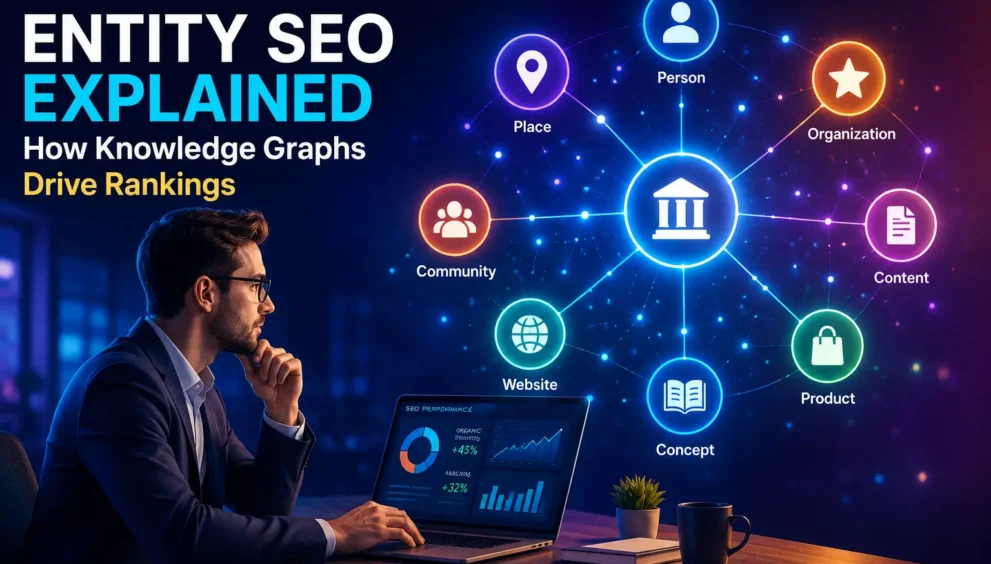
- Every entity in the graph is treated as a node
- Every relationship between two entities is treated as an edge
- Together, these nodes and edges form a web of meaning
- This structure lets Google move beyond isolated pages and understand how everything connects
For instance, the knowledge graph knows that “Paris” connects to “France,” “Eiffel Tower,” and “Gustave Eiffel”:
- None of these connections rely on keyword matching
- They exist because trusted sources — Wikipedia, Wikidata, verified business listings — have confirmed the relationships
- As a result, when someone searches “how tall is the tower Gustave Eiffel built,” Google doesn’t need the exact phrase “Eiffel Tower” anywhere on a page
- It already understands the relationship and can surface relevant results accordingly
Where the Knowledge Graph Gets Its Data
Google pulls entity information from multiple sources rather than trusting any single website. This cross-referencing reduces errors and strengthens confidence in each connection.
Common sources include:
- Wikipedia and Wikidata
- Verified business listings, like Google Business Profiles
- Structured data (schema markup) published on websites
- Authoritative publishers and reference sites
- Government and academic databases
- Because Google checks multiple sources against each other, consistency matters enormously — if your brand name, description, or details differ across platforms, the knowledge graph struggles to confirm which version is accurate
Knowledge Graph vs. Structured Data: Clearing Up the Confusion
These two terms get mixed up often, so it helps to separate them clearly:
| Term | What It Is | Role |
|---|---|---|
| Knowledge Graph | Google’s internal database of entities and relationships | Stores and connects verified information |
| Structured Data (Schema) | Code added to a webpage | Explains entity details directly to search engines |
- Structured data doesn’t create knowledge graph inclusion by itself
- Rather, it acts as a clear signal that helps Google confirm what your page already communicates through content
- Think of schema as a translator, not a shortcut
How Search Engines Understand Entities
Search engines rely on natural language processing (NLP) to detect entities within content. This process happens in stages, and each stage builds on the last:
- First, the system scans text and identifies potential entities — names, places, products, and concepts
- Next, it examines surrounding context to figure out which specific entity is being discussed
- This second step matters more than people realize — consider the word “jaguar”: without context, a search engine can’t tell if you mean the car brand or the animal
- However, if your content also mentions “engine,” “horsepower,” and “luxury sedan,” the entity becomes obvious
This is exactly where semantic keywords prove their value. They supply the surrounding context that removes ambiguity and confirms which entity a page is really about.
Semantic Relevance and Why It Matters
Semantic relevance measures how well your content’s meaning aligns with what a searcher actually wants:
- It goes beyond matching words and instead evaluates whether the underlying concepts connect logically
- A page can rank for many related searches even without containing the exact phrasing of each one
- This happens because search engines evaluate topic depth, not isolated keyword instances
- For example, a well-optimized article about “email marketing” might naturally rank for “newsletter automation” or “subscriber segmentation,” simply because those concepts share a strong semantic relationship
This is precisely why sprinkling relevant semantic keywords throughout your content produces broader visibility than chasing one exact phrase repeatedly. For a full walkthrough of finding and applying these related terms, this guide to growing organic traffic through related-term optimization is worth reading alongside this article.
Topical Authority: Why One Page Isn’t Enough
Ranking for a single entity rarely comes from a single page. Instead, search engines evaluate how comprehensively your entire site covers a topic:
- Topical authority builds when multiple pages reinforce the same entity from different angles
- A pillar page defines the core topic broadly, while supporting pages explore specific subtopics in depth
For a step-by-step process on structuring this kind of pillar-and-cluster setup, this guide on establishing authority through connected content is a useful next read.
Consider a site covering “content marketing” as its core entity. Supporting pages might explore:
- Content strategy frameworks
- Editorial calendar planning
- Content distribution channels
- Performance measurement and analytics
- Each supporting page uses its own semantic keywords while linking back to the pillar page, which over time signals to search engines that the site genuinely understands the topic, not just the phrase
Structured Data: Making Entities Explicit
While content signals meaning implicitly, structured data states it explicitly. Schema markup tells search engines exactly what type of entity a page represents and how its attributes connect.
Common schema types used for entity SEO include:
- Organization schema — defines a brand’s identity, industry, and contact details
- Person schema — identifies authors, founders, or experts
- Product schema — describes products and their attributes
- Article schema — clarifies authorship and publishing context
- LocalBusiness schema — connects a business to a specific location
A few additional points worth knowing:
- The
sameAsproperty links your entity to authoritative external references, such as a Wikipedia page or verified social profile - This confirms that different mentions across the web refer to the same entity, strengthening overall trust
- Schema alone doesn’t guarantee knowledge graph inclusion or improved rankings
- Google still cross-checks structured data against real content and external validation before trusting it fully
Internal Linking and Entity Relationships
Internal links do more than help users navigate a site:
- They also tell search engines how different entities and topics relate to each other
- When you link a page about “keyword research” to a page about “semantic keywords,” you’re reinforcing a meaningful relationship
- This connection helps search engines understand your site’s topical structure more clearly
- For strongest results, use descriptive anchor text that reflects the destination page’s topic, rather than generic phrases like “click here” — this small adjustment carries meaningful semantic value
Building an Entity-Based Content Strategy
Shifting toward entity SEO doesn’t mean abandoning keyword research. Rather, it means expanding your approach to think in terms of topics and relationships.
Here’s a practical framework you can follow:
- Identify your core entity. This is usually your brand, product, or primary topic area.
- Map related entities. List the concepts, subtopics, and terms naturally connected to your core entity.
- Research semantic keywords. Find the related phrases people actually use when discussing these connected concepts.
- Structure content around clusters. Build a pillar page and supporting pages that each cover a distinct angle.
- Add structured data. Implement relevant schema types to make entity details explicit.
- Link pages purposefully. Connect related content with descriptive, relevant anchor text.
- Maintain consistency. Keep names, descriptions, and details identical across your website and external profiles.
Each step builds on the previous one. Skipping the mapping stage, for instance, often leads to disconnected content that fails to reinforce any single entity clearly.
Common Entity SEO Mistakes to Avoid
Even well-intentioned efforts can fall short. Watch out for these frequent mistakes:
- Inconsistent naming — using different brand names or descriptions across pages and platforms
- Entity stuffing — cramming semantic keywords unnaturally instead of writing for readers first
- Treating schema as a shortcut — adding markup without matching real content
- Ignoring internal linking — publishing standalone pages that never connect to related topics
- Chasing panels instead of clarity — focusing on Knowledge Panel visibility rather than genuine entity understanding
Each of these mistakes weakens the very signals that entity SEO depends on. Fortunately, all of them are avoidable with a bit of planning.
Entity SEO Implementation Checklist
Before publishing new content, run through this quick checklist:
- [ ] Core entity is clearly defined in the first paragraph
- [ ] Semantic keywords appear naturally throughout the content
- [ ] Related subtopics are covered with sufficient depth
- [ ] Appropriate schema markup is implemented and validated
- [ ] Internal links connect to related entity pages with descriptive anchor text
- [ ] Brand name and details match across the website consistently
- [ ] Content answers real user questions, not just keyword variations
Working through this list consistently, page after page, is what actually builds topical authority over time.
Entity SEO vs. Traditional Keyword SEO: A Final Comparison
To bring everything together, here’s how the two approaches compare across practical outcomes:
| Factor | Traditional Keyword SEO | Entity SEO |
|---|---|---|
| Ranking scope | Narrow, phrase-specific | Broad, topic-wide |
| Resilience to algorithm changes | Lower | Higher |
| Content requirement | Single optimized page | Interconnected content cluster |
| AI search compatibility | Limited | Strong |
| Long-term value | Diminishes as phrasing evolves | Compounds as authority builds |
- This doesn’t mean keywords are obsolete
- It means their role has evolved into supporting a larger, more meaningful structure
- If you want a deeper look at how this plays out in AI-generated results, this breakdown of ranking in AI-driven summaries covers the topic in detail
Final Thoughts
Entity SEO represents a fundamental shift in how search engines evaluate content:
- Rather than matching exact phrases, they now assess whether a page genuinely understands its topic and how that topic connects to the broader knowledge graph
- Semantic keywords remain central to this process — they provide the context that helps search engines confirm which entity your content represents
- They also expand your visibility across related searches you never directly targeted
- By combining clear entity definitions, consistent branding, thoughtful internal linking, and accurate structured data, you build a foundation that holds up far better than keyword density ever could
Ultimately, the sites that treat semantic keywords and entities as complementary tools — rather than competing strategies — are the ones best positioned for long-term search visibility.