

Addition & Subtraction Worksheets: Free Missing Numbers Tips
Missing number problems are one of the easiest ways to build strong math skills. Basically, addition and subtraction worksheets that use missing numbers ask a child to find the number that completes an equation, instead of just solving it from start to finish. For example, 5 + __ = 9 asks a child to think backward. As a result, kids learn number relationships faster than with plain addition or subtraction alone. In this guide, you will find simple examples, worksheet types, and grade-level tips to help any child practice with confidence.
What Are Missing Number Addition and Subtraction Worksheets?
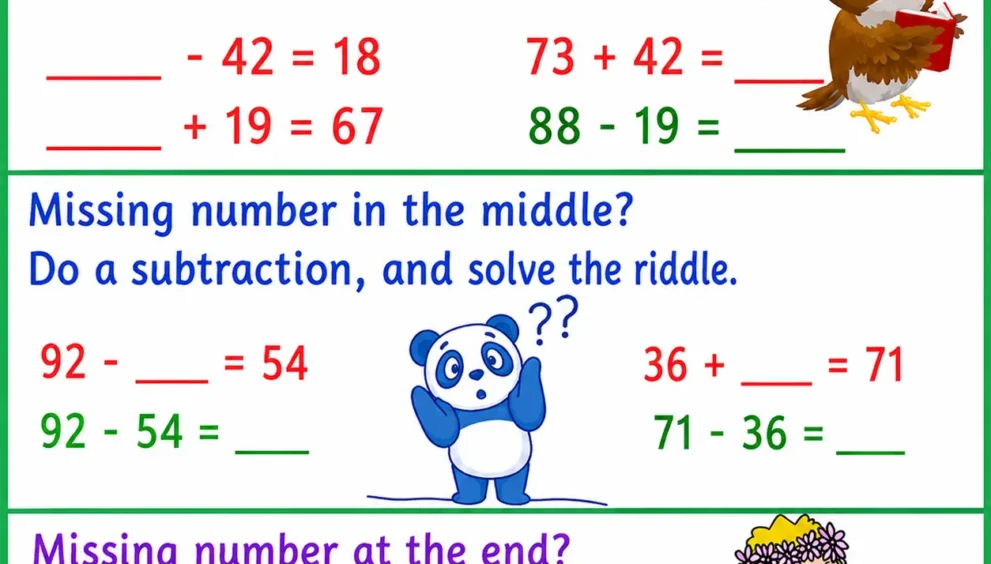
Simply put, addition and subtraction worksheets with missing numbers replace one part of an equation with a blank. For instance, a normal addition problem looks like 4 + 3 = 7. However, a missing number version might look like 4 + __ = 7, or __ + 3 = 7, or even 4 + 3 = __. Similarly, subtraction problems follow the same pattern: 9 − __ = 5, or __ − 4 = 5, or 9 − 4 = __.
Because the blank can appear in any position, children must understand how numbers relate to each other, not just memorize a single answer. Consequently, these worksheets build number sense rather than rote memory. Here are a few quick examples:
- For example, 6 + __ = 10 (answer: 4)
- Similarly, __ + 5 = 12 (answer: 7)
- Also, 8 − __ = 3 (answer: 5)
- Next, __ − 6 = 2 (answer: 8)
- Finally, 7 + 6 = __ (answer: 13)
Why Addition and Subtraction Worksheets Help Kids Learn Missing Numbers
First and foremost, addition and subtraction worksheets with missing numbers teach children to see numbers as flexible, not fixed. For example, once a child solves 3 + __ = 8, they naturally begin to see that the same fact also works as 8 − 3 = __. Therefore, the child learns two math skills from a single problem.
In addition, missing number practice strengthens mental math. Since there is no fixed pattern to memorize, kids must actually calculate the answer every time. As a result, they get faster and more accurate with numbers over time. Furthermore, this type of practice prepares children for algebra later on, since finding an unknown value is exactly what algebra asks students to do.
Below is a short comparison of how a missing number changes the same fact family:
| Problem | Missing Number | Answer |
|---|---|---|
| 5 + __ = 11 | Second addend | 6 |
| __ + 4 = 11 | First addend | 7 |
| 11 − __ = 5 | Subtrahend | 6 |
| __ − 5 = 6 | Minuend | 11 |
Notice how all four problems come from the same fact family: 5, 6, and 11. Because of this, missing number worksheets are also a natural way to teach fact families.
Types of Missing Number Addition and Subtraction Worksheets
Basically, there are several common formats for addition and subtraction worksheets, and each one targets a slightly different skill. Below are the most useful types:
1. Single-digit missing number worksheets. Specifically, these use numbers 0–9 only, which makes them ideal for beginners. For example: 2 + __ = 6, __ − 3 = 4.
2. Two-digit missing number worksheets. Additionally, these add place value practice into the mix. For example: 24 + __ = 50, 63 − __ = 28.
3. Fact family triangles These display three numbers in a triangle shape, and the child fills in the missing operation and number. Example: 7, 5, 12 → 7 + 5 = __, 12 − 5 = __, 12 − 7 = __.
4. Number line worksheets Likewise, these show a number line with one jump missing, so the child counts forward or backward to find the value. For example: start at 8, jump to 15 — how many spaces?
5. Word problem worksheets These turn the missing number into a real-life question. Example: “Sara had 9 apples. She gave some away and now has 4. How many did she give away?” (Answer: 5)
More Missing Number Addition and Subtraction Worksheets Examples
Because repetition builds confidence, here are additional single-digit addition and subtraction worksheets examples for extra practice:
- First, 1 + __ = 4 (answer: 3)
- Next, 2 + __ = 7 (answer: 5)
- Then, __ + 3 = 8 (answer: 5)
- Similarly, __ + 2 = 6 (answer: 4)
- Also, 5 − __ = 2 (answer: 3)
- Likewise, 7 − __ = 4 (answer: 3)
- In addition, __ − 1 = 5 (answer: 6)
- Furthermore, __ − 4 = 3 (answer: 7)
- Moreover, 3 + 5 = __ (answer: 8)
- Subsequently, 9 − 5 = __ (answer: 4)
- Additionally, 6 + __ = 9 (answer: 3)
- Finally, 8 − __ = 1 (answer: 7)
And here are extra two-digit addition and subtraction worksheets examples, since bigger numbers need more repetition to master:
- First, 12 + __ = 30 (answer: 18)
- Next, __ + 15 = 40 (answer: 25)
- Then, 55 − __ = 20 (answer: 35)
- Similarly, __ − 22 = 18 (answer: 40)
- Also, 33 + 29 = __ (answer: 62)
- Likewise, 76 − 34 = __ (answer: 42)
- In addition, 48 + __ = 91 (answer: 43)
- Furthermore, 60 − __ = 17 (answer: 43)
- Additionally, __ + 39 = 70 (answer: 31)
- Finally, 84 − __ = 26 (answer: 58)
Addition and Subtraction Worksheets by Grade Level
Since children grow at different paces, addition and subtraction worksheets should match the right number range for each grade. Here is a simple breakdown:
Kindergarten (numbers 0–10)
- For example, 3 + __ = 5
- Similarly, __ − 2 = 1
- Finally, 4 + 4 = __
Grade 1 (numbers 0–20)
- For instance, 9 + __ = 14
- Next, 18 − __ = 10
- Then, __ + 6 = 15
Grade 2 (numbers up to 100, with regrouping)
- Likewise, 47 + __ = 82
- Also, 90 − __ = 36
- Additionally, __ + 28 = 65
Grade 3 (numbers up to 1000, multi-step)
- In addition, 245 + __ = 500
- Furthermore, 800 − __ = 355
- Finally, __ − 128 = 372
Since each level builds on the one before it, moving through these stages in order gives children the strongest foundation.
How to Solve Missing Number Addition and Subtraction Worksheets (Examples)
Now, let’s walk through the actual math step by step, since that is the real value of these worksheets.
Single-Digit Missing Number Examples
Example 1: 6 + __ = 13. Because addition and subtraction are opposites, subtract the known number from the total: 13 − 6 = 7. So, the missing number is 7.
Example 2: __ + 9 = 20 Again, subtract the known addend from the total: 20 − 9 = 11. So, the missing number is 11.
Example 3: 15 − __ = 8 Here, subtract the answer from the starting number: 15 − 8 = 7. So, the missing number is 7.
Example 4: __ − 6 = 9. This time, add the two known numbers together: 9 + 6 = 15. So, the missing number is 15.
Example 5 (two-digit): 34 + __ = 61. Subtract 34 from 61: 61 − 34 = 27. So, the missing number is 27.
Example 6 (two-digit): 72 − __ = 45. Subtract 45 from 72: 72 − 45 = 27. So, the missing number is 27.
Example 7 (word problem): A shelf has 20 books. After 8 books are removed, how many are left? 20 − 8 = 12. So, 12 books remain.
As shown above, every missing number problem follows one simple rule: use the opposite operation to uncover the hidden value. Once a child understands this rule, they can solve almost any addition and subtraction worksheet with confidence.
Here are a few more worked examples to reinforce the pattern:
Two-Digit Missing Number Examples
Example 8: 22 + __ = 40. Subtract 22 from 40: 40 − 22 = 18. So, the missing number is 18.
Example 9: __ + 17 = 33. Subtract 17 from 33: 33 − 17 = 16. So, the missing number is 16.
Example 10: 58 − __ = 21. Subtract 21 from 58: 58 − 21 = 37. So, the missing number is 37.
Example 11: __ − 19 = 26. Add 26 and 19 together: 26 + 19 = 45. So, the missing number is 45.
Fact Family and Word Problem Examples
Example 12 (fact family): Given 6, 8, and 14 — fill in the triangle. 6 + 8 = 14, 8 + 6 = 14, 14 − 6 = 8, 14 − 8 = 6.
Example 13 (number line): Start at 10, count forward to 24. How many jumps? 24 − 10 = 14. So, there are 14 jumps.
Example 14 (word problem): A basket has __ eggs. After 7 eggs are used, 15 eggs remain. How many eggs were there at the start? 15 + 7 = 22. So, the basket started with 22 eggs.
Example 15 (word problem): Ali scored 12 points in the first game and some more points in the second game. His total score is 27. How many points did he score in the second game? 27 − 12 = 15. So, Ali scored 15 points in the second game.
Extra Practice Sets in Addition and Subtraction Worksheets
To build real fluency, children usually need several rounds of practice rather than just one page. Therefore, here is a mixed practice set of addition and subtraction worksheets that combines every format covered above.
Set A — Kindergarten level (numbers 0–10):
- First, 2 + __ = 5 (answer: 3)
- Next, __ + 4 = 9 (answer: 5)
- Then, 7 − __ = 3 (answer: 4)
- Similarly, __ − 2 = 6 (answer: 8)
- Finally, 3 + 3 = __ (answer: 6)
Set B — Grade 1 level (numbers 0–20):
- First, 8 + __ = 17 (answer: 9)
- Next, __ + 12 = 19 (answer: 7)
- Then, 16 − __ = 9 (answer: 7)
- Similarly, __ − 8 = 5 (answer: 13)
- Finally, 11 + 6 = __ (answer: 17)
Set C — Grade 2 level (numbers up to 100):
- First, 39 + __ = 65 (answer: 26)
- Next, __ + 44 = 80 (answer: 36)
- Then, 71 − __ = 28 (answer: 43)
- Similarly, __ − 35 = 19 (answer: 54)
- Finally, 52 + 27 = __ (answer: 79)
Set D — Grade 3 level (numbers up to 1000):
- First, 315 + __ = 700 (answer: 385)
- Next, __ + 260 = 610 (answer: 350)
- Then, 940 − __ = 415 (answer: 525)
- Similarly, __ − 288 = 402 (answer: 690)
- Finally, 456 + 199 = __ (answer: 655)
Since each set moves up gradually in difficulty, children can work through Set A first, then move to Set B, Set C, and Set D as their confidence grows. Consequently, this step-by-step approach keeps frustration low while still building strong math skills over time.
Tips for Using Addition and Subtraction Worksheets at Home
Although classroom practice matters, addition and subtraction worksheets also work well at home. Here are a few practical tips:
- Start with small numbers first, then move up gradually as confidence grows.
- Also, use objects like buttons, blocks, or coins so the child can count physically before solving on paper.
- Time short 5-minute sessions rather than long ones, since short bursts keep attention high.
- Mix addition and subtraction on the same page, so kids don’t just memorize one pattern.
- Read word problems aloud, since this often makes the missing number easier to spot.
- Praise effort, not just correct answers, since this keeps kids motivated to keep practicing.
Overall, consistency matters more than difficulty. Therefore, a few minutes of daily practice with addition and subtraction worksheets will build stronger skills than one long session per week.
Free Printable Addition and Subtraction Worksheets
Finally, printable addition and subtraction worksheets make practice easy and low-cost. Most free worksheets include:
- First, 20–30 missing number problems per page
- Also, answer keys for quick checking
- In addition, separate sheets for single-digit and double-digit practice
- Similarly, fact family triangles and number line activities
- Finally, word problem pages for older grades
Because printable sheets can be reused and reprinted, they are one of the most affordable tools for daily math practice. Whether at school or at home, addition and subtraction worksheets with missing numbers remain one of the simplest, most effective ways to build lasting number sense in children.
Final Thoughts on Addition and Subtraction Worksheets
In summary, missing number practice turns ordinary addition and subtraction worksheets into a tool that builds true understanding, not just memorization. Since every problem asks a child to think about the relationship between numbers, rather than follow a single fixed pattern, this method naturally strengthens both speed and accuracy. Moreover, because the same fact family can appear as addition, subtraction, or even a word problem, children get more value from every worksheet page.
As a result, starting with small single-digit numbers, then moving toward two-digit and three-digit ranges, gives children a clear and steady path forward. Additionally, mixing formats such as fact family triangles, number lines, and word problems keeps practice engaging instead of repetitive. Ultimately, consistent daily use of addition and subtraction worksheets, even for just a few minutes, builds a strong number foundation that supports every math topic a child will learn afterward.