
Addition and Subtraction Worksheet: Complete Guide
Math homework time. You know the drill — your child sits at the table, pencil in hand, and stares at a blank page like it just insulted their favorite toy. So what do you do? You reach for a worksheet. And honestly, that’s still one of the smartest moves you can make.
The Addition and subtraction worksheets are not old-fashioned busywork. They are one of the most reliable tools for building number confidence in kids, and teachers have leaned on them for decades because they simply work. However, not every worksheet is created equal. Some are dull, repetitive, and forgettable. Others actually teach.
This guide brings together everything you need in one place. We’ll walk through worksheets organized by grade, by skill level, and by format, plus tips for parents, tips for teachers, common mistakes to avoid, and a full FAQ section. By the end, you’ll have a complete roadmap for choosing, using, and even creating the addition and subtraction worksheet that genuinely helps kids learn.
Let’s get into it.
What Is an Addition and Subtraction Worksheet?
At its core, an addition and subtraction worksheet is a printable or digital page filled with math problems designed to help learners practice combining numbers (addition) and taking numbers away (subtraction). Sounds simple, right? It is — and that simplicity is exactly why worksheets remain so popular.
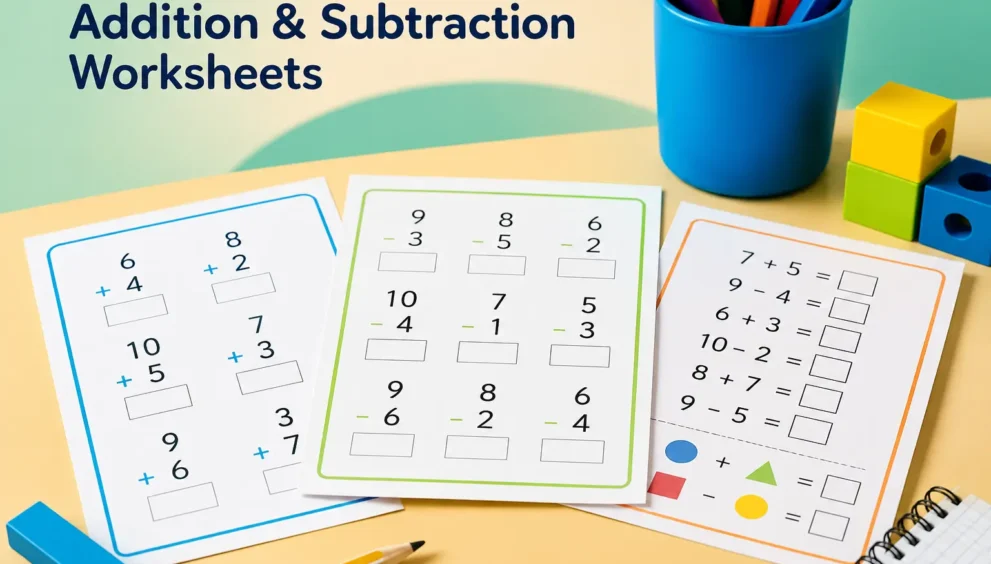
A good worksheet usually includes a mix of elements. There might be straightforward number problems like 7 + 5, alongside word problems that ask kids to apply the same skill to a real-life situation. Some worksheets focus purely on single-digit facts, while others push into double and triple digits with regrouping (also known as carrying and borrowing).
So why do these worksheets still matter in a world full of apps and tablets? Because writing numbers by hand, working through a problem step by step, and checking your own answer builds a kind of muscle memory that swiping on a screen just doesn’t replicate. Plus, worksheets are flexible. A parent can print one in two minutes. A teacher can hand out thirty in a classroom without needing Wi-Fi. That kind of accessibility is hard to beat.
Why These Worksheets Matter
Let’s talk benefits, because there are more than most people expect.
First, worksheets build repetition without boredom — at least when they’re designed well. Repetition is how math facts move from “I have to think about this” to “I just know this.” A child who practices 8 + 6 enough times eventually stops counting on their fingers and simply recalls the answer. That’s fluency, and fluency is the foundation for everything that comes after, from multiplication tables to algebra.
Second, worksheets give parents and teachers a clear window into where a child is struggling. If a student breezes through single-digit addition but stumbles every time regrouping shows up, that’s useful information. You now know exactly where to focus your next study session instead of guessing.
Third, worksheets are quiet confidence builders. There’s something satisfying about filling in a page of correct answers. Kids notice their own progress, and that sense of accomplishment often motivates them to keep going. On top of that, worksheets with fun themes — think holiday designs or color-by-number formats — turn practice into something kids actually look forward to, rather than something they dread.
Finally, worksheets are inexpensive and endlessly reusable. Once you have a printable PDF, you can print it again and again. No subscriptions, no login screens, no distractions from pop-up ads. Just paper, a pencil, and focused practice.
How Worksheets Improve Math Skills
It helps to understand what’s actually happening in a child’s brain during worksheet practice. When a student solves 24 + 15, they’re doing more than adding numbers. They’re recognizing place value, deciding whether regrouping is needed, and organizing their thinking in a logical sequence. Each repetition strengthens that mental pathway.
Over time, this repeated practice shifts math from a slow, effortful process to something closer to automatic recall. That shift matters enormously, because kids who still need to count on their fingers for basic facts in third or fourth grade often struggle with more advanced topics simply because their working memory is tied up with basic arithmetic instead of the new concept being taught.
Worksheets also encourage a habit that’s easy to overlook: checking your own work. A worksheet with an answer key teaches kids to verify their solutions, catch small mistakes, and build the kind of self-correction skills that serve them well far beyond math class.
Printable vs. Digital Worksheet
Before we get into grade-by-grade breakdowns, it’s worth addressing a question a lot of parents and teachers ask: should you go printable, digital, or both?
Printable worksheets have a few clear advantages. There’s no screen time involved, which many parents actively prefer during homework hours. Writing by hand also forces a slower, more deliberate thought process compared to tapping an answer on a screen. And practically speaking, a stack of printed worksheets doesn’t need charging, doesn’t crash, and works just as well on a kitchen table as it does in a classroom with no internet access.
Digital or interactive worksheets, on the other hand, shine when it comes to instant feedback. A child who solves a problem incorrectly on a screen usually finds out immediately, rather than waiting for a parent or teacher to check the page later. Some digital formats also adapt difficulty on the fly, offering easier problems when a child struggles and harder ones when they’re breezing through.
The honest answer is that neither format wins outright. Many successful routines blend both — printable worksheets for focused, screen-free practice sessions, and digital versions for quick review or when a child wants that immediate “did I get it right” confirmation. Choose based on what keeps your child engaged, not on which format seems more modern.
Printable Worksheets by Grade
Not every worksheet suits every age. A kindergartner and a fifth grader need very different levels of challenge, so let’s break this down grade by grade.
Kindergarten Worksheets
Kindergarten math is all about building number sense before diving into formal addition and subtraction. At this stage, worksheets typically rely heavily on pictures, objects, and simple counting exercises rather than abstract numbers alone.
A typical kindergarten worksheet might show three apples plus two apples and ask the child to count the total. Others use dot patterns, ten-frames, or number lines to help kids visualize what addition and subtraction actually mean. Numbers usually stay under 10, and problems are presented one at a time with plenty of white space so young learners don’t feel overwhelmed.
Themes matter a lot here too. Animal-themed worksheets, shape-based counting pages, and simple picture problems keep young children engaged far longer than plain number columns would.
Grade 1 Worksheets
By Grade 1, kids are ready to move from pictures to numbers, though visual supports still help. Worksheets at this level usually focus on single-digit addition and subtraction, with sums generally staying under 20.
You’ll see problems like 6 + 7 or 14 – 5, often paired with number lines or simple ten-frame visuals as backup tools. Grade 1 is also when many curricula introduce the idea of “fact families” — the relationship between addition and subtraction using the same three numbers. Grade 1 Worksheets that reinforce this connection early tend to pay off later.
Grade 2 Worksheets
In Grade 2, addition and subtraction with double-digit numbers really take center stage. Students start working with numbers in the tens and begin learning regrouping, which honestly trips up a lot of kids at first. That’s completely normal.
Worksheets at this level typically include problems like 34 + 28 or 52 – 19, with space for students to show their regrouping work. Mixed practice pages that combine both operations also become more common, helping kids learn to recognize which strategy a problem calls for.
Grade 3 Worksheets
Grade 3 pushes into three-digit numbers and more complex regrouping across multiple place values. Word problems also get more sophisticated, often involving multi-step reasoning instead of a single calculation.
A Grade 3 worksheet might present a problem like: “A school had 342 pencils. They ordered 176 more, then gave away 89 to a nearby classroom. How many pencils are left?” This kind of layered problem teaches kids to plan before they calculate, which is a skill they’ll lean on for years.
Grade 4 Worksheets
By Grade 4, students should have solid command of basic regrouping, so worksheets often introduce larger numbers, mental math shortcuts, and more elaborate word problems. Estimation also enters the picture — kids learn to predict a reasonable answer before solving, which helps them catch calculation errors.
Grade 5 Worksheets
Grade 5 worksheets typically blend addition and subtraction with related concepts like decimals and multi-digit multiplication contexts. Mixed operation worksheets are common here, requiring students to switch strategies mid-page. This flexibility mirrors real-world math, where problems rarely announce which operation to use.
Signs Your Child Is Ready to Move Up a Level
One question that comes up constantly: how do you know when it’s time to move from one worksheet level to the next? Moving too fast leads to frustration, but staying too long on easy material leads to boredom, so getting the timing right actually matters quite a bit.
A good rule of thumb is accuracy combined with speed. If your child consistently solves a worksheet with around 90% accuracy and doesn’t need to pause and think for more than a few seconds per problem, that’s usually a strong signal they’re ready for the next level of difficulty. On the other hand, if they’re getting frequent errors or taking a long time on every single problem, it’s worth staying at the current level a little longer, or even stepping back a level to rebuild confidence.
Another useful sign is how a child talks about the worksheet. Comments like “this is too easy” or rushing through without much effort often mean the material no longer challenges them. Conversely, sighing, erasing repeatedly, or asking for help on nearly every problem suggests the difficulty needs to come down a notch.
It also helps to introduce new difficulty gradually rather than all at once. If a child has mastered single-digit addition without regrouping, the next logical step is single-digit addition with slightly larger sums, not an immediate jump to three-digit regrouping. Small, steady increases in difficulty keep confidence intact while still driving growth.
Worksheets by Skill Level
Beyond grade level, it helps to think in terms of specific skills. This lets you target exactly what a child needs, regardless of their official grade.
Single-Digit Worksheets
These are the building blocks. Problems like 4 + 3 or 9 – 5 form the foundation of number fact fluency. Kids who master single-digit facts move faster and with more confidence through everything that follows, so it’s worth spending real time here even if it feels basic.
Double-Digit Worksheets
Once single-digit problems feel easy, double-digit problems like 24 + 15 or 56 – 22 introduce place value more explicitly. This is often the first point where kids need to line up numbers carefully by ones and tens columns, which is a small but important organizational skill.
Three-Digit Worksheets
Three-digit problems, such as 342 + 176 or 785 – 453, add another layer of complexity. Students need to track regrouping across two separate place values instead of just one, which is exactly why this level deserves its own dedicated practice rather than being lumped in with double-digit work.
Without Regrouping
Worksheets without regrouping are ideal for beginners or for reinforcing basic place value understanding before adding the complexity of carrying and borrowing. Problems here are chosen specifically so no regrouping is required — for example, 23 + 14 or 58 – 26 — letting kids focus purely on the addition or subtraction process itself.
With Regrouping
Regrouping worksheets are, without question, one of the most requested and most useful categories. This is the skill that trips up the widest range of students, and dedicated practice makes a measurable difference. A worksheet might include problems like 48 + 37 or 72 – 48, guiding students step by step through carrying a ten or borrowing from the next column.
Mixed Practice Worksheets
Once a student is comfortable with both addition and subtraction separately, mixed practice worksheets combine the two on a single page. This forces kids to actually read each problem carefully instead of assuming every question uses the same operation — a habit that pays off enormously on tests.
A sample mixed page might look like this:
- 12 + 8
- 19 – 7
- 45 + 12
- 90 – 33
Simple on the surface, but switching between operations mid-page builds flexibility that single-operation worksheets simply can’t offer.
Word Problems
If straight number problems are the skeleton of math practice, word problems are the muscle that makes it useful in real life. Kids need to translate a sentence into a math equation, and that translation step is often harder than the calculation itself.
Take this example:
Emma has 12 apples. She buys 8 more. How many apples does she have now?
Simple, but it requires the student to recognize that “buys more” signals addition. Compare that to:
A classroom has 30 students. 12 students go to the library. How many students remain?
Here, “remain” signals subtraction. Word problem worksheets that mix these signal words together teach kids to read for meaning rather than just scanning for numbers, which is genuinely one of the most valuable skills a worksheet can build.
Missing Number Worksheets
Missing number problems flip the traditional format on its head. Instead of solving for a final answer, students solve for a hidden piece of the equation. For example:
- __ + 7 = 13
- 15 – __ = 8
This format strengthens algebraic thinking early on, long before kids ever hear the word “algebra.” It also deepens their understanding of the relationship between addition and subtraction, since solving for a missing addend often means working backward using subtraction, and vice versa.
Fact Family Worksheets
Fact families show how three numbers connect through both addition and subtraction. Take the numbers 3, 5, and 8:
- 3 + 5 = 8
- 5 + 3 = 8
- 8 – 3 = 5
- 8 – 5 = 3
Fact family worksheets typically present three numbers and ask students to write out all four related equations. This exercise cements the idea that addition and subtraction aren’t separate, unrelated skills — they’re two sides of the same coin. Once that clicks, a lot of other math concepts become easier to grasp.
Fun Formats That Keep Kids Engaged
Not every worksheet has to look like a page from a textbook. In fact, some of the most effective ones don’t.
Color-by-number worksheets turn math practice into art. Kids solve a problem, match the answer to a color code, and fill in a section of a picture. By the time the worksheet is done, they’ve solved a dozen or more problems without even realizing how much practice they just got through.
Cut-and-paste worksheets work especially well for younger learners. Kids solve a problem, then cut out the matching answer and glue it into place. The hands-on element helps with fine motor skills too, which is a nice bonus for early elementary classrooms.
Holiday and seasonal worksheets bring a bit of festive fun into practice time. Think pumpkin-themed subtraction in October, snowflake addition in December, or springtime flower counting pages. These themed sheets don’t just entertain — they also tend to boost engagement precisely because they feel different from everyday homework.
Interactive Practice
Beyond printable pages, interactive practice adds another layer of value, especially for kids who enjoy a bit of variety. Interactive questions let students type or click their answers and get instant feedback, which speeds up the learning loop considerably.
Here’s an example of the format:
Question 1: 9 + 8 = ? Question 2: 15 – 6 =?
Instant feedback matters because kids don’t have to wait until the next day to find out whether they got something right. That immediacy keeps motivation high and helps correct small misunderstandings before they turn into bigger gaps.
Why Answer Keys Matter
It’s easy to overlook, but answer keys are genuinely one of the most requested features by teachers and homeschooling parents alike. Without one, checking a stack of worksheets becomes a slow, error-prone process.
A worksheet with a built-in answer key saves time, but more importantly, it teaches independence. Older kids can check their own work, identify mistakes, and correct them without waiting for an adult to grade every single problem. That small shift builds ownership over their own learning, which is worth far more than the time it saves.
Tips for Parents
If you’re using worksheets at home, a few small adjustments can make a big difference.
Start with short, consistent sessions rather than long, occasional ones. Ten to fifteen minutes of focused practice most days beats a single overwhelming hour once a week. Kids retain more when practice is spaced out, and shorter sessions are far less likely to trigger frustration or burnout.
Next, mix up the format. If your child has been staring at plain number worksheets for a week straight, switch to a color-by-number page or a set of word problems instead. Variety keeps things fresh, and fresh keeps kids willing to sit back down at the table.
Also, resist the urge to jump in the moment your child hesitates. A few seconds of thinking time is normal, and it’s often exactly when real learning happens. If they get stuck for longer, ask guiding questions instead of giving the answer directly — something like, “What do you think happens when you add a ten?” tends to work better than simply stating the solution.
Finally, celebrate progress rather than perfection. A worksheet with a few mistakes but genuine effort is worth more than a perfect page completed with zero engagement. Building confidence matters just as much as building accuracy, especially in the early years.
Tips for Teachers
In a classroom setting, worksheets work best as part of a larger strategy rather than a standalone activity.
Differentiation is key. Not every student in a class is at the same level, so having a range of worksheets — from without-regrouping basics to more advanced three-digit regrouping — lets you meet each student where they actually are, instead of teaching to the middle and hoping everyone keeps up.
Worksheets also work well as informal assessment tools. A quick five-question warm-up at the start of class can reveal exactly which concepts need review before you move into new material. This kind of low-stakes check-in is far less stressful for students than a formal quiz, yet it gives you nearly the same insight.
For homework, consider sending worksheets that reinforce the day’s lesson rather than introducing brand-new material. Kids are far more successful practicing something they’ve already seen in class than struggling through unfamiliar territory alone at the kitchen table.
Lastly, don’t underestimate the value of themed or game-style worksheets in the classroom. A holiday-themed page or a color-by-number sheet can serve as a nice change of pace after a stretch of more traditional lessons, keeping engagement high without sacrificing the actual learning goal.
Common Mistakes to Avoid
Even with the best worksheets, a few common pitfalls can undercut their effectiveness.
One frequent mistake is jumping to regrouping too early. If a child hasn’t fully mastered basic addition and subtraction facts, introducing carrying and borrowing on top of that shaky foundation usually just creates confusion. It’s better to build fluency first, then layer in regrouping once the basics feel automatic.
Another common issue is relying on a single worksheet format for too long. Repetition is useful, but endless identical pages can quickly turn into busywork that a child completes on autopilot without actually engaging their brain. Mixing formats — number problems, word problems, missing numbers, fact families — keeps practice meaningful.
Skipping word problems is another mistake worth avoiding. It’s tempting to stick with straightforward number equations because they’re faster to complete, but word problems build the reading and reasoning skills that pure number practice simply can’t replicate. A well-rounded worksheet routine includes both.
Finally, ignoring answer keys — or not checking work at all — lets small misunderstandings snowball. A child who consistently makes the same regrouping error on ten problems in a row isn’t practicing correctly; they’re practicing a mistake. Regular checking catches these patterns early, before they become hard-to-break habits.
How to Choose the Right Worksheet
With so many options available, picking the right worksheet can feel a little overwhelming. A simple approach: start with your child’s current comfort level, not their official grade. If a fourth grader is still shaky on double-digit regrouping, there’s nothing wrong with pulling a Grade 2 or Grade 3 worksheet instead of forcing grade-level material that just leads to frustration.
From there, rotate through skill types over the course of a week — some single-digit fluency practice, a regrouping page, a word problem set, and maybe a fun themed worksheet to close things out. This kind of balanced rotation covers more ground than repeatedly drilling the same skill in isolation.
Building a Weekly Worksheet Routine
Knowing which worksheets exist is one thing. Actually building them into a workable weekly routine is another challenge entirely, so let’s put together a simple structure you can adapt.
Monday: Start the week with a quick fluency warm-up — a single-digit or double-digit worksheet without regrouping. This eases kids back into practice mode after the weekend without overwhelming them right out of the gate.
Tuesday: Move into regrouping practice, since this is usually the skill that needs the most repetition. A short, focused worksheet of eight to ten regrouping problems works well here.
Wednesday: Switch gears with word problems. Reading-based math practice uses a slightly different mental muscle, and spacing it out through the week keeps things varied rather than repetitive.
Thursday: Try a fun format — color-by-number, cut-and-paste, or a themed seasonal worksheet. Midweek is often when motivation dips, so a more playful worksheet can re-energize the routine.
Friday: Wrap up with mixed practice that combines everything covered during the week. This acts as a mini review and gives you a clear sense of what stuck and what might need revisiting next week.
This kind of rotation prevents the single biggest worksheet pitfall: sameness. A child who does the exact same style of page every day, even if the numbers change, tends to disengage faster than one who never quite knows what Thursday’s worksheet will look like.
Worksheets for Homeschooling Families
Homeschooling parents often lean on worksheets even more heavily than traditional classrooms, mainly because worksheets offer a built-in curriculum structure without requiring a teaching degree to implement. If this describes your situation, a few extra considerations can help.
Because homeschool schedules tend to be more flexible, it’s easy to fall into inconsistent practice patterns. Setting a fixed time each day, even if it’s brief, helps addition and subtraction skills stick far better than sporadic, longer sessions squeezed in whenever there’s spare time.
It also helps to keep a simple tracking sheet alongside your worksheets, noting which skills your child has mastered and which still need work. Since homeschooling parents don’t have a school system automatically tracking progress, this kind of lightweight record keeps you from accidentally skipping a skill or over-practicing one your child has already nailed.
Finally, don’t hesitate to mix grade levels within the same child’s routine. Homeschooling gives you the freedom to pull a Grade 2 regrouping worksheet and a Grade 4 word problem worksheet on the very same day if that matches where your child actually stands in each specific skill area. That flexibility is one of homeschooling’s biggest advantages, so it’s worth taking full advantage of it.
Free vs. Paid Worksheet Resources
One more practical question worth addressing: should you stick with free worksheets, or is it worth paying for a curated set?
Free worksheets are a great starting point, and honestly, they cover most everyday needs. If you just need a batch of double-digit regrouping problems for tonight’s homework, a free printable does the job perfectly well. The main downside is consistency — quality and difficulty can vary quite a bit from one free source to another, so you may need to preview a page before printing it to make sure it actually matches your child’s level.
Paid worksheet bundles or subscription platforms tend to offer more structure. They’re often organized into clear progressions, grouped by grade and skill, and include extras like answer keys, tracking sheets, and themed sets for every season. For a classroom teacher managing thirty students across multiple skill levels, or a homeschooling parent who wants a ready-made year-long plan, that extra structure can genuinely save hours of prep time.
There’s no wrong answer here — it really comes down to how much time you have to search, sort, and organize worksheets yourself versus how much you’d rather have that structure handed to you. Many families end up using a blend: free worksheets for quick daily practice, and a paid set for the more structured, long-term skill progression.
Frequently Asked Questions
What age are addition and subtraction worksheets for?
These worksheets suit a wide range, generally from age four or five through age eleven, depending on the complexity of the problems. Kindergarten worksheets focus on simple counting, while Grade 5 worksheets tackle more advanced multi-digit problems.
How many worksheets should a child complete daily?
There’s no single magic number, but most educators suggest one to two short worksheets a day, totaling around ten to twenty minutes of focused practice. Consistency tends to matter more than volume.
What is regrouping?
Regrouping, sometimes called carrying or borrowing, is the process of exchanging value between place value columns during addition or subtraction. For example, when adding 48 + 37, you regroup ten ones into one ten to keep the columns balanced.
Can I print these worksheets?
Yes, printable worksheets are designed specifically for home or classroom printing. Most come as downloadable PDFs that you can print as many times as needed.
Are answer keys included?
Good worksheet sets always include an answer key, which makes checking work faster and helps kids learn to self-correct.
Which worksheets are best for Grade 2?
Grade 2 students typically benefit most from double-digit addition and subtraction worksheets, along with an introduction to basic regrouping and simple word problems.
Do worksheets work better than apps for learning math?
Neither format is strictly better — they serve different purposes. Worksheets build handwriting, sequential thinking, and offline focus, while apps often provide instant feedback and gamified motivation. Many families find a mix of both works best.
How do I know if my child needs more regrouping practice?
If your child consistently makes errors on double- or triple-digit problems but handles single-digit facts easily, that’s usually a sign regrouping needs extra attention.
Should I time my child while they complete a worksheet?
Timing can be useful once basic accuracy is solid, since fluency ultimately means solving facts quickly and correctly. However, introducing a timer too early — before a child feels confident — can create unnecessary anxiety. It’s usually better to build accuracy first, then add gentle timing later as a fun challenge rather than a pressure test.
What’s the difference between addition worksheets and subtraction worksheets versus a combined worksheet?
Single-operation worksheets isolate one skill at a time, which is useful when a child is first learning a concept or needs focused repetition on something specific like regrouping in subtraction. Combined worksheets, by contrast, mix both operations on the same page, which better reflects real tests and real-life math, where you rarely know in advance which operation a problem requires.
Are worksheets still useful once a child starts using a calculator in later grades?
Yes, though the purpose shifts a bit. In early grades, worksheets build the mental fluency that makes later math faster and less error-prone. Even once calculators enter the picture, that early foundation still matters, since students who never built solid number sense often struggle to catch calculator input errors or estimate whether an answer seems reasonable.
How These Worksheets Fit Into the Bigger Math Picture
It’s worth zooming out for a moment. Addition and subtraction worksheets aren’t just isolated homework pages — they’re the entry point into a much larger math journey. The place value understanding built through double- and triple-digit regrouping directly supports multiplication and division later on.
The habit of checking your own work against an answer key carries forward into every math class a student will ever take. Even the pattern recognition involved in fact families lays early groundwork for algebraic thinking. This is exactly why a scattered, inconsistent approach to worksheets tends to leave gaps that show up years later.
A student who never fully solidified regrouping in second or third grade often hits a wall when fractions and long division show up, simply because those topics assume that earlier foundation is already solid. Treating worksheets as a serious, structured part of early math education — rather than an afterthought — pays off far beyond the current school year.
Final Thoughts
Addition and subtraction worksheets have stuck around for a reason — they work. From simple counting pages for kindergartners to multi-step word problems for fifth graders, the right worksheet at the right time builds real, lasting number confidence.
The key is variety and consistency. Rotate through different formats, match the difficulty to where your child or student actually is, and don’t skip word problems just because they take a little longer to solve. Pair that with regular answer-key checks, and you’ve got a practice routine that genuinely moves the needle.
Whether you’re a parent trying to make homework time a little less painful, or a teacher building out a full topical resource for your classroom, addition and subtraction worksheets remain one of the simplest, most effective tools in the entire math education toolbox. Print a few, hand over a pencil, and let the practice do its work.