
IT Business Solutions Help Reduce Business Operating Costs
Running a business today costs more than it did a few years ago. Rent, wages, supplies, and utilities keep climbing, and profit margins keep shrinking. So, business owners are looking for smarter ways to cut expenses without hurting quality or slowing down growth. That’s where IT business solutions come in. The right technology doesn’t just make work easier — it also lowers day-to-day operating costs in ways that add up fast.
Choosing where to invest first often comes down to making better business decisions about which tools actually move the needle.
In this article, we’ll walk through the most effective IT solutions that help businesses save money, boost efficiency, and stay competitive, even against larger companies with bigger budgets.
Why Technology Matters for Cost Control
Every business has operating costs: labor, maintenance, software, office space, and more. Cutting these costs the old-fashioned way often means layoffs or lower-quality materials. Neither option is good for long-term growth. Technology offers a better path. It removes waste, speeds up daily tasks, and reduces the number of errors that quietly drain company budgets.
Businesses that invest in c often see savings across almost every department, from customer service to finance to inventory management. Let’s break down the specific solutions making the biggest impact.
Cloud Computing: Pay for Only What You Use
Cloud computing has changed how companies handle their data and software. Instead of buying expensive servers and hardware, businesses can now rent computing power on demand. Platforms in this space let companies scale up or down depending on their needs, so they never pay for resources sitting idle.
This shift also cuts maintenance and IT support costs since the cloud provider handles most of the technical upkeep. For small and mid-sized businesses especially, cloud tools remove the need for a large in-house server room, which saves on both equipment and energy bills.
Automation and Robotic Process Automation (RPA)
Repetitive tasks eat up hours of employee time every week. Data entry, invoice processing, and basic customer replies are all common examples. Automation software and RPA tools take over these tasks, freeing employees to focus on higher-value work.
Beyond saving time, automation also reduces human error. Fewer mistakes mean fewer costly fixes down the line. Many companies use automated chatbots to answer routine customer questions, which cuts down on staffing needs for basic support roles while still keeping customers happy.
Artificial Intelligence and Machine Learning
AI and machine learning tools analyze large amounts of business data quickly, spotting patterns that would take a human team much longer to find. This helps companies make smarter decisions about inventory, marketing, and operations.
One major benefit is predictive maintenance. AI can flag equipment issues before they cause a breakdown, which prevents expensive emergency repairs and unplanned downtime. AI also helps optimize supply chains, reducing waste and improving delivery timelines.
Managed IT Services: Outsourcing Without the Overhead
Not every business can afford a full in-house IT department, and honestly, most don’t need one. Managed IT service providers offer a subscription-based alternative that gives companies access to expert support without the cost of full-time salaries and benefits.
These providers handle network management, cybersecurity monitoring, help desk support, and equipment procurement. Because they work with many clients, they can also negotiate better rates on hardware and software licenses, passing those savings on to their customers. Predictable monthly billing also makes budgeting far easier, since there are no surprise repair bills or emergency IT costs.
Cybersecurity: An Investment, Not Just an Expense
It might seem like cybersecurity software is just another cost, but skipping it can be far more expensive in the long run. A single data breach or ransomware attack can shut down operations for days and damage a company’s reputation.
Modern cybersecurity tools, including firewalls, monitoring software, and automatic backups, protect sensitive data while keeping systems running smoothly. Businesses that invest in strong cybersecurity avoid the much larger costs tied to downtime, lost customer trust, and recovery efforts after an attack.
Remote Work and Collaboration Tools
Office space is one of the highest fixed costs a business carries. Rent, utilities, furniture, and maintenance add up quickly. Remote work tools have made it possible for companies to shrink their physical footprint, or in some cases, eliminate it entirely.
Platforms built for video calls, instant messaging, and shared file storage let teams collaborate from anywhere. Employees can work faster with fewer distractions, and businesses save on everything from office rent to daily commuting-related overhead. Cloud-based file sharing also removes the need to email documents back and forth, keeping teams aligned in real time.
CRM Platforms for Smarter Customer Management
Customer relationship management (CRM) software gives businesses a full view of their customer interactions in one place. Instead of juggling spreadsheets and scattered notes, sales and support teams can track conversations, purchase history, and preferences from a single dashboard.
This leads to better-targeted marketing, fewer wasted sales efforts, and stronger customer retention. Since retaining an existing customer is usually cheaper than acquiring a new one, CRM tools indirectly reduce marketing spend while improving revenue.
ERP Software: One System, Fewer Headaches
Enterprise resource planning (ERP) software connects departments like finance, inventory, HR, and sales into a single system. This removes duplicate data entry and gives leadership real-time visibility into operations.
With ERP in place, businesses can plan resources more accurately, avoid overstocking inventory, and catch inefficiencies before they become expensive problems. It’s a strong example of technology that pays for itself through better decision-making.
Going Paperless with Digital Documentation
Printing, storing, and mailing paper documents costs more than most businesses realize once postage, ink, and physical storage space are added up. Digital documentation tools, including electronic signature software, let companies handle contracts and approvals entirely online.
This speeds up the signing process, removes the need for in-person meetings, and cuts material costs significantly. It’s also a simple way to make a business more environmentally friendly, which is becoming increasingly important to customers and partners alike.
Project Management and Task Tracking Tools
Keeping projects organized without the right tools often leads to missed deadlines and duplicated work. Project management software gives teams a shared space to assign tasks, track progress, and share files securely.
Features like time tracking and calendar integration help managers spot bottlenecks early and allocate resources more effectively. This kind of visibility reduces wasted labor hours, which is one of the most overlooked areas of operating cost.
Bringing It All Together
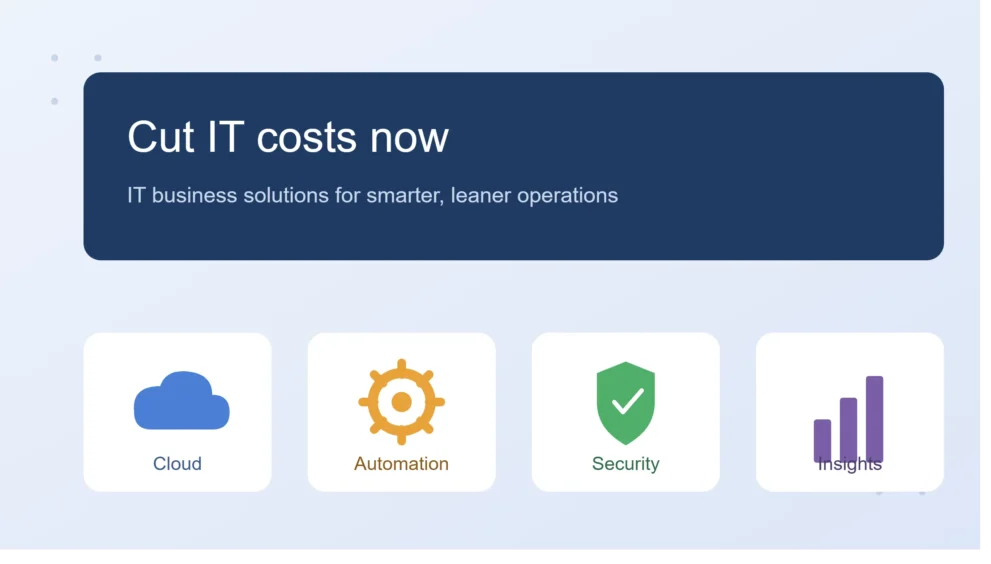
Reducing business operating costs doesn’t have to mean cutting staff or sacrificing quality. IT business solutions offer a smarter alternative. Cloud computing, automation, AI, managed IT services, cybersecurity, remote work tools, CRM platforms, ERP systems, digital documentation, and project management software each tackle a different area of waste and inefficiency.
The businesses that adopt these tools early tend to build a real advantage. They spend less on overhead, make fewer costly mistakes, and free up their teams to focus on growth instead of repetitive tasks. Technology has moved from being a “nice to have” to a core part of any serious cost-reduction strategy.
For companies looking to stay competitive without stretching their budget thin, the message is simple: the right IT investment today can lead to meaningful savings tomorrow.
Conclusion
Cutting business operating costs doesn’t have to mean smaller teams or lower-quality products. IT business solutions offer a smarter way forward. Cloud computing, automation, AI, managed IT services, cybersecurity, remote work tools, CRM platforms, ERP systems, digital documentation, and project management software each solve a different piece of the cost puzzle.
Companies that adopt these tools early build a real edge. They spend less on overhead, avoid costly mistakes, and give their teams more time to focus on growth instead of repetitive daily tasks. Technology is no longer just a support function — it’s a core part of any real cost-reduction strategy.
If your business wants to stay competitive without stretching its budget, the takeaway is simple: smart IT investment today leads to real savings tomorrow.