
How IT Business Solutions Turn Data Into Better Decisions
Business analytics has become one of the most important parts of modern business growth. Today, companies do not only need data. They need clean, useful, and timely data that helps them make better decisions. This is where an IT business solution becomes valuable.
In the past, many businesses used spreadsheets, manual reports, and disconnected tools to understand performance. These methods worked for small tasks, but they often caused delays, errors, and confusion. For example, one team might track sales in one system, while another team tracks customer data in another system. When information stays scattered, business leaders cannot see the full picture.
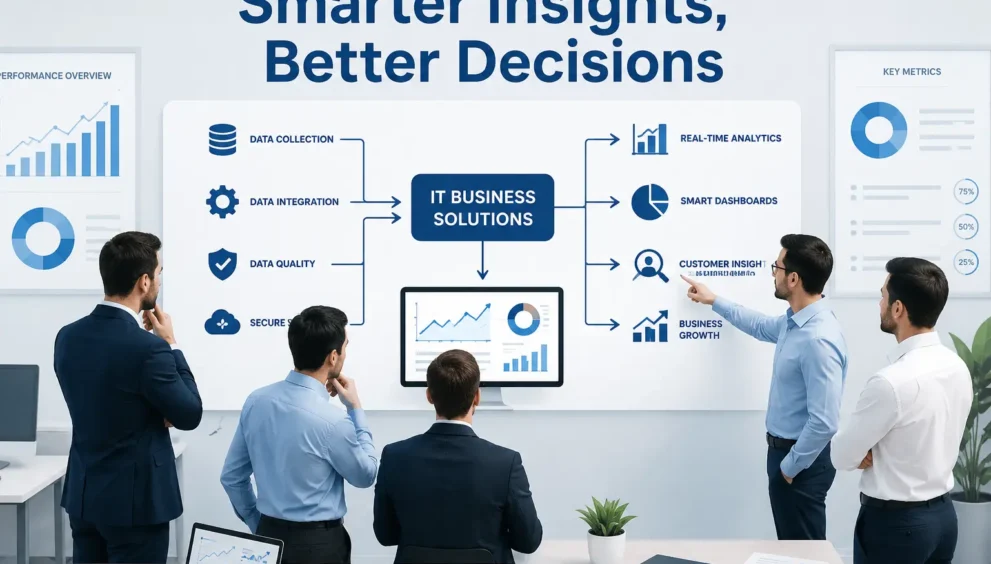
Modern IT business solutions solve this problem by connecting data, tools, teams, and processes into a single, smarter system. They help businesses collect information, organize it, analyze it, and turn it into clear insights. As a result, decision-making becomes faster, more accurate, and more useful.
Why Business Analytics Matters Today
Business analytics helps companies understand what is happening inside their business. It also helps them understand why something happened, what may happen next, and what action they should take. This makes analytics more powerful than simple reporting.
For example, a basic report may show that sales dropped last month. However, business analytics can go deeper. It can show whether sales dropped because of low website traffic, poor customer response, pricing issues, delayed delivery, or weak marketing performance.
This level of insight helps businesses move from guessing to planning. Instead of making decisions based on opinions, companies can use real data to improve results.
How IT Business Solutions Improve Data Collection
Good analytics starts with good data. If the data is incomplete, outdated, or spread across too many systems, the final insight will not be reliable. IT business solutions improve this by bringing data from different sources into one organized system.
These sources may include:
Customer relationship management tools
Sales platforms
Finance software
Website analytics
Inventory systems
Marketing platforms
Customer support tools
Cloud databases
When these systems are connected, businesses can see their operations more clearly. For example, a company can compare marketing campaigns with sales results, customer behavior, and support requests. This creates a more complete view of business performance.
Better Data Quality and Accuracy
One major problem in business analytics is poor data quality. Duplicate records, missing values, wrong entries, and inconsistent formats can damage decision-making. IT business solutions help reduce these problems through automation, validation, and standard data rules.
For example, if customer names, email addresses, or order details are entered differently in multiple systems, analytics reports may become confusing. A smart IT system can clean, match, and organize this data before it reaches dashboards or reports.
This improves trust. When business leaders trust the data, they make decisions with more confidence.
Real-Time Analytics for Faster Action
Older reporting methods often depend on weekly or monthly updates. However, many business decisions now need faster responses. Real-time analytics helps companies monitor important changes as they happen.
For example, an online store can track product demand in real time. If one product starts selling quickly, the business can adjust inventory, pricing, or advertising. Similarly, a support team can monitor customer complaints and identify common issues before they grow.
IT business solutions make this possible by using cloud systems, live dashboards, and automated data pipelines. This helps companies respond quickly instead of waiting for old reports.
Business Intelligence and Clear Dashboards
Business intelligence tools are an important part of business analytics. They help turn complex data into simple charts, dashboards, and reports. Instead of reading long spreadsheets, managers can view key numbers in a clear visual format.
Dashboards can show:
Sales performance
Customer trends
Marketing results
Inventory levels
Profit margins
Team productivity
Forecasting data
This makes analytics easier for non-technical users. A business owner, manager, or department head can understand performance quickly without needing deep technical knowledge.
Using Analytics to Improve Growth, Efficiency, and Future Planning
IT business solutions do more than organize data. They help companies use analytics to improve real business outcomes. This includes better planning, stronger customer understanding, improved operations, and smarter use of resources.
One important area is customer analytics. Businesses can study customer behavior, buying patterns, preferences, and feedback. This helps them create better marketing campaigns, improve customer service, and offer more relevant products.
For example, if analytics shows that customers often leave the checkout page before buying, the business can improve the checkout process. If reports show that one customer group responds better to email campaigns, the marketing team can focus more on that audience.
Predictive Analytics and Future Planning
Predictive analytics helps businesses look ahead. Instead of only studying past performance, companies can forecast future trends. This is useful for sales planning, inventory management, customer demand, and risk control.
For example, a retail business can predict which products may sell more during a specific season. A finance team can forecast cash flow. A service company can predict busy periods and prepare staff in advance.
IT business solutions support predictive analytics by using machine learning, historical data, and cloud-based analytics tools. This allows businesses to plan before problems happen.
Data Security and Governance
Business analytics often involves sensitive data. This may include customer details, financial records, employee information, and private business reports. Because of this, security is very important.
Modern IT business solutions improve business analytics by adding access control, data protection, secure storage, and user permissions. This means only the right people can view or edit important information.
Data governance also helps businesses keep their analytics consistent. It defines how data should be collected, stored, used, and shared. This reduces confusion and improves compliance.
How Businesses Can Use Analytics Across Departments
Business analytics can support almost every department. In marketing, it helps improve campaigns and customer targeting. In finance, it supports budgeting and risk analysis. In operations, it helps reduce delays and improve processes. In HR, it can support hiring, employee performance tracking, and workforce planning.
This is why IT business solutions are not only technical tools. They are business growth tools. They connect people, processes, and data so every department can work with better information.
The Future of Business Analytics
The future of business analytics will become more intelligent, automated, and real-time. Artificial intelligence will help businesses find patterns faster. Cloud computing will make analytics more scalable. Automation will reduce manual reporting. Real-time dashboards will help teams act quickly.
However, technology alone is not enough. Businesses also need clear goals, clean data, trained teams, and strong decision-making habits. When these elements work together, analytics becomes a powerful business advantage.
Conclusion
IT business solutions improve business analytics by making data easier to collect, manage, understand, and use. They help businesses move away from slow manual reports and toward smarter, faster, data-driven decisions.
With the right systems, companies can improve customer experience, reduce costs, forecast future trends, protect sensitive data, and increase operational efficiency. More importantly, they can make decisions based on facts instead of guesswork.
In today’s competitive market, better analytics is not just helpful. It is essential for long-term business success.