



Istikhara Dua: Authentic Method, Meaning, and Islamic Guidance

Istikhara Dua: Authentic Method, Meaning, and Islamic Guidance
Istikhārah and Consultation
(Chapter on seeking guidance and consultation)
Explanation of Seeking Advice and Mutual Consultation
The Prophet ﷺ Used to Consult the Companions رضي الله عنهم
Qur’anic Command for Consultation
قال الله تعالى:
﴿وَشَاوِرْهُمْ فِي الْأَمْرِ﴾
(Surah Aal-e-Imran: 159)
Translation:
“Consult them in matters.”
Explanation (تشریح)
Allah Almighty directly commanded the Prophet ﷺ to consult the Companions رضي الله عنهم, even though the Prophet ﷺ received divine revelation. This clearly shows the importance of consultation (Shūrā) in Islam.
If Allah instructed His Messenger ﷺ to consult others, then ordinary people are far more in need of consultation. A person who consults others does not regret their decision, while a person who avoids consultation often faces loss.
From Whom Should Advice Be Taken?
Hazrat Ali رضي الله عنه narrates that after the passing of the Prophet ﷺ, whenever an issue arose for which there was no clear ruling in the Qur’an or Sunnah, the Companions رضي الله عنهم would consult one another.
The Prophet ﷺ trained the Companions on consultation, and through mutual discussion, they would arrive at the best and most balanced decision.
The Companions Conducted Their Affairs Through Mutual Consultation
Qur’anic Evidence
God Almighty said: “And their affair is [conducted by] consultation among themselves.” (Surah Ash-Shura: 38)
Translation:
“And their affairs are conducted by mutual consultation.”
Explanation (تشریح)
This verse explains that the believers manage their affairs through consultation. In Islam, making decisions through consultation is a sign of wisdom, righteousness, and sound judgment.
The very name “Shura” highlights the importance of consultation in Islam. This verse proves that Muslims must consult one another in important matters.
References:
روضة الطالبين، ج 4، ص 232
(Raudat-ut-Talibeen, Vol. 4, p. 232)
Consultation in All Matters of Life
Whether it is:
- Business
- Judiciary
- Acts of worship
Consulting knowledgeable people in every matter brings benefit and protection from loss.
References:
- Ahkām al-Qur’ān (Rulings of the Qur’an) (احکام القرآن)
- Uwais al-Qarani (اويس القرن )
- Rūḥ al-Ma‘ānī (The Spirit of Meanings) (روح المعاني)
The Prophet ﷺ Used to Teach Istikhāra Like a Surah of the Qur’an
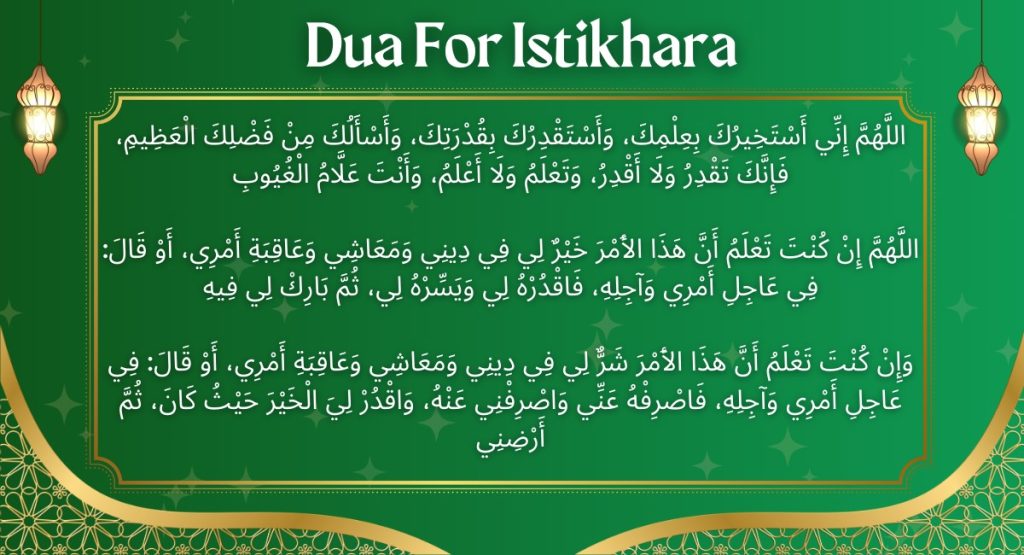
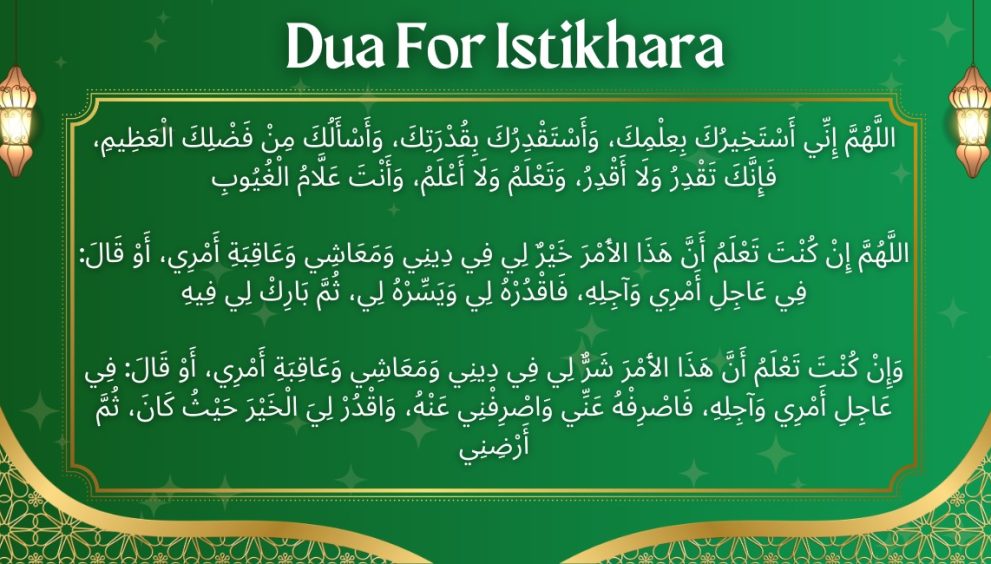
Hadith on Istikhara Dua
عن جابر رضي الله عنه قال:
كان رسولُ الله ﷺ يُعلِّمُنا الاستخارةَ في الأمورِ كلِّها، كما يُعلِّمُنا السورةَ من القرآن…
(Full Hadith remains unchanged exactly as provided)
O Allah, I seek Your guidance through Your knowledge… then make me content with it. He said, and he mentions his need. (Narrated by Al-Bukhari)
Translation of the Hadith
Hazrat Jabir رضي الله عنه narrates that the Messenger of Allah ﷺ used to teach Istikhārah for all matters just as he taught a Surah of the Qur’an. When someone intends to do something, they should pray two non-obligatory rak‘ahs and then recite this Istikhara Dua, asking Allah for guidance, power, and goodness in both present and future affairs.
(Reported by Bukhari)
Explanation of the Hadith
This hadith proves that Istikhārah is a fundamental Sunnah, taught with great importance. The servant admits his weakness and seeks Allah’s knowledge and power because Allah knows everything and humans do not.
Every task of life — big or small — such as:
- Business
- Travel
- Marriage
- Important decisions
Should begin with Istikhara Dua, so Allah guides the person toward what is best.
Vocabulary (لغات)
Istikhārah (الاستخارہ):
To seek goodness from Allah before making a decision.
Istikhār (استخار):
To ask Allah for guidance.
‘Ājil (عاجل):
Something immediate.
Ajl (أجل):
A fixed appointed time.
‘Ajlah (عجلہ):
Haste without proper thought.
Meaning Explanation:
- Ajl: Fixed time decreed by Allah
- ‘Ājil: Something near or immediate
- ‘Ajlah: Acting hastily without reflection
What Is Istikhārah?
Istikhārah means asking Allah for goodness in matters where a person is unsure which option is better. It is performed only in permissible (halal) matters.
Istikhārah Is NOT Required For:
- Obligatory acts (Salah, fasting, etc.)
- Clearly forbidden acts (haram)
Istikhārah Should Be Done When:
- Confused between two permissible options
- Unsure about long-term outcomes
Incorrect Understanding of Istikhārah
Many people mistakenly believe Istikhārah means:
- Seeing a dream
- Seeing green or white colors
- Receiving guidance only through sleep
This understanding is incorrect.

Reality of Istikhārah:
- A dream is not necessary
- No supernatural sign is required
- Allah guides through ease, inclination, and circumstances
Scholarly Explanations
Statement of Maulana Ashraf Ali Thanvi (may Allah have mercy on him)
Istikhārah means asking Allah to make the chosen matter easy and beneficial. Seeing a dream is not compulsory. Sometimes Allah guides the heart, and sometimes He opens the path practically.
Statement of Hazrat Shah Waliullah (may Allah have mercy on him)
After Istikhārah, one should:
- Consult knowledgeable people
- Use intellect and reasoning
- Proceed with confidence
If a matter becomes easy, it is a sign of goodness.
Arabic Du‘ā (Kept Exactly as It Is)
اَللّٰهُمَّ خِرْ لِي وَاخْتَرْ لِي
English Explanation:
“O Allah, choose what is best for me and select it on my behalf.”
This reflects complete trust in Allah, even when His choice differs from personal desire.
Frequently Asked Questions (FAQs)
1. How to do Istikhara in the Islamic way?
Istikhara is performed by praying two non-obligatory rak‘ahs and then reciting the Istikhara dua taught by the Prophet ﷺ. This method is proven from an authentic Hadith narrated by Hazrat Jabir رضي الله عنه. Istikhara should be done only for permissible (halal) matters where a person is unsure about the best decision.
2. What did Prophet Muhammad ﷺ say about Istikhara?
The Prophet ﷺ used to teach Istikhara like a Surah of the Qur’an. He instructed that whenever someone intends to do something, they should pray two rak‘ahs and then make the Istikhara supplication, asking Allah for guidance, ease, and blessing. This Hadith is reported in Sahih Bukhari.
3. Can I pray Istikhara for guidance in any matter?
Istikhara can be prayed only for matters that are permissible in Islam. It is not required for obligatory acts (such as Salah or fasting) or clearly forbidden acts. Istikhara is recommended when a person is confused between two or more halal options and seeks Allah’s guidance.
4. How do you know if Allah accepted your Istikhara dua?
Acceptance of Istikhara is not dependent on dreams or colors. According to authentic Islamic understanding, Istikhara is accepted when Allah creates ease, clarity, or inclination toward a decision, or removes obstacles from a harmful option. Guidance may appear through circumstances rather than signs.
5. Is it necessary to see a dream after Istikhara?
No, seeing a dream is not necessary. This is a common misconception. Scholars have clearly stated that Istikhara does not require a dream or supernatural sign. The real outcome of Istikhara is Allah’s guidance through ease, direction, and contentment of the heart.
6. What is the Istikhara dua in Arabic?
The Istikhara dua is the supplication taught by the Prophet ﷺ, beginning with:
اللهم إني أستخيرك بعلمك…
This dua asks Allah for guidance, power, goodness in present and future affairs, and satisfaction with His decision. The Arabic dua should be recited exactly as it was taught.
7. Can a person perform Istikhara along with consultation (Shura)?
Yes. Islam strongly emphasizes consultation (Shura) along with Istikhara. The Qur’an commands consultation, and the Prophet ﷺ himself consulted the Companions رضي الله عنهم. After performing Istikhara, a person should consult knowledgeable and wise people and then proceed with confidence.
8. Can a person perform Istikhara for marriage decisions?
Yes, it is one of the most important decisions in life. A person should pray Istikhara dua, seek Allah’s guidance, consult elders or knowledgeable people, and then move forward based on ease and clarity provided by Allah.
Final Summary
- Istikhara Dua is a supplication, not a dream system
- It is only for permissible matters
- Guidance appears through ease and clarity
- Consultation and Istikhārah go hand in hand
- Trust Allah and move forward without hesitation